how to write

Writing Tips: Writing Chapter Hooks

This is part two of “Writing Hooks,” based on the workshop notes by Bunny Hansen, a Writers in the Grove member. If you haven’t read part one, please do so as it contains many notes and resources for understanding more about the writing of opening hooks.

Hooks can be found anywhere in the telling or a story. These hooks keep the reader reading and carry them through from sentence to sentence, paragraph to paragraph, page turning page, and pulling the reader through the book, chapter after chapter.

An example of a foreshadowing (okay, blatant foreshadowing) is found in the new book, “The Martian,” by Andy Weir, a statement that not only keeps the reader reading, but they now know what is coming, and based upon what has come so far in the book, they know it is going to be a fun ride.

Everything went great right up to the explosion.

The satirical nature of Weir’s writing and the strength of his first person character is found throughout the book, excellent examples of character-driven hooks, and readers keep reading for those precious ironic gems such as this much quoted passage at the midpoint of the book.

I need to ask myself, ‘What would an Apollo astronaut do?’ He’d drink three whiskey sours, drive his Corvette to the launchpad, then fly to the moon in a command module smaller than my Rover. Man those guys were cool.

And this prime example of voice, style, and character after using his own body waste to start a garden of potatoes:

They say once you grow crops somewhere, you have officially ‘colonised’ it. So technically, I colonised Mars.

In your face, Neil Armstrong!

In the trailer for the movie from the book, examine the use of hooks that not only ask questions but keep the viewer watching.

An example of foreshadowing is found in this excerpt from “To Kill a Mocking Bird” by Harper Lee in the early section of the story:

I wanted you to see what real courage is, instead of getting the idea that courage is a man with a gun in his hand. It’s when you know you’re licked before you begin, but you begin anyway and see it through no matter what.

The lawyer, Atticus Finch, tells his children that it is better to be noble than take arms, proving it when he takes a case sure to fail by defending Boo Radley because it is the right thing to do. The reader easily sees into the heart of the character and feels compassion for him. You feel his courage and determination, a warrior with the law as his only weapon, and you keep reading on. (more…)
Writing Techniques: Writing Hooks

The following are the notes from the presentation on writing hooks by Writers in the Grove member, Bunny Hansen. The two hour workshop presented in August 2015 was based upon extensive research by Bunny on the variety of hooks used in writing, with tips on how to write such hooks. Writers in the Grove thanks Bunny for sharing her notes with us.

In part two, Bunny covers the hooks found throughout a story or novel, focusing also on the hooks at the ends of chapters.

There is art in the writing of hooks and story openings. They are found in poems, short stories, fiction, and non-fiction. Even editorial articles begin with strong hooks that compel the reader to keep reading. Some are written by the author in the beginning, a thought that leads to the opening of a story, and others are crafted, each word considered carefully, tested among readers, torn apart and glued together to make the reader dive into the words.

A good hook sets the tone, the way the author expresses his attitude toward the subject, characters, action, and setting. Tone can be ironic, sarcastic, personal, impersonal, melancholy, joyous, angry, contemptuous, frightening, etc. Here are some of the characteristics of a well-written hook:

  • Ideally the opening sentence.
  • An attention-getter.
  • Creates a bond of interest, giving the reader a reason to care and invest in reading the story.
  • Says, “Drop everything you’re doing and read me right now.”
  • Draws a reader into the action and the message, making him a part of the story or piece.

A good hook always asks a question whether implicitly or explicitly. The question is what makes an opening a hook. The body of your work (fiction, nonfiction, novel, essay, article, poem, book or music) answers the questions raised by the hooks. A good hook, thus a good question, engages the reader, and they spend the rest of the book seeking answers to those initial questions.

Consider the questions raised in the opening lines of the acclaimed and award-winning book, “Ender’s Game,” by Orson Scott Card.

I’ve watched through his eyes, I’ve listened through his ears, and I tell you he’s the one. Or at least as close as we’re going to get.

Who is this person speaking? How are they watching and listening through this character? What could have that much power? Who is the one? Why is he the one? One for what? And why are we settling for this one? Have we run out of time? The questions just keep coming in the reader’s mind. (more…)

What is Scrivener?

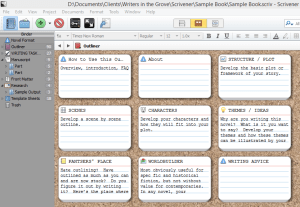
Scrivener - Corkboard Example - Lorelle VanFossen for Writers in the GroveScrivener by Literature and Latte is software for writers. It’s tagline is “Outline. Edit. Storyboard. Write.”

Some of the members of Writers in the Grove recently purchased it based upon my advice, and they’ve asked me to present a workshop on Scrivener basics soon. In the meantime, to help people get started, this is an introductory series on how writers can, and should, use Scrivener.

What is Scrivener?

Scrivener is software for Windows and Mac. It is designed for professional writers to ease the process of researching and writing. It is used by professional (and not) writers, authors, script writers, poets, teachers, researchers, and anyone with a writing project.

Microsoft Word or its equivalent is used by most people to “write.” It is a word processor. It processes words. You can style and format them, making them pretty, and even write great papers and novels, setting up table of contents, chapters, page numbering, and indexes.

For a writer who writes many things, or is working on a book, working with a Word document is like writing on a never ending ribbon. Navigation is a nightmare. Finding things is horrid. It’s easy to get lost, repeat yourself, and just lose track of what you are doing.

Think of Scrivener as your pre-production writing tool, the tool you use before you get to Word. (more…)

Writing Tips for Editors July 2015

This roundup of writing tips comes from editors – specifically editors screaming to writers to LISTEN AND OBEY!

Editors are the sheriff to our published words, the one who rounds up the misbegotten criminals and victims of our words. We owe it to them to listen to their great words of advice so we become better writers before we hand over our words to them.

Ten useful writing tips from a frustrated editor – One Salty Blonde: This is not directly from an editor but from a writer with a fantastic editor who left notes on her book that not only made it better, but made her a better writer.

5. Avoid weak adjectives and most adverbs. They weaken writing. So instead of walked quickly, write dashed or bolted. Instead of tall man, write about him towering over something.

6. Do a search of “that” when you are done with a piece. Then take out the ones that are unnecessary. It will be lots of them. “He said that he didn’t do it.” Imagine you must pay $5 for every unneeded that.

Another great article on editing is designed for blogging, but applies to writing of all types. It comes from “7 Simple Edits That Make Your Writing 100% More Powerful” by Shane Arthur of Boost Blog Traffic:

There are some bloggers who seem to have a natural gift when it comes to writing. Some bloggers seem to be naturally gifted writers.

They manage to get their ideas across clearly and economically, which means that readers can easily follow what they write. Readers devour their clear, economical prose.

Not only is there a lot of respect for what they have to say, but also the way that they say it. People respect what they say – and love how they say it.

Some beautiful lessons on editing in that.

Here are a few more good tips, advice, and instructions from editors to editors and to writers.

Writing Fiction Tips For May 2015

From time to time we may share links to writing tips we’ve found on the web to help us improve our writing. The majority of these are focused on fiction because our workshop motto is everything we write is fiction, whether or not it is. 😀

Five Essential Tips for Anyone Trying to Write A Book – Forbes: Brett Arends offers excellent tips that may seem simple but are really the things that get in our way and hold us back. These include practice writing, finding a writing space and time, planning your book, and so on. He also highlights how a writing group helped him, which is what we are here for! Come join us.

Writing tips by Paul Coelho: Hard to argue with a master and award-winning author. A favorite:

I write the book that wants to be written. Behind the first sentence is a threat that takes you to the last.

10 Writing Tips from Legendary Writing Teacher William Zinsser, May He Rest in Peace – Open Culture: The world of writing is a little smaller with the recent loss of William Zinsser, author of On Writing Well, a staple of how to write since 1976. The article paying tribute to him selects some of the best writing tips he’s offered.

“A clear sentence is no accident. Very few sentences come out right the first time, or even the third time. Remember this in moments of despair. If you find that writing is hard, it’s because it is hard.”

12 Writing Tips I’ve Learned After 20 Books and 3,000 Articles Over 20 Years – Inc.com: Inc’s Andrew Griffiths offers us some great tips that are not just about writing from a writer’s perspective, which they are, but also from an avid book reader. There is something to be said about good advice from those who love books such as:

I had the great pleasure of seeing Seth Godin in Sydney recently and he said something that really resonated with me: “If you are just writing to get ‘shares’ or ‘likes,’ you are writing too safe and too conservatively. If we really want to connect and engage our community, we have to be prepared to write content that is not popular, but it needs to be written.”

20 Writing Tips from Fiction Authors – iUniverse: This is a collection of quotes from modern writers, for the most part, on writing. There are some great ones in this collection including:

“The nearest I have to a rule is a Post-it on the wall in front of my desk saying ‘Faire et se taire’ (Flaubert), which I translate for myself as ‘Shut up and get on with it.’”
Helen Simpson

Writing tips from the CIA’s ruthless style manual – Quartz: Finding out that Struck and White were CIA sources – well, their writing styles were sourced by the US government in their style guide for writing “Intelligence Publications” – was fascinating, but the tips and advice in this collection of their tips celebrates their “crisp and pungent” language “devoid of jargon,” something that I’m not sure the US Government, or any government, practices much any more. Still a good set of tips for the rest of us to practice.

5 Writing Tips: Jane Smiley – Publishers Weekly: Winner of the Pulitzer Prize, Jane Smiley shared a few fantastic tips including:

Exhaust your own curiosity about your project before showing it to someone else. Let your own ideas play out without getting input from others, then, after you show them your work, use their responses as input to push you forward. It may take you several drafts and a long time to come to the end of your ability to tackle a given subject, and when you do, you might be satisfied or dissatisfied with your product. If you are dissatisfied, the input of others will give you ideas for how to shape your novel further. If you are satisfied, the input of others will let you know if your novel is readable and accessible.