Author: Lorelle VanFossen

Lorelle VanFossen is a pioneering XR Innovator and WordPress leader, tech educator, keynote speaker, and producer bridging virtual reality and digital innovation. Co-founder of Educators in VR, founding WordPress community member, and passionate advocate for emerging technologies and human rights. Expert in immersive education, VR/XR event production, UX, and digital transformation.

Lend an Ear 2017 on July 8, 2017

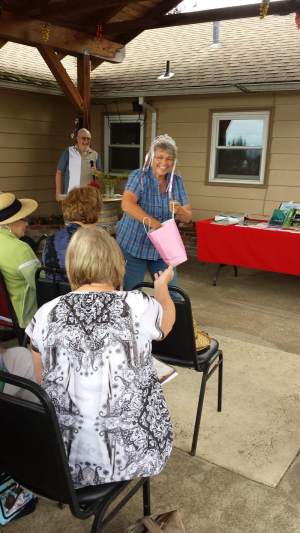
Lend an Ear 2015 - Susan Schmidlin distributes goodies after her reading to the audience.The 8th Annual Lend an Ear, Come and Hear reading event is in just a couple weeks on July 8, 2017. The submissions this year have been wonderful, and we’ve narrowed them down to about 20 writers who will be reading their stories, poems, and prose for free at Plum Hill Winery in Gaston, Oregon.

July 8, 2017
Saturday 10:30am-1pm
Plum Hill Vineyards
6505 SW Old Highway 47
Gaston OR 97119

The event is free and open to the public.

Come join us for this delightful storytelling and author reading event. There will be food trucks and plenty of wine to enjoy on the hillside surrounded by nature and this beautiful winery in the Tualatin Valley.

WordCrafters Writers Conference August 25-27, 2017

WordCrafters conference in Eugene, Oregon, is August 25-27, 2017, and a must-attend for writers and fans of mysteries, thrillers, police procedurals, and crimes of passion this year. Each year the conference has a theme, and this year is for the who-done-it writers.

The conference is a part of the amazing work of WordCrafters in Eugene, offering extensive literacy and writing programs to the adults, children, prisoners, special interest groups, and the public in general.

We are writer and readers. We believe in the power and value of the written word and seek to help others to express themselves through their writing. We believe we are the keepers of the literature and the chroniclers of our times, and to do that effectively, we must write effectively. Wordcrafters is about the craft of writing.

This year’s conference fe3atures a wide range of sessions including “Into the Mind of a Killer,” “Pyschological Sleuthing,” “Forensics Unmasked,” and “Plotting the Perfect Murder.” Special speakers include D.P. Lyle, Forensic MD and author, and Katherine Ramsland, Forensic Psychologist and author.

Register now for a place at this great writer’s conference.

Prompt: Favorites

The prompt this week was on favorites. Do you have the experience of being the favorite child? When raising children, it’s hard to be equal. Did you end up having a favorite even though you didn’t know it at the time. What does favoritism do to a family and relationships? What about work? Are there favorites at work, the ones the boss always turns to for help or wisdom? How can we treat others, even our own family, equally?

Write whatever comes to you on this topic.

Are You Using A Lot A Lot?

Recently I was chastised “a lot” for using “a lot” in my writing. While the vague measurement is now over-used and abused, I was reprimanded to not use a lot a lot. I pass this writing wisdom and grammar greatness onto you.

“A lot” is a piece of property, typically land. It is also used to represent multiple items in a collection at an auction or any collection of items or people. Lot was also the nephew of Abraham whose wife turned into a pillar of salt when she looked back after being specifically instructed against such treachery, which has nothing to do with casting your lot, taking a chance or making a decision based upon the random generation of a number of objects such as pebbles, coins, straw, or dice.

Today’s dictionaries include the definition of “a large number or amount; a great deal; much,” but old English professors still claim that this is an atrocious use of the words, and demand alternatives, as well as removal of the various twisted forms of “a lot” such as alot, lotsa, and lotta, which send spell checkers into a lot of fits.

So what are a lot of alternatives to “a lot?”

Impertinent Remarks by Laura Hale Brockway offered 32 alternatives to help us a lot. They include:

a good deal
a great deal
a large number
ample
bunches
enormous amount
heaps
infinite
loads
many
masses
much
plenty
reams
scads
several
slew
surplus

She also offers example sentences:

“Our style guide does not appear to be used by many people.”
“I try not to ask for any help from the IT Department.”

Thesaurus.com offers these alternatives:

enough
full
abundant
adequate
considerable
copious
countless
endless
everywhere
extravagant
galore
generous
immeasurable
jam-packed
lavish
mega
oodles
profuse
satisfying
sizable
slathers
substantial
sufficient
voluminous

I decided to test out a few more sentences of my own and play around with the various synonyms.

  • He uses the phone a good deal.
  • He uses the phone a great deal.
  • He uses the phone a large number.
  • He uses the phone ample.
  • He uses the phone bunches.
  • He uses the phone an enormous amount.
  • He uses the phone heaps.
  • He uses the phone infinite.
  • He uses the phone loads.
  • He uses the phone many.
  • He uses the phone masses.
  • He uses the phone much.
  • He uses the phone plenty.
  • He uses the phone reams.
  • He uses the phone scads.
  • He uses the phone several.
  • He uses the phone a slew.
  • He uses the phone surplus.
  • He uses the phone enough.
  • He uses the phone full.
  • He uses the phone endless.
  • He uses the phone everywhere.
  • He uses the phone extravagant.
  • He uses the phone jam-packed.
  • He uses the phone lavish.
  • He uses the phone mega.
  • He uses the phone oodles.
  • He uses the phone slathers.
  • He uses the phone substantially.
  • He uses the phone voluminously.

Some worked in this sentence structure, some clearly didn’t. Some are actually very funny.

Let’s try again and incorporate the alternative for “a lot” in a preposition.

  • I avoid asking for a good deal of help with my computer.
  • I avoid asking for a great deal of help with my computer.
  • I avoid asking for a large number of help with my computer.
  • I avoid asking for ample of help with my computer.
  • I avoid asking for bunches of help with my computer.
  • I avoid asking for enormous amount of help with my computer.
  • I avoid asking for heaps of help with my computer.
  • I avoid asking for infinite of help with my computer.
  • I avoid asking for loads of help with my computer.
  • I avoid asking for reams of help with my computer.
  • I avoid asking for scads of help with my computer.
  • I avoid asking for several of help with my computer.
  • I avoid asking for slew of help with my computer.
  • I avoid asking for surplus of help with my computer.
  • I avoid asking for copious of help with my computer.
  • I avoid asking for countless of help with my computer.
  • I avoid asking for endless of help with my computer.
  • I avoid asking for everywhere of help with my computer.
  • I avoid asking for extravagant of help with my computer.
  • I avoid asking for galore of help with my computer.
  • I avoid asking for generous of help with my computer.
  • I avoid asking for immeasurable of help with my computer.
  • I avoid asking for jam-packed of help with my computer.
  • I avoid asking for lavish of help with my computer.
  • I avoid asking for mega of help with my computer.
  • I avoid asking for oodles of help with my computer.
  • I avoid asking for slathers of help with my computer.
  • I avoid asking for voluminously of help with my computer.

Clearly, these synonyms for “a lot” don’t slip right into place as replacements. They take a lot of fuss to make sense out of I avoid asking for jam-packed of help with my computer.. It’s a lot to ask to for every replacement to replace well.

However you search and replace your lots, you shouldn’t have a lot of excuses for using a lot a lot.

The Round Tuit

The following was written by Writers in the Grove member, Lorelle VanFossen, based upon the prompt about “someday.”

My father brought home a plaque one day and hung it on the wall in the kitchen. We children stood around it and admired its shiny wood finish engraved with a wood burning tool with the words in burnt black letters, “tuit.”

“What is it?” My brother David asked in wonder.

“It’s a tuit.”

“What’s a twit?” My youngest sister, Cheryl asked with a lisp.

“Tu-it,” Janet corrected. “Toooo-it.”

“Twwwwwuuuu-it. Twit.”

“No, toooooo-it-it-it.”

“Twwwwwwooooo – ”

“Cut it out,” I poked both of them. “Dad, what’s a tuit?”

He leaned in toward us kids huddled in the kitchen, our eyes glued to the round wooden plaque. “This isn’t just any tuit. It’s a round tuit. I always told myself I’d get a round tuit and I finally did. Aren’t you proud of me?”

We turned our gaze from the plaque to him, and he waited.

David got it first and let out a moan, then I, then Janet. Cheryl needed it explained to her. It took about a week, but she finally got round tuit.

Prompt: Missed Connections

There is a series called “Missed Connections” that features description of personal encounters, where someone saw somebody and it made an impression on them. “I saw you standing in line at Starbucks with red hair and I thought you were so beautiful.” The idea is to figure out if you are or know the person described.

Did someone write about you, or say something about you, that doesn’t match your perception of yourself? Describe the experience.

How to Write a Tutorial

We are starting a new project featuring Writers in the Grove members only. Our members will be publishing tutorials and writing and publishing on this site to help educate themselves and others. We have some of the most amazingly talented writers, and we are eager to share their wisdom and experiences with you. Stay tuned for some great writing tips, tricks, techniques, and advice. And consider signing up for email notifications from this site when we publish something new so you can keep up with all our goodies.

A tutorial is an educational how-to, informative tip, studied technique, or wise advise. A tutorial on a website is a concise, step-by-step recipe for how to do something.

A tutorial published on the web shouldn’t be an entire guide book on how to do something. It is a taste, a simple instructional process, helping you learn one new thing at a time.

Writing a tutorial is different from writing an essay, poem, or prose in general. It is different from writing most editorial articles. A successful tutorial is written as if the author is sitting down next to the person, guiding them through the process in a simple and gentle fashion.

There is form and structure to writing a tutorial, especially for the web, though its style arose from magazine publishing.

The Tutorial Form and Structure

A tutorial for this website, and websites and magazines in general, is structured at its most simple form as:

  1. Opening paragraphs: Example of someone using this technique, with a little bit of the why. Keep this to no longer than 2-3 paragraphs, one is better.
  2. Explain the why: If it is not clear in the opening, next explain why someone should use this tip, technique, or advice. Keep it to one to two paragraphs.
  3. Ingredients/Tools/Supplies/What you need to know: The next section lists the various things you need to have or know to complete the task. For writers, this could be using a software program, the web, a notebook and pen, specific books, or other items.
  4. Step-by-Step Instructions: Break the process down to individual steps, taking the reader through the process one thing at a time. Use numbered and unnumbered lists for improved readability and clarity. You may also use heading styles to break the steps up as I have done in this article.
  5. Taking it one step further: This section takes the process just one step further, offering an alternative method, a way to expand upon the lesson learned, just a tiny step further in the process to inspire and motivate.
  6. Resources: If the article needs it, add more resources, websites, books, classes, videos, other materials to help the reader learn more about the topic.
  7. Summary (optional): Some writers like to summarize what they just wrote. In the web and in many magazines, the article usually stands alone without a summary, but if you need to, this is where it goes.

What You Need to Know About Writing Web Tutorials

A well-written tutorial begins with the paragraph and not a subtitle or heading. Headings (subtitles) are used throughout the article after the opening paragraphs to break the content up into sections and guide the reader through the information.

Links are used, if appropriate, in a properly and well-formed HTML link. Ensure all links offer specific and related content to support the tutorial’s intentions.

Images are excellent additions. Use them to support specific visual examples. Not every tutorial needs images, but when they do, they are helpful. For this site, size them at 800 pixels (about 4 inches) maximum when you upload them or include them in your submission, and allow them to be resized and aligned right, left, or center appropriately as needed in the article. And please keep them at a small file size, below 100K, as JPG or PNG files.

Consider your audience. What is the least they need to know to do this themselves? Write that.

Keep it simple. Keep it clear.

Have fun. Make this process enjoyable and readers will enjoy the process of learning from you.

For More Information