Author: Lorelle VanFossen

Lorelle VanFossen is a pioneering XR Innovator and WordPress leader, tech educator, keynote speaker, and producer bridging virtual reality and digital innovation. Co-founder of Educators in VR, founding WordPress community member, and passionate advocate for emerging technologies and human rights. Expert in immersive education, VR/XR event production, UX, and digital transformation.

Prompt: Light and Dark Across Seasons

The prompt this week is about light and shadow. An artist uses light and shadow to create pattern, shape, and texture. Light dictates changes in the seasons. A writer can do the same thing with descriptions that include light and shadow.

The prompt was inspired by this excerpt from Dean Koontz, “Innocence:”

This weather-sculpted stone was also a familiar warren, because I had explored its limited interior architecture as far as it would accommodate me. The tunnel was low and tight and curved to the right, and I crawled through the blinding dark, frightened not just of the hunter but of what might currently be in residence in the chamber at the end of that passageway. In the past, when I’d gone exploring there, I had done so with a flashlight, but I didn’t have one this time.

The warren offered a home for various species if they wanted it, including rattlesnakes. In the cool of early October, snakes would be lethargic, perhaps not too dangerous, but although Nature’s creatures had spared me all these years, a weasel or a badger or some other formidable animal would be frightened and would feel cornered when I came rushing in upon it.

Leading with my face, I was vulnerable, and I shut my eyes tight to protect them from a sudden swipe of claws.

The passageway brought me around a corner and into the cave, roughly six feet in diameter and between four and five feet high. Nothing attacked, and I opened my eyes. A silver dollar of sunlight lay in one corner of the room, having fallen through one of the flutes, and a larger and more irregular pattern of light, about the size of my hand, formed under another flute. The day lacked wind, and quiet pooled in that subterranean lair—and there proved to be no tenant other than me.

I intended to remain there until I felt certain that the hunter had hiked far away. The air smelled vaguely of lime and moldering leaves that had blown in through the larger hole in the ceiling. If I had suffered from claustrophobia, I could not have tolerated such confinement.

At that moment, I couldn’t have predicted that before much longer I would have no choice but to find my way out of the mountains or that by night and by arduous travel, surviving multiple attempts on my life, I would journey to a great city, or that I would live secretly for many years deep beneath its teeming streets, in storm drains and subway tunnels and in all the strange byways that exist below a metropolis, or that one winter, while visiting the vast central library after midnight, when it should have been deserted, I would meet a girl in lamplight near Charles Dickens and my world would change, and her world, and yours.

After a few minutes, as I crouched there in the dark between the narrow shafts of light, I heard noises. I thought the badger of my imagination might have become flesh and might be approaching now through the passageway that I had followed. The long claws of a badger’s forefeet make it a dangerous adversary. But then I realized that the sounds came from above, carried to me with the sunshine. Boots on stone, a clank of something, a rattle. A man coughed and cleared his throat and sounded very near.

If he hadn’t merely glimpsed me, if he had seen me in some detail, either he would have been searching for me aggressively or he would have decided to depart from a forest so queer that it could harbor something like me. Instead he seemed to have settled down for a brief rest, suggesting that he had not gotten a clear look at me. What I might be, how I could be brought into the world through the agency of a man and woman, I didn’t know and thought that I would never know. Much of the world is beautiful, and much more is at least fair to the eye, and what might be ugly is nevertheless of the same texture as everything else and clearly belongs in the tapestry. In fact, on the closest consideration, an ugly spider is in its way an intricate work of art worthy of respect or even admiration, and the vulture has its glossy black feathers, and the poisonous snake its sequined scales.

The prompt was to write a scene that focuses on the use of light and dark, and to also consider seasonal lights impact on a scene.

Prompt: Generalizations

The prompt this week was on stereotypes and sweeping generalizations. The comment “all red heads have fiery personalities” labels all red heads, but when applied to the individual may not be true.

We discussed stereotype and sweeping generalization examples and how and where they are applied.

In writing, the inclusion and use of stereotypes and sweeping generalizations are also called characterization frames. When used well, the adjectives that define these stereotypes help the reader to make quick judgment calls about the characters. When used expertly, generalizations set the character up for conflict, with others and themselves. An Asian student struggling with the Asian F demand by parents and culture to get only A or A+ (and anything less than that like an A- is considered an F), may uncover a learning disability which puts the character in conflict with expectations of scholastic achievement within themselves, with their family, with the school system expectations and assumptions, and within their society. A fiery redhead who becomes a quiet librarian, encouraging an antagonist to “light the fire within.” A redhead deals with societal preconceptions and expectations on a daily basis, and such pressures are felt internally as well, as they attempt to live up to those assumptions.

Stereotypes are typically defined by the following:

  • culture
  • expectation
  • adaptation
  • conflict
  • dos/taboos

Culture sets attitudes and expectations about behavior, manners, etiquette, and relationships such as no sex before marriage, the wearing of the hijab, length of skirt, bowing as greeting or handshakes, language usages, etc. We expect certain behaviors within groups and societies, as a large encompassing group or within a small social circle. As we enter a new group, we use cultural norms to start, the expand what are acceptable behaviors within that group, such as a group of high school girls hanging out in the bathroom smoking, trusting the others not to tell on them. People moving into those circles must adapt, or conflict, avoidance or the accepted response in a conflict situation. Teens outside of the smoking girls group learn quickly how to behave around them, even though they are not part of the group. They support the group behavior. Thus, it becomes a social norm and expectation, and conflict arises when they are challenged.

The dos and taboos of a group or society dictate attitude, behavior, and define those social norms. These come in many forms from the innocuous, the choice to wear white shoe in winter, to the dangerous and threatening like road rage.

A character’s actions often define stereotypes, as does their language and thought process. How you choose to use these helps to craft and frame your character.

The prompt is to find a character that is part of a “group” and write about them. What group are they a part of? What are the expectations, behaviors, dos/taboos, and cultural impositions about that group? How does the character behave within that framework? Let us see them in a situation where these sweeping generalizations are challenged, helping us see deeper into the character’s story and development.

Gotta Dance

The following is by Writers in the Grove member Gretchen Keefer, inspired from Prompt-a-Month: Dance.

“You there, Kevin! Stop adding those curlicues and follow the plan!”

Kevin, embarrassed, quickly found his place in the formation and continued practicing with the other dancers. He stumbled a few times, which added to his embarrassment, but gamely continued with practice until the choreographer called a break. Shoulders slumped on his lanky frame, Kevin ambled to the corner where he had stashed his pack with his water bottle.

“Don’t be discouraged,” Angie, an older, more experienced dancer, said to him, handing him a towel. “Barrett is hard on everyone. He gets great results, but we all work like the devil getting there.” She looked Kevin over. ‘You have good moves and a classic dancer’s body. You’ll do all right.”

Kevin smiled his thanks for the encouragement, pushing a lock of his dark hair off his forehead. “It just seems to me that the moves are too simple. Any second year student could do them. I wanted to add some pizzazz.”

“If you want to stay in this game, remember rule number one: always do what the choreographer says. He sees the routine from a different perspective, from the audience’s view. HE’s the artist; you are just his tool.”

“Thanks. Say, do you want to get something to eat?”

“Sorry,” Angie held up her own lunch. “I really have to be careful with food. I’m not as lucky as you youngsters. Ask Lindsay there”. She nodded towards a petite blonde.

Kevin moved towards the younger girl. “Hi, I’m Kevin the bumble-footed. Would you like to get some lunch? I hear there is a deli around the corner with great salads.”

Laughing the girl replied, “I’m Lindsay the famished. I’d love to have yet another salad. Maybe there is something there without lettuce.”

After covering the requisite information about backgrounds, the two young people continued their conversation with dance topics. “I love ball room dancing,” Lindsay said. “I was on a ball room dance team in college. We won some competitions. It was a lot of fun.”

“Congratulations. That must look great on your resume. I prefer jazz dancing, and physical, creative tap.” (more…)

Young Body, Old Soul

The following is based upon the prompt Prompt: The Soul is Born Old, and written by Writers in the Grove member, Gretchen Keefer.

I could tell them so many things, answer so many questions, if I could only figure out how to make the noises they seem to understand. I have tried, and they respond with smiles, but they just do not understand.

When I am uncomfortable or hurt, I can make a harsh noise they respond to quickly. They make sure my physical needs are met.

Do they understand when I tell them “thank you”? I am grateful, even though this physical stuff is awkward, and challenging…and tiring! It feels good when they hold me, rock me, sing to me. I want to caress them back, but I still haven’t managed these limbs.

I want to tell them how glad I am to be here with them. I remember them from before, when we agreed they would go first and prepare a place for me.

I want to remind them that they promised to teach me all I needed to know to be successful here. Do they remember that?

Most of all I want to tell them that Father loves them and knows their concerns. He sent me here with a specific task…now I have forgotten what that was.

Every day I learn more and soon I will be able to tell them and show them so many wonderful things about where I came from.

Ahhh, where was that again?

Writers in the Grove member Gretchen Keefer enjoys writing short family friendly fiction. She has always had scenes developing in her mind, when she is not occupied with family or events on the rural Oregon property she and her husband share with the dog, cat, horse and 20 sheep.

The River is Cold

The following is from Writer’s in the Grove (Vernonia Library) member Jim Buxton, inspired by our Prompt-a-Month: Water.

The river is cold, he thought, but not as cold as this time last year. The previous winter had been colder, the spring thaw had come later and the summer cooler.

This year had been different.

He thought, now, will I be able to untangle myself from these sheets? I must not panic — just move my legs gently and kick my way out.

The gust of wind that caught the sails and heeled the boat over was not unexpected. What was unexpected was the stay giving way causing the mast to snap during the capsizing of the boat. It will be an expensive repair to replace the broken mast, but that is the least of my problems at this moment. I need to surface and breathe again, he thought…

Writer’s Toolbox: Geometric Shapes

It went “Zip” when it moved
And “Bop” when it stopped
And “Whirrr” when it stood still
I never knew just what it was and I guess I never will.

Chart of Geometric Shapes from Playbuzz.The Tom Paxton song made famous by Peter, Paul, and Mary, as well as John Denver, describes a thing that defines description, a child’s toy that was amusing all the same.
When it comes to describing the physical shape of an object, we can’t get away with just the sound effects. We need the words.

The basic geometric shapes are:

  • lines
  • curves
  • angles
  • triangles
  • square
  • rectangle
  • pentagon
  • pentagram
  • hexagon
  • octagon
  • polygon
  • circle
  • arc
  • ellipse

Then we add variations on the above. These are geometric shapes based upon lines and planes, but what about solid figures or 3-dimensional shapes?

  • cube
  • cylinder
  • rectangular prism
  • pyramid
  • tetrahedron
  • octahedron
  • polygon
  • sphere
  • cone

What shape is a carrot? Do you know? Is it a triangle? No, it’s an inverted cone. Is the sun a ball? Yes, it is a ball, more specifically, the sun is a sphere.

The words you use to describe a shape may be technical or playful, finding similes to represent their shapes, such as “he was as thin and lanky as a much-used toothbrush.”

Did you know that there are some personality tests that use geometric shapes to represent a person or personality?

From “Geometric Shapes: Simple and Unusual Personality Test,” if the triangle is your preferred shape:

This form symbolizes leadership. Main ability of triangles is to focus on goals and deeply and quickly analyze situations. A Triangle is a very confident person who wants to be right in everything. Triangles find it difficult to admit their mistakes, are easy to train, and absorb information like a sponge. Their career gives their life meaning.

Here are some charts and web pages to add to your writer’s toolbox to help you define the geometric shape of the objects, and possibly the characters, in your writing. We’ve also included some lists of words to describe the shape of objects.

Scrivener Tips: The Scratch Pad

This is another Scrivener Tip from Writer’s in the Grove. We will be presenting a series of Scrivener workshops soon in Forest Grove, Oregon. Until then, or after, if you have a question about how to use Scrivener, let us know and we’ll do our best to help you out.

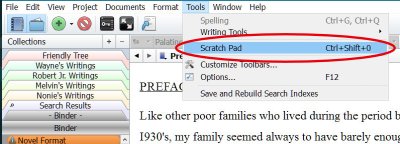
Scrivener - Scratch Pad on Tools Menu - Writers in the Grove.Ever get a new idea, a bit of inspiration, as you are writing? I used to turn to a piece of paper or sticky note to jot down my idea, but found that by the time I made the note and switched back to my writing program, I’ve lost track of what I’m writing. Moving my eyes from the computer screen and fingers from the keyboard invites distraction. Luckily, Scrivener offers a way to make notes and keep on writing.
The Scrivener Scratch Pad is built into Scrivener and can be accessed by:

  • Windows: Tools > Scratch Pad or CTRL+ALT+SHIFT+P
  • Mac: SHIFT+CMD+ENTER

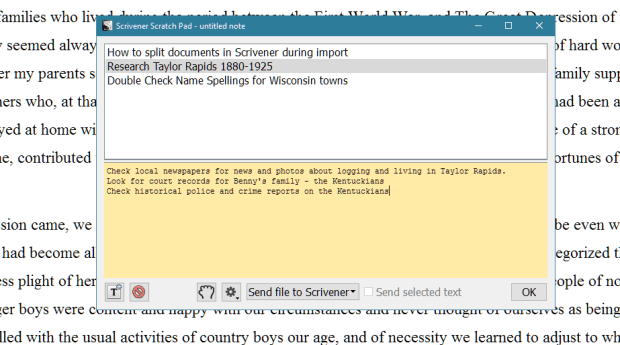
You can add a note to it quickly with a mouse from within the Scratch Pad window. Click the T for Text in the bottom left corner to create a new note and start typing.

Scrivener Scratch Pad - examples - Writers in the Grove.

You can add as many notes as you wish in the Scratch Pad.

You can send the note to Scrivener later as the start of a new plot shift or poem.

  1. Select the note.
  2. Click Send file to Scrivener.

Two options will appear to either copy it to a specific file or new one, or append text to another text, adding it to the bottom. You can also select a portion of the note and send just the selected text.

One of the cool things about the Scratch Pad in Scrivener is that the notes persist between projects. You can make notes on other projects that pop into your head or you discover while researching another project. Think of all the ways you can use the Scratch Pad in Scrivener to deal with these thoughts while staying focused on the task at hand.

For more tips, see “Using the Scratch Pad in Scrivener” by The Digital Researcher, and the following: