Prompts

Prompt-a-Month: Garden

Writers in the Grove Prompt-a-Month badge.This is the first of the prompt-a-month series for our members we’re producing here on our Writers in the Grove site. All the details are in the announcement including a few guidelines.

The prompt for the month of June is:

Garden

Member submissions will be accepted until the deadline of June 31, 2016, and will be published throughout July.

Have fun!

Prompt: I Am From

The prompt this week came from George Ella Lyon in a poem called “Where I’m From.

I am from clothespins,
from Clorox and carbon-tetrachloride.
I am from the dirt under the back porch.
(Black, glistening,
it tasted like beets.)
I am from the forsythia bush
the Dutch elm
whose long-gone limbs I remember
as if they were my own.

I’m from fudge and eyeglasses,
from Imogene and Alafair.
I’m from the know-it-alls
and the pass-it-ons,
from Perk up! and Pipe down!
I’m from He restoreth my soul
with a cottonball lamb
and ten verses I can say myself…

Read the rest of the poem and write a description of who you are starting each line with “I am from.”

Prompt: Fear

The prompt today is to write a short scene where someone is afraid.

The example came from Ken Follet’s book, The Hammer of Eden:

Judy had been in one major earthquake.

The Santa Rosa earthquake had caused damage worth $6 million—not much, as these things go—and had been felt over the relatively small area of twelve thousand square miles. The Maddox family was then living in Marin County, north of San Francisco, and Judy was in first grade. It was a minor tremor, she knew now. But at the time she had been six years old, and it had seemed like the end of the world.

First there was a noise like a train, but real close, and she came awake fast and looked around her bedroom in the clear light of dawn, searching for the source of the sound, scared to death.

Then the house began to shake. Her ceiling light with its pink-fringed shade whipped back and forth. On her bedside table, Best Fairy Tales leaped up in the air like a magic book and came down open at “Tom Thumb,” the story Bo had read her last night. Her hairbrush and her toy makeup set danced on the Formica top of the dresser. Her wooden horse rocked furiously with no one on it. A row of dolls fell off their shelf, as if diving into the rug, and Judy thought they had come alive, like toys in a fable. She found her voice at last and screamed once: “DADDY!”

From the next room she heard her father curse, then there was a thud as his feet hit the floor. The noise and the shaking grew worse, and she heard her mother cry out. Bo came to Judy’s door and turned the handle, but it would not open. She heard another thud as he shouldered it, but it was stuck.

Her window smashed, and shards of glass fell inward, landing on the chair where her school clothes were neatly folded, ready for the morning: gray skirt, white blouse, green V-neck sweater, navy blue underwear, and white socks. The wooden horse rocked so hard, it fell over on top of the dollhouse, smashing the miniature roof; and Judy knew the roof of her real house might be smashed as easily. A framed picture of a rosy-cheeked Mexican boy came off its hook on the wall, flew through the air, and hit her head. She cried out in pain.

Then her chest of drawers began to walk.

It was an old bow-fronted pine chest her mother had bought in a junk shop and painted white. It had three drawers, and it stood on short legs that ended in feet like lions’ paws. At first it seemed to dance in place, restlessly, on its four feet. Then it shuffled from side to side, like someone hesitating nervously in a doorway. Finally it started to move toward her.

She screamed again.

Her bedroom door shook as Bo tried to break it down.

The chest inched across the floor toward her. She hoped maybe the rug would halt its advance, but the chest just pushed the rug with its lions’ paws.

Her bed shook so violently that she fell out.

The chest came within a few inches of her and stopped. The middle drawer came open like a wide mouth ready to swallow her. She screamed at the top of her voice.

The door shattered and Bo burst in.

Then the shaking stopped.

* * *

Thirty years later she could still feel the terror that had possessed her like a fit as the world fell apart around her. She had been frightened of closing the bedroom door for years afterward; and she was still scared of earthquakes. In California, feeling the ground move in a minor tremor was commonplace, but she had never really gotten used to it. And when she felt the earth shake, or saw television pictures of collapsed buildings, the dread that crept through her veins like a drug was not the fear of being crushed or burned, but the blind panic of a little girl whose world suddenly started to fall apart.

Why is this so effective? What makes you know a six-year old is terrified?

Create a scene in which someone is terrified.

Prompt: My Yoni

Poem by Samantha Reynolds with image of an old woman.

The above and poem below is by Samantha Reynolds, with photo credit to Ritta Ikonen and Norwegian Photographer Karoline Hjorth.

My Yoni

I Am Not Old
I am not old…she said
I am rare.
I am the standing ovation
At the end of the play.
I am the retrospective
Of my life as art
I am the hours
Connected like dots
Into good sense
I am the fullness
Of existing.
You think I am waiting to die
But I am waiting to be found
I am a treasure.
I am a map.
And these wrinkles are imprints of my journey
Ask me anything.

Spend a moment gazing at the photo.  Consider the possibilities:

  1. Who is your Yoni?  Describe.  Tell about a time you spent with her.
  2. What does it mean to age?
  3.  Who are you?  Do others see you as you see yourself?
  4.  What lands on Yoni’s nest?  Who lives on (or in) Yoni’s head?
  5.  You are rare.  A treasure.  A map.  What are you, and where have you been?

Prompt: A Roll of the Dice

Attending a weekend writing retreat led by science fiction author Nina Kiriki Hoffman, Writers in the Grove member, Lorelle VanFossen received permission from Nina to introduce our group to The Story Catcher technique she developed. The following is a summation of the technique for inspiring writing prompts based upon random words and phrases. The document used for the prompt exercise is available for download and printing in a link at the bottom of this post.

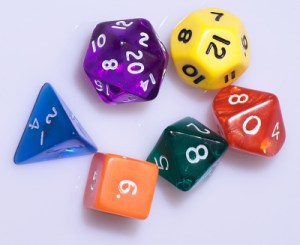
Collection of multi-sided, colorful dice.A prompt is anything that inspires you, the writer, to write. It could be a word, a phrase, an idea, and the source of the inspiration could come from anywhere or anything at any moment. The prompt this week was also a workshop on generating random prompts.

How would your writing change if you could generate the serendipity of your prompts on a regular basis, possibly turning it into a habit, a writing exercise used daily?

Nina Kiriki Hoffman developed The Story Catcher, a tool to generate random prompts based upon chance, specifically a roll of the dice.

Nina’s Story Catcher is a booklet where you collect words and phrases as you go through your day-to-day living, twelve words on a page, each page numbered in sequence.

To use the Story Catcher:

  1. Roll one or two standard dice.
  2. Select one or both dice to generate the page number. For page 11, one or both of the dice could total 11. For page 64, one die would be 6 and the other 4.
  3. Turn to that page number and roll again.
  4. Write down the resulting prompt from among the 12 on that page.
  5. Repeat this process three to five more times, noting each word or phrase generated.
  6. Using the resulting randomly generated words or phrase, write your prompt within a 15 minute time limit.

This process generates a completely random set of prompts. Examples might be: (more…)

Prompt: It’s About the Details

The prompt this week comes from Agatha Christie, Dumb Witness, a continuation of studying the setting of a scene, and the details you choose to set up the characters and the scene in general.

We were directed to the coffee room, a room of fine proportions, a room of tightly shut windows and an odor of stale food. We had some excellent mutton, large slabs of water cabbage, and some dispirited potatoes. Some rather tasteless stewed fruit and custard followed. After Gorgonzola and biscuits the waiter brought us some doubtful fluid called coffee.

Write a paragraph using the details that defines the scene or a character.

Prompt: Write a Story Twice

The prompt this week is about writing for the audience, keeping their experience in mind when sharing your experience in words.

When writing to relate an experience, how do you tell the story? If it happened “this way,” do you have to write it that way or can you be creative with the storytelling process. How do you modify it, how do you adapt the story from reality to storytelling? Does it need to have the ring of truth or be the truth?

It depends. It depends upon your goals as a writer and your audience. What does your audience need to know to make your point? Are you making a point? Are you going for a joke? Are you testifying before the court? Are you teaching them something? What elements do you keep, which do you omit, which do you emphasize, which do you unemphasize?

Everything we do is colored by our experience, then adjusted for our audience. The choices in words, phrasing, and storytelling technique dictates what influences as you tell the story.

In the 1970s, Fuji Film took on its rival Kodak to create a new range of print and slide film. They researched customer’s experiences with film and film processing and found that the main complaint people had when picking up their film after processing was that the colors weren’t as intense. “You should have been there, it was so colorful.” The researchers found that memory intensified over time. Comparing a photograph of a sunset, it would look the same, but in the one to three weeks from taking the picture to having it developed and in their hands, human memory intensified the colors. Fuji amped up the colors in their film to make it match the human memory.

Writers need to do much the same. Intensify the scene and characters to enhance the moment. As author William Faulkner said, “In writing, you must kill all your darlings.”

A story too bare may not hold the attention of the reader, but watch out for diluting the story with too many tangents and extraneous details.

From The Riverside Reader by Joseph Trimmer and Maxine Hairston came more information to help with our prompt. In summary, it stated that writers of narrative essays must be concerned about how much they tell their readers. Because an essay is based upon experience, few readers will know the entire backstory by that point in the story, nor should they. Do they need to? How much should they know and when they should know it is a constant struggle for fiction writers.

The ability to identify major and minor details in the writing as critical to the storytelling differentiates from the real life experience. When we experience an event, we have a knack for confusing dates, names, and the sequences of events, and we have the unalterable belief that simply “just because something happened to me, you are going to be fascinated.” This doesn’t always hold true when writing the event. We must pick and choose what we include as well as what we remove. We might play with the chronology of the event, restrict the backstory, change the characters or blend them together, even change the scene to make the reader’s experience a more enjoyable one as well as increase the tension and drama of the story.

According to Writers in the Grove member, Diana Lubarsky, “What is truth? Sometimes you got to make it up.”

The Prompt: Write a Story Twice

The prompt was to write a story twice. Have a different audience in mind for each telling.

Write a “true” story,” something that happened to you. Write it for two different audiences such as a child, grandchild, prissy mother, controlling mother-in-law, students in a class, a newspaper reporter – you choose.

Compare the two. Does the tone of voice change? Do the words change? How?

Three Random Words

This week’s writing prompt was Three Random Words, and since one of the words I was given was lollipop, there was no chance what I wrote would be the least bit serious!  Give this exercise a try, and have fun with it.

Lollipop Letter Landslide

Lolli-popping, be-bopping, hip-hopping

glide of a landslide, free ride

down a steep leap hillside

tumble, rumble, fumble

this word or that, fat cat,

another letter, better, a real go getter

guesser, geyser, wiser or not,

put it down, twist it around,

your word against mine, a line, a sign,

sweet heat on dancing feet,

now repeat and do it neat, hear,

because you are lolli-popping,

be-bopping, hip-hip-hopping. Yeah.


Ann Farley

April 2, 2016

Prompt: Three Random Words with Same First Letter and Share

The prompt this week was to think of three nouns, all starting with the same letter, having nothing to do with each other. Then pass it to your neighbor and that is your prompt.

If you are doing this alone, grab a newspaper or dictionary, pick a letter and select the first three nouns starting with that letter, and write.