scenes

NaNoWriMo Tips: Locations

Where does your story take place? Does it happen in one place or many places?

Take time in NaNoWriMo to write extensive descriptions of each location in each scene in your story. In the editing phase, you might only use a small part of this, but by exploring the surrounds around your characters fully, you have a wealth of information to choose from.

It’s difficult to write about a place you’ve never experienced, though science fiction and fantasy authors do it all the time. If you are new to writing, write about a location you are familiar with, one you know well. You can always change or rename the location later during the editing stage.

Consider the following as you describe each location:

  • Where are they?
  • When are they? What time of day? What year? What month? Which day of the week?
  • Describe the ground.
  • Describe the building(s) outside.
  • Describe the building(s) inside.
  • What is the most predominate color?
  • What do you smell? One thing or many things? Which is dominant? Which is a hint of fragrance?
  • What are the sounds? Are there many or few? Which is loudest, drowning the rest? Which is softest, heard only when paying attention or in a moment of silence from the rest of the sounds?
  • What is the temperature?
  • Is it dry, humid, wet, damp, windy, hot, cold?
  • What does the character(s) feel on their skin? Is the sensation the same on top of the head as well as the feet?
  • Where is the sun? Can it be seen?
  • Describe textures, of walls, ceilings, furniture, floor, plants.
  • Is nature here? What kind of nature? What is it, what does it look like?
  • Does anything in the scene trigger stereotype reactions?
  • Does anything in the scene trigger an emotional or memory response to one or more characters?
  • Are there doors, paths, or exits?
  • Are there windows? Open, closed? What is visible through them?
  • Does the space feel open or closed, restricted, or free?
  • Are there landmarks, statues, artwork, elements that serve as markers or direction indicators?
  • Which way are the characters facing? North, east, west, south, etc.
  • Is the sun/moon in their face or behind them? Or not anywhere?
  • Are their vehicles? Furniture? What man made objects are near them? Do they interact with them?
  • Find one element in the scene and describe it. Is it important to the scene, or an accessory? Does it help the story or help define the characters?
  • Find another element, one that might be missed. Describe it. Why is it there?

This should start a series of your own questions specific to the location. Write those down and create your own list.

You can find more writing tips and prompts and tips for NaNoWriMo on our Writers in the Grove site.
Prompt: Light and Dark Across Seasons

The prompt this week is about light and shadow. An artist uses light and shadow to create pattern, shape, and texture. Light dictates changes in the seasons. A writer can do the same thing with descriptions that include light and shadow.

The prompt was inspired by this excerpt from Dean Koontz, “Innocence:”

This weather-sculpted stone was also a familiar warren, because I had explored its limited interior architecture as far as it would accommodate me. The tunnel was low and tight and curved to the right, and I crawled through the blinding dark, frightened not just of the hunter but of what might currently be in residence in the chamber at the end of that passageway. In the past, when I’d gone exploring there, I had done so with a flashlight, but I didn’t have one this time.

The warren offered a home for various species if they wanted it, including rattlesnakes. In the cool of early October, snakes would be lethargic, perhaps not too dangerous, but although Nature’s creatures had spared me all these years, a weasel or a badger or some other formidable animal would be frightened and would feel cornered when I came rushing in upon it.

Leading with my face, I was vulnerable, and I shut my eyes tight to protect them from a sudden swipe of claws.

The passageway brought me around a corner and into the cave, roughly six feet in diameter and between four and five feet high. Nothing attacked, and I opened my eyes. A silver dollar of sunlight lay in one corner of the room, having fallen through one of the flutes, and a larger and more irregular pattern of light, about the size of my hand, formed under another flute. The day lacked wind, and quiet pooled in that subterranean lair—and there proved to be no tenant other than me.

I intended to remain there until I felt certain that the hunter had hiked far away. The air smelled vaguely of lime and moldering leaves that had blown in through the larger hole in the ceiling. If I had suffered from claustrophobia, I could not have tolerated such confinement.

At that moment, I couldn’t have predicted that before much longer I would have no choice but to find my way out of the mountains or that by night and by arduous travel, surviving multiple attempts on my life, I would journey to a great city, or that I would live secretly for many years deep beneath its teeming streets, in storm drains and subway tunnels and in all the strange byways that exist below a metropolis, or that one winter, while visiting the vast central library after midnight, when it should have been deserted, I would meet a girl in lamplight near Charles Dickens and my world would change, and her world, and yours.

After a few minutes, as I crouched there in the dark between the narrow shafts of light, I heard noises. I thought the badger of my imagination might have become flesh and might be approaching now through the passageway that I had followed. The long claws of a badger’s forefeet make it a dangerous adversary. But then I realized that the sounds came from above, carried to me with the sunshine. Boots on stone, a clank of something, a rattle. A man coughed and cleared his throat and sounded very near.

If he hadn’t merely glimpsed me, if he had seen me in some detail, either he would have been searching for me aggressively or he would have decided to depart from a forest so queer that it could harbor something like me. Instead he seemed to have settled down for a brief rest, suggesting that he had not gotten a clear look at me. What I might be, how I could be brought into the world through the agency of a man and woman, I didn’t know and thought that I would never know. Much of the world is beautiful, and much more is at least fair to the eye, and what might be ugly is nevertheless of the same texture as everything else and clearly belongs in the tapestry. In fact, on the closest consideration, an ugly spider is in its way an intricate work of art worthy of respect or even admiration, and the vulture has its glossy black feathers, and the poisonous snake its sequined scales.

The prompt was to write a scene that focuses on the use of light and dark, and to also consider seasonal lights impact on a scene.

Prompt: Coming Over the Rise I Saw

The prompt this week was inspired by a trip taken by MJ Nordgren. She described covering over a rise in her car and seeing before her a wide sweep of brightly colored flowers, a field of bright red poppies alongside a field of vivid blue Bachelor’s Buttons. It was so lovely, she had to stop and reflect upon it. Thus our prompt this week is:

As I was coming over the rise I saw…

Are We There Yet? How Long Does It Take?

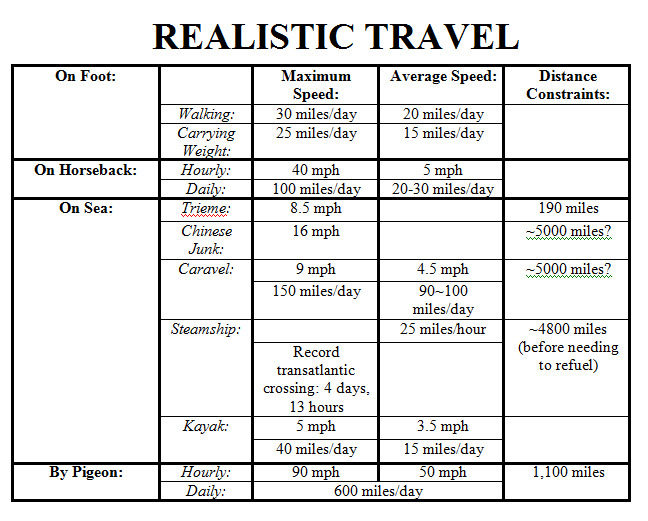
Ever wonder how long it takes to travel?

This is more than an answer to “Are we there yet?” It is a challenge that faces ever writer when their character leaves the comfort of home or work and must travel to another location.

If traveling by foot, how long does it take? By car? By bus? By train? What about by horse? The time spend traveling across the same difference changes with the mode of transportation.

The folks behind The Writer’s Handbook found a chart that answers some of these questions if you are considering traveling by horse, sea, foot, or pigeon. This is a great tool to add to your writer’s toolbox.

Another travel time chart to keep in your writer’s toolbox comes from Lapham’s Quarterly.

What about calculating for traffic congestion? It might take you 30 minutes to get to Portland, Oregon, in the middle of the day, and 3 hours to travel the same distance during rush hour. There is much to think about when you take your character traveling.

Here are a few more examples:

  • A healthy person can walk 3-4 miles an hour on flat and even ground (36-48 miles a day possible)
  • A healthy person can walk 1-2 miles an hour on rugged terrain, less if off-trail
  • By horse on roads or trails with level or rolling terrain – 40 miles per day
  • By horse through mountainous terrain on roads or trails – 20 miles per day
  • By horse through hilly grasslands with no roads or trails – 25 miles per day
  • By horse through rugged mountainous terrain with no roads or trails – 10 miles per day
  • By horse during Roman Era on roads or trails with level or rolling terrain – 20 miles per day
  • By horse during Roman Era on level or rolling terrain with no roads or trails – 15 miles per day
  • A wagon can travel 15-25 miles a day depending upon size, horses, path, and load
  • A league is 3 miles, the distance someone could travel in one hour.

Other tools to help you estimate travel times include:

This is just the tip of the travel time iceberg. What about travel by train? By skateboard? By bike? By helicopter? By skiing? By air balloon?

It’s your imagination traveling with your character. Add their travel type and estimates to your writer’s toolbox as a guide to help you estimate travel times.

Writing Your Book: Plots and Stories

Tameri Guide for Writers by C.S. Wyatt and Susan D. Schnelbach includes “Plot and Story,” a fabulous breakdown of the basics you need to know about crafting your plot and story.

A plot is not a story, nor does every story have a strong plot. Good writers know the importance of both plot and story, especially before they dare to write a story with a “weak” or “thin” plot. Any plot can feature a love story; that illustrates the difference. Plots are events, stories reveal how characters react to those events.

The study of crafting a successful book goes back thousands of years, and stands the test of time as millions of books have been published covering billions of topics all on this timeless structure of storytelling. Your story has a beginning, middle, and end, but where do you take the reader along that structure?

This guide goes in depth into plot and story structure to help guide you on the path of developing a story that takes the reader on the journey with you.

Prompt: Same Place, Same Bad News, Different Characters

Write two scenarios. Make the two scenes different even though they are in the same place with the same bad news.

Scene One: Someone is giving and another one is receiving bad news.

Scene Two: Same as above, but use different people. You can switch or one or both of the characters must change. The same news in the same room, but different characters.

Prompt: Fear

The prompt today is to write a short scene where someone is afraid.

The example came from Ken Follet’s book, The Hammer of Eden:

Judy had been in one major earthquake.

The Santa Rosa earthquake had caused damage worth $6 million—not much, as these things go—and had been felt over the relatively small area of twelve thousand square miles. The Maddox family was then living in Marin County, north of San Francisco, and Judy was in first grade. It was a minor tremor, she knew now. But at the time she had been six years old, and it had seemed like the end of the world.

First there was a noise like a train, but real close, and she came awake fast and looked around her bedroom in the clear light of dawn, searching for the source of the sound, scared to death.

Then the house began to shake. Her ceiling light with its pink-fringed shade whipped back and forth. On her bedside table, Best Fairy Tales leaped up in the air like a magic book and came down open at “Tom Thumb,” the story Bo had read her last night. Her hairbrush and her toy makeup set danced on the Formica top of the dresser. Her wooden horse rocked furiously with no one on it. A row of dolls fell off their shelf, as if diving into the rug, and Judy thought they had come alive, like toys in a fable. She found her voice at last and screamed once: “DADDY!”

From the next room she heard her father curse, then there was a thud as his feet hit the floor. The noise and the shaking grew worse, and she heard her mother cry out. Bo came to Judy’s door and turned the handle, but it would not open. She heard another thud as he shouldered it, but it was stuck.

Her window smashed, and shards of glass fell inward, landing on the chair where her school clothes were neatly folded, ready for the morning: gray skirt, white blouse, green V-neck sweater, navy blue underwear, and white socks. The wooden horse rocked so hard, it fell over on top of the dollhouse, smashing the miniature roof; and Judy knew the roof of her real house might be smashed as easily. A framed picture of a rosy-cheeked Mexican boy came off its hook on the wall, flew through the air, and hit her head. She cried out in pain.

Then her chest of drawers began to walk.

It was an old bow-fronted pine chest her mother had bought in a junk shop and painted white. It had three drawers, and it stood on short legs that ended in feet like lions’ paws. At first it seemed to dance in place, restlessly, on its four feet. Then it shuffled from side to side, like someone hesitating nervously in a doorway. Finally it started to move toward her.

She screamed again.

Her bedroom door shook as Bo tried to break it down.

The chest inched across the floor toward her. She hoped maybe the rug would halt its advance, but the chest just pushed the rug with its lions’ paws.

Her bed shook so violently that she fell out.

The chest came within a few inches of her and stopped. The middle drawer came open like a wide mouth ready to swallow her. She screamed at the top of her voice.

The door shattered and Bo burst in.

Then the shaking stopped.

* * *

Thirty years later she could still feel the terror that had possessed her like a fit as the world fell apart around her. She had been frightened of closing the bedroom door for years afterward; and she was still scared of earthquakes. In California, feeling the ground move in a minor tremor was commonplace, but she had never really gotten used to it. And when she felt the earth shake, or saw television pictures of collapsed buildings, the dread that crept through her veins like a drug was not the fear of being crushed or burned, but the blind panic of a little girl whose world suddenly started to fall apart.

Why is this so effective? What makes you know a six-year old is terrified?

Create a scene in which someone is terrified.

Jessica Morrell Speaks on Anchor Scenes November 9

Jessica MorrellSave the date and be at the Forest Grove Senior and Community Center on Monday, November 9, 2015, from 9-11am for a great presentation by a favorite author and writing instructor, Jessica Morrell. We expect the room to be full so bring a clipboard or something to write on as there may not be enough seats at tables.

Jessica will be presenting her workshop on “Anchor Scenes.” This is a talk presented typically in a day workshop, distilled for us into two hours. The presentation description is:

The task of a novelist or memoirist is to tell a story so riveting that it will hold a reader’s attention for hundreds of pages. This requires intimate knowledge of characters, their inner lives, and central dilemma. It also requires an understanding of plot, the sequence of events that take readers from beginning to end.

These events won’t hang together without a compelling structure that underlies the whole—the essential scenes that every story needs to create drive, tension, conflict, climax, and resolution. We’ll pay special attention to the architecture of scenes and the plot points and reversals that power stories forward.

Jessica offers a wide variety of writing workshops and conferences around Oregon and the Pacific Northwest. There are day workshops to full weekend conferences, helping the writer dig deeper into their craft.

Her book, Thanks But This Isn’t For Us, is wildly acclaimed as being the first book a writer should read when preparing to enter the publishing industry. Between the Lines is another fiction writing technique book that takes the writer through the process of exploring the deeper story between the lines in your writing, and structuring your story line, character development, and plot in and around these guidelines and rules.

Writing Out the Storm is a book that deals with what many writers face, the fear that goes beyond writer’s block.

So you sit down to write and find that you’re scared. Of starting, of trying, of putting your bruised heart on the line and words on a page. But I believe that we can quell this fear, put it beside us like a sleeping dog, and write despite our fears, our doubts, our cowardliness.

You must be wondering, if writing is such a pain, why bother? The answer is easy: because writing is good for us. It deepens us, strengthens us, teaches us how to be honest and patient and loving. Writing is both a practical skill and a way of connecting to ourselves and a bigger source. Becoming a writer will unleash our creativity, and in turn, creativity brings meaning to our lives. It all adds up to something wonderful…

The following are some of her recent articles about the craft of writing and publishing to give you a taste of the magic of Jessica Morrell.

We are privileged to have her present for Writers in the Grove. The event is free, though we will starting a fundraising drive for the Community Center and pass a hat around asking for contributions.