writing tips

What Can You Copyright and Trademark (and Not)

Copyright Symbol.In response to “Understanding Publishing Rights,” several writers have asked us to be a little more definitive about what you can and cannot copyright and trademark. While a full discussion of this is beyond the scope of this site and our group, Writers in the Grove, we’ve broken down some of the details pertinent to writers.

Copyright law protects what are called works of authorship. These include all forms of literary work including books, magazines, scripts, manuals, brochures, sound recordings, video, etc. These are referred to as intellectual property.

Trademark SymbolTrademark laws protect word(s), phrases, symbols, designs, or a combination of these to distinguish the source of a product, goods, or services from others. You cannot trademark a book, but you may trademark a series of books such as “Nancy Drew” or “The Hardy Boys” as a brand. If the series has a logo, artwork that designates the branding of the work, that may be trademarked, like the Chicken Soup series. If your work includes the concept or creation of a unique item such as the game “Quidditch” in Harry Potter books, this maybe trademarked to protect the words and phrases.

Copyright law does not protect ideas, inventions, facts, words, names, symbols, processes, systems of operations, and other proprietary information, though these could be protected under other laws such as inventions and processes protected under patent law, and some words, names, symbols, etc., may be protected under trademark law. Proprietary information is sometimes protected by trade secret laws.

You may copyright any original artistic work. It may be completely original, or a collage or compilation that makes it “new” and unique. These are known as derivative works. Some derivative works require permission of the copyright holders if the usage goes beyond their copyright license and permissions for fair use and compilation specifications.

There is an international body of law that protects copyrighted work, but on the web, it is necessary to be very specific about your license and permissions for usage. For example, it is well within your rights to make your copyrighted work set to public domain. This means you are giving it away for free and you release all rights to the work for whatever usage anyone may wish to do with your work. That is your choice, and one of the different copyright licenses you may choose. Or not. You may choose to have a stricter license for usage of your work. Thus, on the web as well as in other published works, don’t let the reader/user assume your copyright policy. Be specific about what rights you offer for usage of your work for excerpts and fair use, if any.

Copyright Fair Use is part of copyright law that permits the “fair use” of copyright content to avoid copyright infringement, the illegal use of the content. Fair use includes quotes, excerpts, and pictures of the work, such as a picture of the book jacket for a review article. In general, copyright fair use states that a portion of the work maybe used as long as it does not infringe upon the copyright holder’s rights and ability to license their work. It’s a fine line, so when you can, be specific with what you will and will not allow as fair use of your work. “Fair Use and Copyright and What Every Writer, Self-Publisher and Blogger Ought to Know” by The Book Designer has some excellent scenarios to walk you through fair use examples.

There is also a form of Trademark Fair Use that permits usage of the trademarked item as a guarantee of the First Amendment of the United States and may not apply outside of the country. Generally, the usage of a trademark within fair use allows the use of the term, slogan, or logo within the proper context of the work and without insult, defamation, libel, slander, or harm to the reputation of the company. According to legal experts, the usage would rely upon the trademark owner’s “goodwill and reputation” for allowing such use.

You do not have to register your work as it is considered copyrighted the moment it is “fixed in tangible form.” If you choose to protect that copyright through legal action, you are required to register the work with the copyright offices.

For the writer, let’s be specific with what you can and cannot trademark. (more…)

NaNoWriMo Tips: Locations

Where does your story take place? Does it happen in one place or many places?

Take time in NaNoWriMo to write extensive descriptions of each location in each scene in your story. In the editing phase, you might only use a small part of this, but by exploring the surrounds around your characters fully, you have a wealth of information to choose from.

It’s difficult to write about a place you’ve never experienced, though science fiction and fantasy authors do it all the time. If you are new to writing, write about a location you are familiar with, one you know well. You can always change or rename the location later during the editing stage.

Consider the following as you describe each location:

  • Where are they?
  • When are they? What time of day? What year? What month? Which day of the week?
  • Describe the ground.
  • Describe the building(s) outside.
  • Describe the building(s) inside.
  • What is the most predominate color?
  • What do you smell? One thing or many things? Which is dominant? Which is a hint of fragrance?
  • What are the sounds? Are there many or few? Which is loudest, drowning the rest? Which is softest, heard only when paying attention or in a moment of silence from the rest of the sounds?
  • What is the temperature?
  • Is it dry, humid, wet, damp, windy, hot, cold?
  • What does the character(s) feel on their skin? Is the sensation the same on top of the head as well as the feet?
  • Where is the sun? Can it be seen?
  • Describe textures, of walls, ceilings, furniture, floor, plants.
  • Is nature here? What kind of nature? What is it, what does it look like?
  • Does anything in the scene trigger stereotype reactions?
  • Does anything in the scene trigger an emotional or memory response to one or more characters?
  • Are there doors, paths, or exits?
  • Are there windows? Open, closed? What is visible through them?
  • Does the space feel open or closed, restricted, or free?
  • Are there landmarks, statues, artwork, elements that serve as markers or direction indicators?
  • Which way are the characters facing? North, east, west, south, etc.
  • Is the sun/moon in their face or behind them? Or not anywhere?
  • Are their vehicles? Furniture? What man made objects are near them? Do they interact with them?
  • Find one element in the scene and describe it. Is it important to the scene, or an accessory? Does it help the story or help define the characters?
  • Find another element, one that might be missed. Describe it. Why is it there?

This should start a series of your own questions specific to the location. Write those down and create your own list.

You can find more writing tips and prompts and tips for NaNoWriMo on our Writers in the Grove site.

Why Not Publish?

Beach Chair and Drink.This was too good not to share. In “5 Crippling Beliefs That Keep Writers Penniless and Mired in Mediocrity” by Jonathan Morrow on Copyblogger, he said:

Is it just me, or is the whole starving artist thing highly overrated?

Yes, there’s a certain romanticism to being a penniless vagabond, sacrificing material goods in the selfless pursuit of art.

…And if you’re lucky, you survive. No, you’re not sitting by the beach drinking margaritas, but you have food and a bed and a car, and people don’t worry about catching weird diseases when they’re standing beside you in the elevator. It’s nice, but you still haven’t “made it,” and you wonder why.

In my experience?

It’s because you don’t have your mind right. You have these nasty little demons sitting on your shoulder, feeding you lies about the relationship between success and art. You probably picked up some of these ideas from your parents, others from your teachers, and still others from fellow writers and artists.

And if you let them, they’ll cripple you. You’ll go through your whole life knowing you’re talented but never quite making it and forever wondering why.

Let’s make this coming year the year many of us fantasizing about publishing, get published. Or we might be sitting on that beach with the margarita wondering why with our nasty little demons. Hey, get out of my drink!

Writer’s Toolbox: Plot and Character Cheat Sheet

Peter Halasz of nowhitespace created a Writing Cheatsheet, a PDF document downloadable and printable that compresses just about all the bits and pieces you need to know about plot and character development.

On one side, the focus is on plot, outlining the hero’s journey, master plots, story structures, classic dramatic situations, myths, folktales, pacing…crammed together into the 8.5 x 11 inch space.

On the other side, it deals with character such as the basics, physical appearance, other people in the character’s life or circle, speech and language styles, soul searching, possessions, habits, personality and values, personality types, archetypes, personality factors, virtues and traits, and a wide variety of standard personality types, classes, phobias, and disorders.

The sources of the information are used in many Master of Fine Arts and writing programs such as Polti’s Thrity-Six Dramatic Situations, Campbell’s Hero’s Journey, Pinker’s Relationship Types, Myers-Briggs Personality Classifications, Edelstein’s Personalities and Virtues, and more.

Whether using this to help you with NaNoWriMo or in general, this is a brilliant tool to add to your writer’s toolbox.

You can find more writing tips and prompts and tips for NaNoWriMo on our Writers in the Grove site.

NaNoWriMo Preparation: Word Trackers

During NaNoWriMo, it is important that you track your word count or time as part of the self-discipline and goal-setting aspect of the month-long event. There are many tools available to help you keep track of your daily goals, adding up to the hopeful 50,000 words or 30 hours, goals we’ve set for participating members of Writers in the Grove.

When tracking your word count with NaNoWriMo, just remember you always enter the total of the words so far, not the total for the day’s word count, to their calculator. Their system will calculate the increase from the previous day for you so you don’t need the specific word count unless you are monitoring the daily word count for your own needs.

How to Find Word Counts

Tracking your writing time is easy. Just check the clock or watch, or set a stop watch or use the one on your smartphone.

Counting words should be easy, but some programs make it a little complicated. The key issue is that these word count calculations are based upon the entire document, not the words you wrote during that day’s session(s).

For NaNoWriMo’s word counter, this is idea, but if you wish to track your own word count daily, you need to determine how many words you wrote that day. Once you enter the number into NaNoWriMo’s word counter, it will estimate the daily total based upon the new total word count subtracted from the previous total word count. Sometimes you skip a day and total the two days together before entering it onto the website, or wish to calculate it daily, so the following will help you find your word counts, be it a total or for the day.

If you are not using Scrivener, there are two options for finding your daily word count.

  • Create, write, and save one file per day. You may merge them later, but it makes keeping the word count easier. Note the word count in the file before you save it and close it. It will represent a good estimate of the words in that document.
  • Write in one file. At the end of each writing session, note the total word count. Subtract the previous session count from the new total to determine an estimate of the words produced during that session.

Some programs will allow you to select what you’ve written and right click to report the word count for that selected block.

Let’s look at the specifics for finding the word count for Word, WordPerfect, and Scrivener. (more…)

NaNoWriMo 2016

It is almost time for the annual NaNoWriMo, the National Novel Writing Month. It begins at midnight October 31, and runs through the last day of November.

The goal of NaNoWriMo is to write 50,000 words (and complete a novel) in 30 days.

Don’t stress out yet. The numbers divide down to 1,667 words a day, typically 60-90 minutes of writing.

Join more than 300,000 people globally, and Writers in the Grove members, by participating actively or passively. This can be a solo experience or a highly social one. You can connect online and/or connect in person through the many local activities, events, and write-ins where people gather in a social space to write and get to know each other.

Go to the NaNoWriMo site for more information, and check out last year’s “It’s NaNoWriMo Time: How To, Tips, Techniques, and Survival Advice.”

Last year, Writers in the Grove had about eight people participating, some openly, some secretly, not willing to go public because they were afraid of failure. Let’s clear something up right from the start. There is no failing with this. The goal is to write, and anything that gets you writing, and keeps you writing, is a good thing, whether or not you achieve the 50K goal. Many never reach it, but keep trying year after year.

NaNoWriMo is not just about the word count. It is about the writing.

To handle the diverse Writers in the Grove membership needs, we are once again challenging our members to do one of the following:

  1. Write a minimum of 1,667 words a day.
  2. Write for an hour minimum a day.

What You Will Learn From Participating in NaNoWriMo

Last year was the first year we had many members participating and we all learned so much, it was an amazing journey. Here are some samples:

  • I learned I could write consistently every day.
  • I learned how to write consistently daily.
  • I discovered some fears and road blocks I didn’t know I had.
  • I figured out how to work harder with less research.
  • I just wrote. Usually I spend too much time in my head and less writing, but I just wrote.
  • I learned it isn’t as hard as it sounds.
  • I learned that I had something to say, a story to tell.
  • I realized how much I allow life to get in my way. I sit down to write and the phone rings, doorbell goes off, email pings, thoughts roam – and how much I need to just say no.
  • I realized that the true art in writing is editing after you write.

NaNoWriMo is a chance to note all the things that get in your writing way. Keep a notebook and jot them down when you encounter them, and make a plan around or through them. You will always need those solutions as you charge ahead with your writing career. (more…)

Understanding Publishing Rights

The “right” clause depends on many factors – there is no “one size fits all” – so be vigilant and pay attention, and make the right business decision for you and your book.

Today’s big take-away lesson is this: pay attention to the grant of rights, and know what rights you’re agreeing to give your publisher. A proper grant of rights lays the foundation for a positive, long-term business relationship between the author and the publisher – and that, of course, is good for everyone.

Do You Know Your (Publishing) Rights? – Susan Spann of Rocky Mountain Fiction Writers

Many of our Writers in the Grove members publish and share their work on our website here, often a first step toward publishing elsewhere such as on other websites, magazines, newspapers, and books.

According to many authors and publishing experts, one of the first things a professional writer needs to learn is what their publishing rights are, though it is often the last thing learned, usually after much confusion and frustration.

Writing is an art form, and professional writing is a business. There are business standards and practices. There are contracts, agreements, guidelines, and policies. You need to be professional in your writing and writing submissions.

Among all the things you need to learn before sending your work out into the world, you need to begin with understanding your publishing rights, the rights that determine who owns your work, how, where, and when it may be published, and how these rights influence your income from your written words.

Copyright and Trademark

To begin, let’s address the first two rights for writers, two that come with some confusion: the difference between copyright and trademark. When someone abuses your copyright or trademark, it is legally called a violation of your intellectual property. Both are intellectual property rights you will deal with constantly in your professional writing career.

Trademark protects brands and brand names. As a writer, you could choose to register your brand and author name, or the title of a book series, not the book title itself, as a trademark, protecting it from abuse and misuse, but that is a discussion for your legal professionals as you step through your career.

J.K. Rowling has long history of legal battles to protect Harry Potter and its entertainment empire. Some of those legal actions were over the trademark name of “Harry Potter,” “muggles,” and “Hogwarts,” including use of the name in fansite website addresses. Apple, Coca Cola, and many businesses protect their trademark name and brand by preventing trademark violations such as these. You are not allowed to use those names in your domain name or within your creative work unless it complies with their trademark rules and guidelines, or you receive legal permission, commonly called a license. (more…)

Writer’s Toolbox: Geometric Shapes

It went “Zip” when it moved
And “Bop” when it stopped
And “Whirrr” when it stood still
I never knew just what it was and I guess I never will.

Chart of Geometric Shapes from Playbuzz.The Tom Paxton song made famous by Peter, Paul, and Mary, as well as John Denver, describes a thing that defines description, a child’s toy that was amusing all the same.
When it comes to describing the physical shape of an object, we can’t get away with just the sound effects. We need the words.

The basic geometric shapes are:

  • lines
  • curves
  • angles
  • triangles
  • square
  • rectangle
  • pentagon
  • pentagram
  • hexagon
  • octagon
  • polygon
  • circle
  • arc
  • ellipse

Then we add variations on the above. These are geometric shapes based upon lines and planes, but what about solid figures or 3-dimensional shapes?

  • cube
  • cylinder
  • rectangular prism
  • pyramid
  • tetrahedron
  • octahedron
  • polygon
  • sphere
  • cone

What shape is a carrot? Do you know? Is it a triangle? No, it’s an inverted cone. Is the sun a ball? Yes, it is a ball, more specifically, the sun is a sphere.

The words you use to describe a shape may be technical or playful, finding similes to represent their shapes, such as “he was as thin and lanky as a much-used toothbrush.”

Did you know that there are some personality tests that use geometric shapes to represent a person or personality?

From “Geometric Shapes: Simple and Unusual Personality Test,” if the triangle is your preferred shape:

This form symbolizes leadership. Main ability of triangles is to focus on goals and deeply and quickly analyze situations. A Triangle is a very confident person who wants to be right in everything. Triangles find it difficult to admit their mistakes, are easy to train, and absorb information like a sponge. Their career gives their life meaning.

Here are some charts and web pages to add to your writer’s toolbox to help you define the geometric shape of the objects, and possibly the characters, in your writing. We’ve also included some lists of words to describe the shape of objects.

Scrivener Tips: The Scratch Pad

This is another Scrivener Tip from Writer’s in the Grove. We will be presenting a series of Scrivener workshops soon in Forest Grove, Oregon. Until then, or after, if you have a question about how to use Scrivener, let us know and we’ll do our best to help you out.

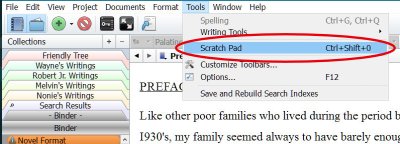
Scrivener - Scratch Pad on Tools Menu - Writers in the Grove.Ever get a new idea, a bit of inspiration, as you are writing? I used to turn to a piece of paper or sticky note to jot down my idea, but found that by the time I made the note and switched back to my writing program, I’ve lost track of what I’m writing. Moving my eyes from the computer screen and fingers from the keyboard invites distraction. Luckily, Scrivener offers a way to make notes and keep on writing.
The Scrivener Scratch Pad is built into Scrivener and can be accessed by:

  • Windows: Tools > Scratch Pad or CTRL+ALT+SHIFT+P
  • Mac: SHIFT+CMD+ENTER

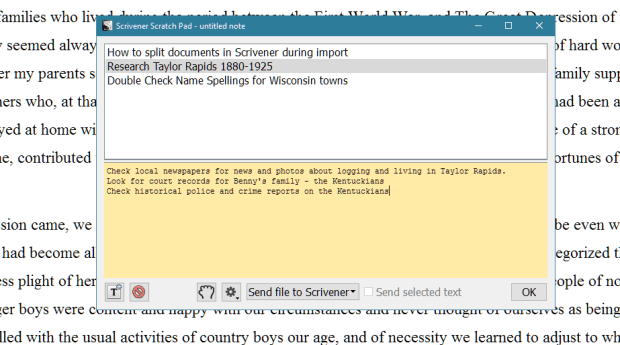
You can add a note to it quickly with a mouse from within the Scratch Pad window. Click the T for Text in the bottom left corner to create a new note and start typing.

Scrivener Scratch Pad - examples - Writers in the Grove.

You can add as many notes as you wish in the Scratch Pad.

You can send the note to Scrivener later as the start of a new plot shift or poem.

  1. Select the note.
  2. Click Send file to Scrivener.

Two options will appear to either copy it to a specific file or new one, or append text to another text, adding it to the bottom. You can also select a portion of the note and send just the selected text.

One of the cool things about the Scratch Pad in Scrivener is that the notes persist between projects. You can make notes on other projects that pop into your head or you discover while researching another project. Think of all the ways you can use the Scratch Pad in Scrivener to deal with these thoughts while staying focused on the task at hand.

For more tips, see “Using the Scratch Pad in Scrivener” by The Digital Researcher, and the following:

Writer’s Toolbox: Describe and Critique Art

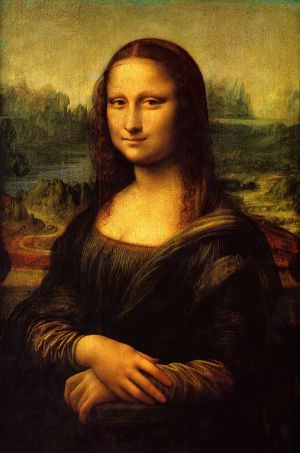
Mona Lisa - Leonard Da Vinci - Wikipedia.Your characters head for the local museum or art gallery. Their eyes are filled with wondrous sights. Colors, patterns, shapes, textures, renewing their spirit, giving them the beauty they crave in their life. Or boring them to tears as they’ve just been dragged to another thing-they-don’t-wish-they-had-to-do-in-order-to-save-a-realtionship-or-get-sex.
Either way, it helps to have words to describe and critique that art.

Describing artwork is one of the fascinating uses of language, in any language. How does the writer capture a painted expression, a twisted sculpture, an abstract painting? Could you describe the Mona Lisa with the right words to make the magic of Leonardo Da Vinci’s portrait explain why it continues to attract millions of visitors eager for a glimpse of the woman’s face with a lack of expression?

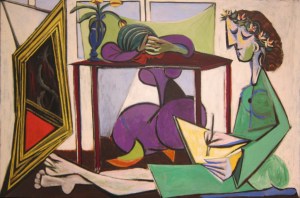
Interior with Girl Drawing - Pablo Picasso.Artwork is encountered in most books in some way, a photograph of a suspect, a painting on a wall, a quilt, lacework, or arts and crafts item that tells us more about the character, place, or solves a mystery. How do you describe it to not only let the reader see see it, but also choose words that match the tone, scene, time, and owner?

In general, use the following tips for presenting a work of art, though how you choose to describe it and use it in your writing is your personal, creative decision.

  1. Identify the artwork type and medium (canvas, photograph, painting, sculpture, drawing, etc.).
  2. Identify the artist (if possible or relevant).
  3. If a well-known piece, name it.
  4. Describe the objects in or subject matter of the artwork (field, flowers, sunset, ocean, person, portrait, sky, furniture).
  5. Describe the colors, lines, patterns, shapes, and textures.
  6. Describe the first impression of the artwork, what your character or your reader would see at first glance.
  7. Where is the light source? Is the source from the sky, electric, natural light, artificial light, and light direction (top, under, side, backlit (behind)).
  8. What are the sensory qualities, the mood and visual effect, of the work?
  9. Why is it placed in this this particular spot?
  10. Why did the owner buy it?
  11. If the artwork has sentimental value, what is it? How does that help with the character development and backstory?
  12. If the artwork has financial value, what is it and why is that important to your story and character? Did they buy it only for investment? Or to support an artist they found interesting? Or maybe a relative trying to be an artist? Or is it part of their nest egg, saving for the future, betting on the artist? Would they sell it? When? Why?
  13. How does it fit into the rest of the room, building, or scene? Would the character seeing this, if they didn’t own it, think it fits perfectly there or not?
  14. What does this artwork tell the reader about the character or place?
  15. Many people interpret and respond to artwork differently, some with contrasting viewpoints. How would your characters respond? The same, differently? Would they each have a different reaction to the artwork? Does that add to the conflict?
  16. If important to the story, interpret the artwork from the perspective of the artist. Why did they create this? What was their inspiration, motivation, and goals to do so? This might reflect back on the personalities and backstory of your characters.

To help you learn more about learning how to describe arts and arts and crafts, we’ve put together some resources.

Here is a YouTube video for writers on how to describe art.

The following will help you describe artwork and critiquing it to help you flesh out the experience of your characters.