writing tips

Where to Publish Your Short Story

During our Writers in the Grove workshops, we often suggest to our members that a particular work needs to be sent out to a magazine or online publishing site for publishing.

While there are many writing contests a writer could enter with a poem or short story, the following are articles featuring a variety of places that want your story short work. And some pay fairly well.

There are many articles on the web to help you get your short story through the submission process well, but take note of the specifics in “How to Get Your Short Stories Published in Lit Mags” by Writer Unboxed. There are some great guidelines to help.

Writing Tips: Shoelaces, Knots, and Ties

Another tool to add to your writer’s toolbox is Ian’s Shoelace Site. The tagline is “bringing you the fun, fashion, and science of shoelaces.”

How does your character tie his or her shoes? The choices they make may tell the reader much about their personality, their past, culture, and experiences with shoes.

Do they tie them tight or loose? Use a specific technique for tying? Why? How? How do you describe how they tie their shoes?

Are they athletic? Maybe they were in the past and tie their shoes based upon the technique they used for their football, baseball, ice skates, hockey skates, or running shoes, even though they haven’t touched the sport in decades.

Maybe they are old and need the helix twisted shoe laces to hold their shoes on because their arthritis can’t tie a bow any more. Or maybe they had to go through physical therapy to relearn how to tie their shoes after an accident or stroke. How would they do that and what are the different shoelaces and shoes available to help them?

What types of laces do they have in their shoes? Leather shoes often have thin strings for laces. Many people today slip colorful shoelaces into their tennis shoes for fashion or attention.

Can you name the parts of a shoelace? Are they shoe ties or shoelaces? What’s the tip called that helps slip through the loops or rings to threat a pair of shoes? What is it made of? Are there different kinds?

Did you know that there are almost 2 trillion ways to thread a shoelace through eyelets to tie a pair of shoes?

Ian’s Shoelace Site offers answers to all these character development questions. Ian even has a book published in 2007 called “Laces” to help you learn even more about shoe laces with detailed pictures and graphics.

Check out the following web pages on Ian’s site to learn more about how your character might tie their shoes.

Are We There Yet? How Long Does It Take?

Ever wonder how long it takes to travel?

This is more than an answer to “Are we there yet?” It is a challenge that faces ever writer when their character leaves the comfort of home or work and must travel to another location.

If traveling by foot, how long does it take? By car? By bus? By train? What about by horse? The time spend traveling across the same difference changes with the mode of transportation.

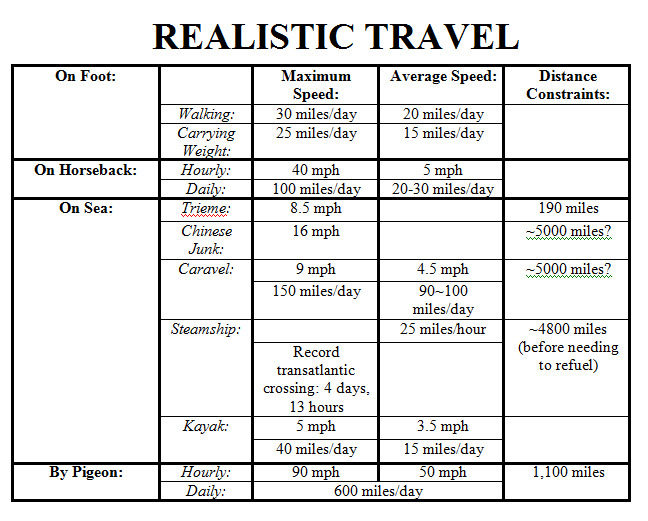
The folks behind The Writer’s Handbook found a chart that answers some of these questions if you are considering traveling by horse, sea, foot, or pigeon. This is a great tool to add to your writer’s toolbox.

Another travel time chart to keep in your writer’s toolbox comes from Lapham’s Quarterly.

What about calculating for traffic congestion? It might take you 30 minutes to get to Portland, Oregon, in the middle of the day, and 3 hours to travel the same distance during rush hour. There is much to think about when you take your character traveling.

Here are a few more examples:

  • A healthy person can walk 3-4 miles an hour on flat and even ground (36-48 miles a day possible)
  • A healthy person can walk 1-2 miles an hour on rugged terrain, less if off-trail
  • By horse on roads or trails with level or rolling terrain – 40 miles per day
  • By horse through mountainous terrain on roads or trails – 20 miles per day
  • By horse through hilly grasslands with no roads or trails – 25 miles per day
  • By horse through rugged mountainous terrain with no roads or trails – 10 miles per day
  • By horse during Roman Era on roads or trails with level or rolling terrain – 20 miles per day
  • By horse during Roman Era on level or rolling terrain with no roads or trails – 15 miles per day
  • A wagon can travel 15-25 miles a day depending upon size, horses, path, and load
  • A league is 3 miles, the distance someone could travel in one hour.

Other tools to help you estimate travel times include:

This is just the tip of the travel time iceberg. What about travel by train? By skateboard? By bike? By helicopter? By skiing? By air balloon?

It’s your imagination traveling with your character. Add their travel type and estimates to your writer’s toolbox as a guide to help you estimate travel times.

Writing Tips: Don’t Write Chronologically

In an article on Writer’s Digest called “10 Tips for Writing” by Chuck Sambuchino, he offers two good tips we writers need to remember:

Don’t write linearly: Don’t set out to write something from beginning to end. A story is meant to be read from front to back, but not necessarily created that way. If you have an idea for writing the sixth chapter first, then start there. The epilogue can even be the first thing you put down on paper, then work your way back. Scattered chapters will eventually be filled in, and it will force you to look at the story from different angles, which may present different ideas or new approaches. You’d be surprised how well this works when a whole book starts coming together…

Ask for (and take lots of) punishment: It is well worth finding yourself a professional writer or editor and asking/paying them to look at your work. Tell them to give you highly critical feedback with no sugarcoating. Let them go so far as to be cruel too, just so you really get the point. There is a lot of rejection and criticism involved in the publishing industry. Getting accustomed to it sooner than later is advantageous. If you want to be serious about your writing, then you’ll need to know everything wrong with your writing. Accepting and understanding the harsh realities of your shortcomings is a most important step to getting better.

The first point is very important. Write what you know about what you want to say, then go back and fill in the rest of the story. Editing is part of the craft of writing, so let the story unfold as it comes into your mind, not on some chronological journey.

While Writers in the Grove doesn’t offer the harsh feedback noted in this article, such feedback maybe given one-on-one or in other groups designed for such feedback, focused on publishing. We also recommend the Willamette Writers Conference and their various groups and meetups. They offer a wide range of critique and feedback opportunities.

Writing Tips: Kill Your Darlings and Make Writing a Habit

Marelisa of Daring to Live Fully brought us “57 Tips For Writers, From Writers,” a fantastic series of tips from some of the most famous writers.

From Stephen King’s book, On Writing, she references this bit of wisdom for writers.

Mostly when I think of pacing, I go back to Elmore Leonard, who explained it so perfectly by saying he just left out the boring parts. This suggests cutting to speed the pace, and that’s what most of us end up having to do (kill your darlings, kill your darlings, even when it breaks your egocentric little scribbler’s heart, kill your darlings)…I got a scribbled comment that changed the way I rewrote my fiction once and forever. Jotted below the machine-generated signature of the editor was this mot: “Not bad, but PUFFY. You need to revise for length. Formula: 2nd Draft = 1st Draft – 10%. Good luck.

From John Grisham, she shares this:

He goes on to say that at first you have to treat writing as a hobby; you write a page a day in your spare time. Grisham explains that he created spare time to write, although he had a full time job. He adds that he always tells young aspiring writers that if they’re not writing a page a day, then nothing is going to happen. But if they make sure to write a page a day it becomes a habit, and before long they have a lot of pages piled up.

For those of us considering writing full time, these are wise words.

Writing Tips: Harsh, Eye-Opening Tips for Writers

In “21 Harsh But Eye-Opening Writing Tips From Great Authors” by Cody Delistraty of Thought Catalog, he explains:

Even the great writers of our time have tried and failed and failed some more. Vladimir Nabokov received a harsh rejection letter from Knopf upon submitting Lolita, which would later go on to sell fifty million copies. Sylvia Plath’s first rejection letter for The Bell Jar read, “There certainly isn’t enough genuine talent for us to take notice.” Gertrude Stein received a cruel rejection letter that mocked her style. Marcel Proust’s Swann’s Way earned him a sprawling rejection letter regarding the reasons he should simply give up writing all together. Tim Burton’s first illustrated book, The Giant Zlig, got the thumbs down from Walt Disney Productions, and even Jack Kerouac’s perennial On the Road received a particularly blunt rejection letter that simply read, “I don’t dig this one at all.”

Cody continues with some excellent tips writers need to know when it comes to publishing your book.

One tip and quote of particular meaning to our group was:

You can’t wait for inspiration. You have to go after it with a club.
Jack London

Looking for inspiration, use your club on our many Prompts.

Prompt: A Roll of the Dice

Attending a weekend writing retreat led by science fiction author Nina Kiriki Hoffman, Writers in the Grove member, Lorelle VanFossen received permission from Nina to introduce our group to The Story Catcher technique she developed. The following is a summation of the technique for inspiring writing prompts based upon random words and phrases. The document used for the prompt exercise is available for download and printing in a link at the bottom of this post.

Collection of multi-sided, colorful dice.A prompt is anything that inspires you, the writer, to write. It could be a word, a phrase, an idea, and the source of the inspiration could come from anywhere or anything at any moment. The prompt this week was also a workshop on generating random prompts.

How would your writing change if you could generate the serendipity of your prompts on a regular basis, possibly turning it into a habit, a writing exercise used daily?

Nina Kiriki Hoffman developed The Story Catcher, a tool to generate random prompts based upon chance, specifically a roll of the dice.

Nina’s Story Catcher is a booklet where you collect words and phrases as you go through your day-to-day living, twelve words on a page, each page numbered in sequence.

To use the Story Catcher:

  1. Roll one or two standard dice.
  2. Select one or both dice to generate the page number. For page 11, one or both of the dice could total 11. For page 64, one die would be 6 and the other 4.
  3. Turn to that page number and roll again.
  4. Write down the resulting prompt from among the 12 on that page.
  5. Repeat this process three to five more times, noting each word or phrase generated.
  6. Using the resulting randomly generated words or phrase, write your prompt within a 15 minute time limit.

This process generates a completely random set of prompts. Examples might be: (more…)

Prompt: Write a Story Twice

The prompt this week is about writing for the audience, keeping their experience in mind when sharing your experience in words.

When writing to relate an experience, how do you tell the story? If it happened “this way,” do you have to write it that way or can you be creative with the storytelling process. How do you modify it, how do you adapt the story from reality to storytelling? Does it need to have the ring of truth or be the truth?

It depends. It depends upon your goals as a writer and your audience. What does your audience need to know to make your point? Are you making a point? Are you going for a joke? Are you testifying before the court? Are you teaching them something? What elements do you keep, which do you omit, which do you emphasize, which do you unemphasize?

Everything we do is colored by our experience, then adjusted for our audience. The choices in words, phrasing, and storytelling technique dictates what influences as you tell the story.

In the 1970s, Fuji Film took on its rival Kodak to create a new range of print and slide film. They researched customer’s experiences with film and film processing and found that the main complaint people had when picking up their film after processing was that the colors weren’t as intense. “You should have been there, it was so colorful.” The researchers found that memory intensified over time. Comparing a photograph of a sunset, it would look the same, but in the one to three weeks from taking the picture to having it developed and in their hands, human memory intensified the colors. Fuji amped up the colors in their film to make it match the human memory.

Writers need to do much the same. Intensify the scene and characters to enhance the moment. As author William Faulkner said, “In writing, you must kill all your darlings.”

A story too bare may not hold the attention of the reader, but watch out for diluting the story with too many tangents and extraneous details.

From The Riverside Reader by Joseph Trimmer and Maxine Hairston came more information to help with our prompt. In summary, it stated that writers of narrative essays must be concerned about how much they tell their readers. Because an essay is based upon experience, few readers will know the entire backstory by that point in the story, nor should they. Do they need to? How much should they know and when they should know it is a constant struggle for fiction writers.

The ability to identify major and minor details in the writing as critical to the storytelling differentiates from the real life experience. When we experience an event, we have a knack for confusing dates, names, and the sequences of events, and we have the unalterable belief that simply “just because something happened to me, you are going to be fascinated.” This doesn’t always hold true when writing the event. We must pick and choose what we include as well as what we remove. We might play with the chronology of the event, restrict the backstory, change the characters or blend them together, even change the scene to make the reader’s experience a more enjoyable one as well as increase the tension and drama of the story.

According to Writers in the Grove member, Diana Lubarsky, “What is truth? Sometimes you got to make it up.”

The Prompt: Write a Story Twice

The prompt was to write a story twice. Have a different audience in mind for each telling.

Write a “true” story,” something that happened to you. Write it for two different audiences such as a child, grandchild, prissy mother, controlling mother-in-law, students in a class, a newspaper reporter – you choose.

Compare the two. Does the tone of voice change? Do the words change? How?
Getting Your Article, Short Story, or Poem Published for the First Time

Writers in the Grove is a creative writing group, focused more on supporting each other’s writing passions through education and writing opportunities. Some of us are also published from time to time. While the group’s focus isn’t on how to get published, we do cover that topic occasionally.

This article serves as a general tutorial and guide to help you get your work published for the first time, taking you step-by-step through the generic process of submitting your work in article, story, or poem formats, not novels and non-fiction books, though the process is similar.

The process begins with craft, learning as much as you can about what you are writing and preparing to submit before you begin the process.

Know The Craft of Writing

Each writing genre has specific standards for writing format, form, and function, and it is part of the development of your craft to learn these.

Understand, editors don’t want to reject anyone’s writing. Their job is to accept and reject those that don’t pass through their filters. Many editors are inundated with dozens if not hundreds of submissions weekly, sometimes daily, so they’ve learned to reject for simple grammar mistakes or be the rare ones to see past the poor language skills to find the gem of the story. Present your best work so you never give them an excuse to reject your work.

Improve Your Skills with Writers in the Grove

Writers in the Grove offers a chance for you to bring your short story or poem to our group to read in the second half of our weekly workshops. This is a great opportunity for gentle feedback, but also practice your reading skills.

We also produce two author reading events annual, Lend an Ear and Wintersong, a chance to submit and read a 4-minute piece before an audience of 50-100 people, again, another excellent opportunity to read publicly and get public exposure for your work.

  • Learn How to Spell or Use Spell Check Wisely: Some editors are forgiving about the occasional spelling mistake, others are not. If you regularly misspell words, learn them or pay close attention to them when you use them.
  • Learn Punctuation Rules: Learn how to use punctuation, and understand why you use commas, colons, semi-colons, hyphens, and quote marks, and how to constrain yourself from using exclamation points.
  • Become a Grammar Guru: Learn sentence structure, prepositions, clauses, and how to use and not use them. Writing is a non-stop class in how to use the language. Learn to use it to craft the words into a symphony.
  • Edit Brilliantly: Edit your work. Never submit a first draft. Craft your draft. Only submit your best work, so edit with a strong and graceful hand.
  • Get Feedback: There are many groups dedicated to helping you publish, giving you the high-powered review and critique you may need to succeed in the marketplace. Writers in the Grove members will give you gentle feedback, designed to encourage rather than discourage, though we will give you a harder review if you ask, we are not publishing experts nor editors, just writers with experience. In addition to our group, look for groups focused on publishing in our area or online to improve your professional writing skills.
  • Network and Build Relationships: Some writers rarely submit their work for publication. Editors invite them to submit because they have established a connection, a relationship, and reputation for quality work. Look for opportunities in your community to attend other writing groups, conference, and workshops to get to know others in the business. Travel to writing conferences, and find a way to connect with those who are buying your work.
  • Take Classes, Read Articles, Study Books, Learn Writing: You are never too old or experienced to stop learning about your craft. Luckily, the Portland area is stuffed with exceptional colleges and educational facilities offering writing courses, workshops, and events. Don’t forget the Willamette Writers and their monthly activities and annual conference.
  • Learn What Publishers Want and Need: As with everything, writing is part of the supply and demand economy. You have to give them what they want to buy. Carefully study their publication. Read through their guidelines for writing and submission as well as their want lists to give them just what they need.

Your Writing is Now a Business

Did you know that many short stories were picked up by agents and publishers to be turned into novels and movies? Orson Scott Card’s famous, award-winning book, Ender’s Game, started out as a short story. It not only became an international bestseller, with numerous sequels, but also a movie. (more…)