Author: Lorelle VanFossen

Lorelle VanFossen is a pioneering XR Innovator and WordPress leader, tech educator, keynote speaker, and producer bridging virtual reality and digital innovation. Co-founder of Educators in VR, founding WordPress community member, and passionate advocate for emerging technologies and human rights. Expert in immersive education, VR/XR event production, UX, and digital transformation.

Get Ready Now: NaNoWriMo is Six Months Away

NaNoWriMo is in November, barely six months away. For some, that’s a long time. For others, it comes too soon. Either way, it’s time to start thinking about how you will spend your November churning out 50,000 words, or an hour a day, of writing.

We’ve featured many articles and tips for NaNoWriMo on this site over the past few years, so your first task should be to dive into that great content to warm up your creative juices.

Do you have a topic to write about, a plot for a novel, your memoir, a technical how-to book? Maybe you want to finish that book you’ve barely started, or rewrite one that went no where the first time. It is never too early to start planning what you will be writing.

There are three times of writers in NaNoWriMo. There are the plotters, those who plot and outline everything out before the event begins. The pantsers write by the seat of their pants, trusting their muse to find the words daily. The plotsters or plantsers are the ones who did a little of both, plot out a rough outline, have a sense of where they are going, then let the muse take them where their fingers and imagination goes.

We also recommend you take time to get Scrivener, the writing studio software, to hold your outline, notes, research, and to write in and keep track of your writing during the month-long event. New to Scrivener? Check out our tips on using Scrivener, especially during NaNoWriMo, and watch this site for an announcement soon on a 4-week workshop on Scrivener Basics at the Forest Grove Community and Senior Center in Forest Grove, Oregon, in September, just in time for NaNoWriMo.

Here are some more tips to help you get ready for NaNoWriMo, and for writing any time.

  • Make an appointment with yourself – and keep it. Protect your writing time. Your muse works best when you show up at the same time every day, or train it to work for spontaneous 10 or 15 minute segments through the day. Either way, set writing time on your schedule and don’t miss an appointment.
  • Write what you know. It is true that it is best to write about what you know, but lean into this even more. Use characters you know, inside and out, from your own life, compilations of a variety of people, or a specific person from your childhood or present. Put your characters in a place familiar to you, your childhood community, or where you lived for many years and know all the back streets. Give your characters jobs you’ve held. Play with the rest, but use what you know. There is something special about reading a book where you just know the author loves the characters and places where the events take place.
  • Trust yourself. Trust yourself to write a great story. Trust yourself to know what to write. Trust yourself to let your characters lead you. Trust that you know how to do this, because you do. You wouldn’t be doing this unless you knew you could. Trust yourself to do it.
  • The first draft of everything is shit. Hemingway is supposed to have said that often, and it is true. First drafts don’t sell. They aren’t published. The magic comes in the second, third, possibly even the twentieth draft. Just write. Get it all down and fix it later.
  • Writing is about storytelling. Never forget, you are telling a story. You are taking the reader on an adventure, a journey, teaching them about how your characters see the world around them, and how they behave within it. The best stories are written not with the best grammar, but the best storytelling techniques.
  • Journal and note your ideas now. As you make your way toward November, jot down the ideas that come to you in the oddest of moments. You never know where one might lead, or if you may need it later when the well starts to run dry. Some people take a while to let their imagination simmer, so be ready to catch whatever floats to the top and preserve it.
  • Show don’t tell. Pay attention to everything around you over the next few months. See a beautiful sunrise, or the sun bursting forth through storm clouds? Write down what it looked like, but focus on how you felt in the moment. Look at people around you. How are they walking? Talking? Sitting? Moving in and out of the crowd. Takes notes on what you see and how they moved emotionally, with determination, courage, faith, pain, misery, depression, joy…show us how they moved. The next few months have two seasons, possibly three, in them, and you have an opportunity to view people in cold, wet, and rain, and bright sunshine, possibly even extreme heat conditions. How are their bodies responding to the environment?
  • Listen. Over the next few months, listen deeply to the voices all around you. At the store, at work, at meetings, social events, listen and take notes. How do they speak? What are they saying? Would your characters say that? How would they say the same things? The best characters are like real people, so pay attention to all the ways real people talk, to themselves and to each other, and take notes.
  • Put conflict in every sentence, paragraph, page. There are seven types of conflict in storytelling and writing. There is man vs. self, man vs. man, man vs. society, man vs. nature, etc. These struggles, elements of conflict, are the core in any good story. We need heroes. We need anti-heroes. We need villains. We need to have our characters tortured by their circumstances. Think about all the ways you could bring your characters to their knees and test their spirits, and put that in your story plans.
  • Pay attention to the news. Right now, the United States, and the world, are in teetering on the edge. The edge shifts from day-to-day, or could be all of everything, global warming, politics, pollution, economy, fake news, malware attacks, prejudice, even war. How does it feel? How do others feel? How are they responding? Are they hoarding food or money, just in case? Protesting? Apathetic? Terrified? An ostrich, head in the sand, disconnected from the world around them? Take note of all these attitudes, behaviors, and responses to the world around you and them. It’s all good fodder for the characters in your book.
  • Look for stories, and stories within stories. A well-written book doesn’t have one plot. It often has several plots, sub-plots, stories within stories with the same or different characters. Maeve Binchy specialized in writing about characters, each with their own plot lines, weaving them in and out, until they merged together at the end, surprising the reader. Look at all the stories around you, little stories like the man who forgot his wallet and realized it at the grocery checkout, and breaks down in tears not because he forgot his money but because he wife died a week ago and this is the first time in 30 years he’s shopped for himself. Or big stories of a cheerleader a month from graduation at the top of her class, who finds out she has cancer, two weeks after her mother died of cancer, and her father dies of a heart attack two days later, and she has to go on. Every moment is a moment for story, and within every story is another story, maybe three or four.

Writers in the Grove features more writing tips and advice on writing for all your writing challenges as well as NaNoWriMo. Subscribe to our site by email or add us to your feed reader to keep us close as you tackle your next writing project.

If you are in the Portland, Oregon, area, please join us at our Monday morning workshops from 9-11:30 AM at the Forest Grove Community and Senior Center, and on the second Saturday of the month at the Forest Grove Library.
Tell Me a Story

The following is by Writers in the Grove member, Bev Walker, based upon the prompt, The Roles We Play.

“Why can’t a woman be more,
More like a man?” he said.
“Because then you wouldn’t be here,” says I.

Would I trade having kids,
Watching them grow,
Laugh, learn,
For the hard labor of a
Construction site?
Or sitting in an office all day?
No.

Would I trade the warm scent
Filling my kitchen
As I take loaves of fresh bread
Out of the oven,
For the oil and grease
Of a mechanic, a factory,
Or the dry sterile atmosphere
Of a skyscraper downtown?
No.

Would I like to be an astronaut,
Like Peggy Whitson,
Out there, exploring the stars?
Yes!

But the time is not,
Nor ever was,
For me to fly to the moon,
Discovery electricity,
Romance in Paris,
Dance across the Great Wall,
Or pet a tiger.
But I can.

I can do whatever anyone
Throughout time has ever done,
Feel what they’ve felt,
See what they’ve seen.

So, show me, storyteller.
Where have you been?
What have you done?
What have you seen?
Tell me a story
So I can go, too.

8 May 2017

Prompt: Blame and Forgiveness

The prompt today was on blame and forgiveness.

We started out with the twist on the classic quote, “To err is human, to forgive divine.”

To err is human. To blame someone else is even more human.

Other variations on this theme included:

He started it when he hit me back.
To err is human, to blame it on somebody else shows management potential.
To err is human. To blame it on someone else is politics.

Prompt: The Roles We Play

Living up to roles, the things I’m “supposed” to be. Some are not welcome, some have been around so long, they are a part of us. Writers in the Grove member, Patti Bond, brought in the prompt:

Why can’t a woman be more like a man?
From My Fair Lady, “A Hymn to Him” sung by Henry Higgins, lyrics by Alan Jay Lerner and Frederick Loewe.

Your prompt is to address the issues of roles, be it why a woman can’t play the roles of a man, or any roles we play in life.

Broadening Travel? Well, Depends.

The following is by Writers in the Grove member, Bev Walker.

I’d be much skinnier if I lived in Germany.
Cabbage, sauerkraut and beer are not my thing.
I know why Brits are such avid tea drinkers,
There isn’t a decent cup of coffee in the whole island.
I’m addicted to cheese.
I’d have to find a substitute if I lived in Scandinavia,
(Not that there is such a thing)
Their’s smells like sewage.
But how all those French stay so slim is beyond me.
Chocolate, creams, and pastries!
I gain ten pounds just looking in a bakery window.
Open the door, get a whiff, another ten.
Dare to go inside?
You’re a goner.

Prompt-a-Month: Sunshine

Writers in the Grove Prompt-a-Month badge.The May prompt-a-month for our Writers in the Grove members is:

Sunshine

The deadline for submissions is 6/1/2017. Submissions will be published during the next 30 days.

Writers in the Grove members may hand in their submissions during the workshops or use our members only submission form. Check out the guidelines and instructions for submissions in the announcement.

Lend an Ear 2017 on July 8, 2017

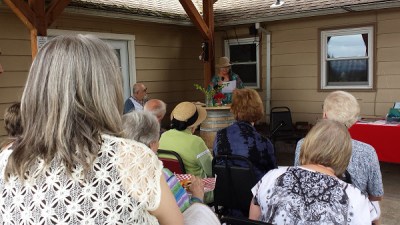
Lend an Ear 2015 - Audience listen to Veronica read.The 8th Annual Lend an Ear, Come and Hear reading event is July 8, 2017, at Plum Hill Winery in Gaston, Oregon. It begins at 10:30AM and goes to approximately 1PM, and is produced by Writers in the Grove.
July 8, 2017
Saturday 10:30am-1pm
Plum Hill Vineyards
6505 SW Old Highway 47
Gaston OR 97119

The event is free and open to the public.

For eight years, writers from around Forest Grove and Washington County have submitted and read their work to dozens. Last year we broke records with over a hundred attendees. This free event is held in a beautiful winery in the foothills near Hagg Lake overlooking the Tualitin Valley. There will be food from several food wagons and, of course, some wine from Plum Hill Winery, our fabulous hosts. Come laugh, cry, and sigh as you listen to our marvelous readers sharing their creative writing and storytelling skills.

Enter Your Submission: If you would like to participate as one of our readers, submit your poems or prose of four-minute readings per the instructions on our submission form for Lend an Ear, available as a downloadable Word document or PDF file to complete and return to Writers in the Grove by June 12, 2017. Submissions must be original and able to be read out loud for no more than 4 minutes. This is a juried event. Pieces will be selected on the basis or originality, writing style, and quality of work. All genres are welcome, however, they must be family friendly. Submissions should reflect content suitable for mixed age groups.

Come join Writers in the Grove for this fun, family event at Plum Hill Winery.

Prompt: Sensations Without Sight

The prompt this week was:

Think of an episode or event in life, childhood, or adulthood. Think of where it occurred, when, what season, and those involved. Think in terms of senses other than sight. If you were a sculpture, what would the texture be for the sculpture you would make of this? What are the sounds, smells, touch, sensations other than sight? Use sight minimally or not at all to tell your story.

Writers in the Grove News: Local Pen Pals

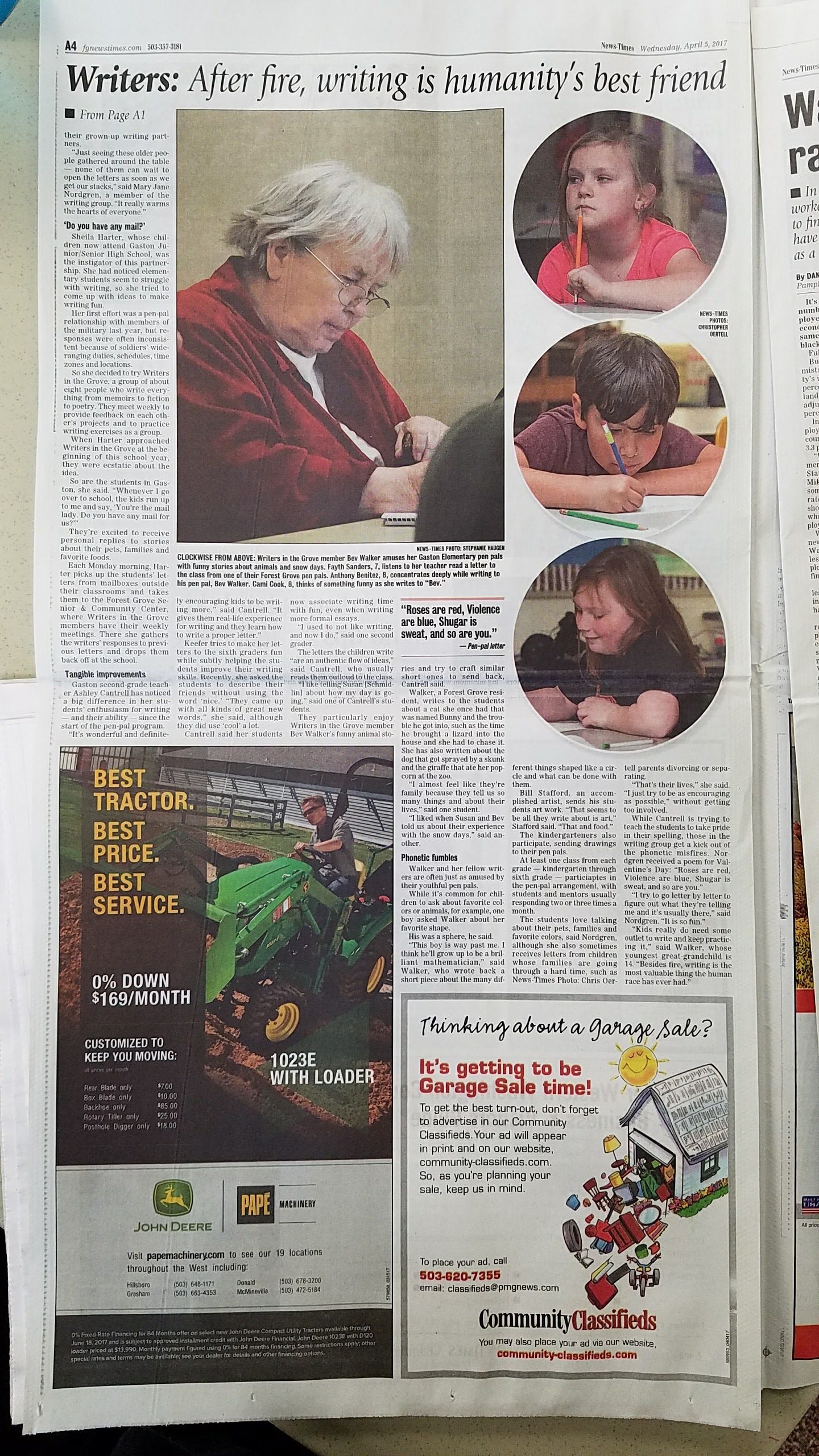
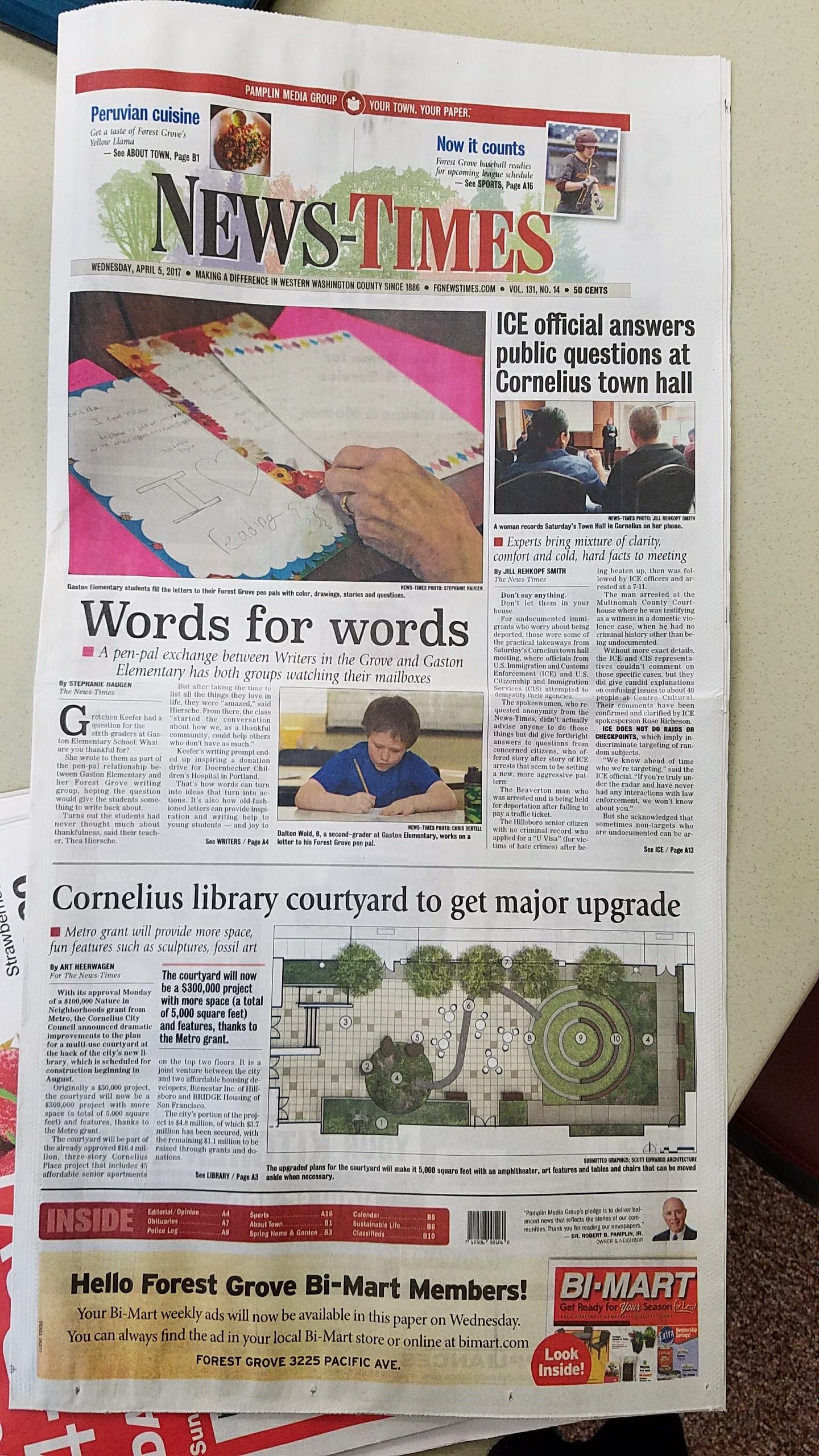
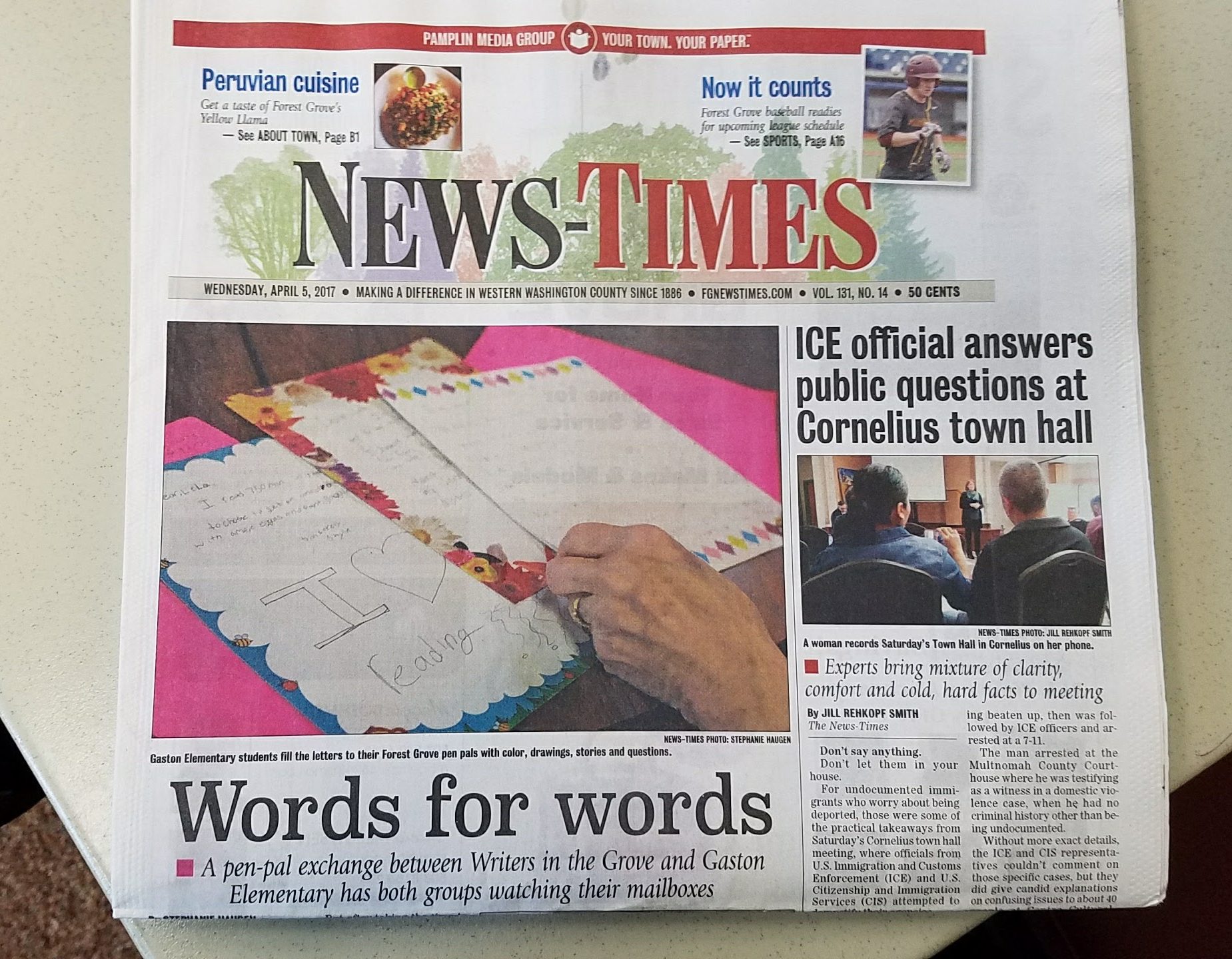
News - Writers in the Grove - News Time Article on Local Pen Pals April 2017 Forest Grove Oregon - CoverAt the beginning of this school year 2016-2017, a local parent and volunteer with the nearby Gaston, Oregon, elementary school contacted Writers in the Grove about a local pen pal program. Many members volunteered to correspond with the children at the school, and it has changed lives on both ends of the mailbox.

Words bring old and young writers together in special partnership” features the unique program of connecting local writers with local elementary students for a pen pal program, and includes interviews with several of our members.

Gretchen Keefer had a question for the sixth-graders at Gaston Elementary School: What are you thankful for?

She wrote to them as part of the pen-pal relationship between Gaston Elementary and her Forest Grove writing group, hoping the question would give the students something to write back about.

Turns out the students had never thought much about thankfulness, said their teacher, Thea Hiersche.

But after taking the time to list all the things they love in life, they were “amazed,” said Hiersche. From there, the class “started the conversation about how we, as a thankful community, could help others who don’t have as much.”

Keefer’s writing prompt ended up inspiring a donation drive for Doernbecher Children’s Hospital in Portland.

That’s how words can turn into ideas that turn into actions. It’s also how old-fashioned letters can provide inspiration and writing help to young students — and joy to their grown-up writing partners.

“Just seeing these older people gathered around the table — none of them can wait to open the letters as soon as we get our stacks,” said Mary Jane Nordgren, a member of the writing group. “It really warms the hearts of everyone.”

This wonderful project could not have happened without the dedication of Sheila Harter. She has worked overtime to volunteer her services as “pony express courier” to collect letters from both groups and exchange them every week.

You may read the full article on the Forest Grove Times News site, and check out our pictures of the articles below.

News - Writers in the Grove - News Time Article on Local Pen Pals April 2017 Forest Grove Oregon (2) News - Writers in the Grove - News Time Article on Local Pen Pals April 2017 Forest Grove Oregon (3)