Writing Tips

Writing Tips for June 2015

Our writing tips posts usually feature a variety of articles from around the web offering great tips for writers, specifically those writing fiction and memoir. Today we’re going to do things a little differently because we’ve found a great resource stuffed with writing tips.

Botham Writers offers “Writing Tips from the Masters,” a collection of writing tips and advice from top authors including Neil Gaiman, P.D. James, Jack Kerouac, Michael Moorcock, Elmore Leonard, Billy Wilder, Joyce Carol Oats, Henry Miller, Joss Wedon, Struck & White, and a wide variety of classic and modern writers. It covers all types of writing, from general writing and professional writing tips to writing scripts and published material.

Examples include:

Get through all of these and you might find the secret sauce in good writing.

Writing Fiction Tips For May 2015

From time to time we may share links to writing tips we’ve found on the web to help us improve our writing. The majority of these are focused on fiction because our workshop motto is everything we write is fiction, whether or not it is. 😀

Five Essential Tips for Anyone Trying to Write A Book – Forbes: Brett Arends offers excellent tips that may seem simple but are really the things that get in our way and hold us back. These include practice writing, finding a writing space and time, planning your book, and so on. He also highlights how a writing group helped him, which is what we are here for! Come join us.

Writing tips by Paul Coelho: Hard to argue with a master and award-winning author. A favorite:

I write the book that wants to be written. Behind the first sentence is a threat that takes you to the last.

10 Writing Tips from Legendary Writing Teacher William Zinsser, May He Rest in Peace – Open Culture: The world of writing is a little smaller with the recent loss of William Zinsser, author of On Writing Well, a staple of how to write since 1976. The article paying tribute to him selects some of the best writing tips he’s offered.

“A clear sentence is no accident. Very few sentences come out right the first time, or even the third time. Remember this in moments of despair. If you find that writing is hard, it’s because it is hard.”

12 Writing Tips I’ve Learned After 20 Books and 3,000 Articles Over 20 Years – Inc.com: Inc’s Andrew Griffiths offers us some great tips that are not just about writing from a writer’s perspective, which they are, but also from an avid book reader. There is something to be said about good advice from those who love books such as:

I had the great pleasure of seeing Seth Godin in Sydney recently and he said something that really resonated with me: “If you are just writing to get ‘shares’ or ‘likes,’ you are writing too safe and too conservatively. If we really want to connect and engage our community, we have to be prepared to write content that is not popular, but it needs to be written.”

20 Writing Tips from Fiction Authors – iUniverse: This is a collection of quotes from modern writers, for the most part, on writing. There are some great ones in this collection including:

“The nearest I have to a rule is a Post-it on the wall in front of my desk saying ‘Faire et se taire’ (Flaubert), which I translate for myself as ‘Shut up and get on with it.’”
Helen Simpson

Writing tips from the CIA’s ruthless style manual – Quartz: Finding out that Struck and White were CIA sources – well, their writing styles were sourced by the US government in their style guide for writing “Intelligence Publications” – was fascinating, but the tips and advice in this collection of their tips celebrates their “crisp and pungent” language “devoid of jargon,” something that I’m not sure the US Government, or any government, practices much any more. Still a good set of tips for the rest of us to practice.

5 Writing Tips: Jane Smiley – Publishers Weekly: Winner of the Pulitzer Prize, Jane Smiley shared a few fantastic tips including:

Exhaust your own curiosity about your project before showing it to someone else. Let your own ideas play out without getting input from others, then, after you show them your work, use their responses as input to push you forward. It may take you several drafts and a long time to come to the end of your ability to tackle a given subject, and when you do, you might be satisfied or dissatisfied with your product. If you are dissatisfied, the input of others will give you ideas for how to shape your novel further. If you are satisfied, the input of others will let you know if your novel is readable and accessible.
The Inciting Event

The Monday morning workshop recently focused on scriptwriting, specifically tracing inciting events and the patterns of storytelling for television, film, and even books.

An inciting event in a plot is the shift forward in a story, the twist, hook, and plot points of the story.

K.M. Weiland, author of the book, “Structuring Your Novel,” helps us understand the confusion in and around an inciting event in a story in “Your Book’s Inciting Event: It’s Not What You Think It Is” on Helping Writers Become Authors.

What the heck is the Inciting Event? That’s a question just about any writer can answer. The trouble is that sometimes we all have a different answer.

Is the Inciting Event the first thing that happens in the story?

Is it the moment that kicks off the plot and the conflict?

Is it the First Plot Point at the end of the First Act?

Is it something in between?

Is it something that happens before the story ever starts?

The chief trouble with identifying the Inciting Event is that the term is used rather wildly to apply to just about any of the above. One writer calls the Hook the Inciting Event, another calls it the First Plot Point. Argh! No wonder we’re all so confused.

Weiland demonstrates three examples.

  • The Hook: The opening moment in your opening scene, the first moment something happens that keeps the reader reading or “hooked.”
  • The First Plot Point: The thing that happens at the end of the first act that changes the course of the story. She calls it “where your story really begins…the moment that fully engages your character in the conflict. He couldn’t walk away now, even if he really wanted to.”
  • First Act Turning Point: This is the moment that is the “call to” adventure or action, the no-turning-back point, the lit-match moment. She explained that most writer’s don’t include nor think of the turning point in the first act as the inciting incident, but it is. It is the moment that can be pointed to throughout the rest of the story, the moment when everything was shaken up and decisions needed to be made and action inspired. This is the inciting event.

Weiland explained that the first act turning point, or inciting event, should be placed at the 12% mark or 1/8th the way into the story. The first eighth of the story is character development, the time the audience needs to connect with the main characters, the time, and the place, the set up. (more…)

Edwidge Danticat: Would There Be Poetry Amidst the Haitian Ruins?

OPB Radio’s Literary Arts: The Archive Project featured award winning Haitian American writer Edwidge Danticat speaking about the catastrophic earthquake in Haiti from a 2010 presentation with the Portland Arts and Lectures.

She mentions Haiti’s nickname, terre glissée or “slippery ground,” and expounds on the metaphoric and literal connotations of that phrase. With the devastation still on everyone’s mind, Danticat tells of both her own and her family’s experiences during and after the earthquake, mentioning that her cousin Maxo was killed. She witnessed bodies in the rubble and an “altered human landscape” of so many people with injuries. After the quake, Haitians would simply call it “the thing,” or “the devil dancing,” or even onomatopoeias like “gudugudu.” Referencing several other Haitian writers throughout her lecture, such as Dany Lafferière, Danticat discusses the role of the artist who comes from a place of loss, including the importance of bearing witness.

We’ve been working on writing with all of our scenes, and most recently writing to describe the land. Her vivid and emotional descriptions of the impact of the earthquake, described with spiritual metaphors, poetic grace, destructive similes, and survivor humor, are examples of the diverse ways a writer can not only describe the land, but the impact of the land on the creatures that walk its surface. She comments on the Haitians description of themselves as “We are ugly, but we are here.”

There is poetry often in Haitian language, through proverbs, through the way that we try to interpret tragedy.

…I kept wondering, would there be poetry amidst the Haitian ruins?

…The Angel of Death is more democratic [than God]; everybody goes.

LISTEN: The original 52 minute recording is available at the bottom of Edwidge Danticat – The Archive Project on the Literary Arts Site.

Local Labyrinths

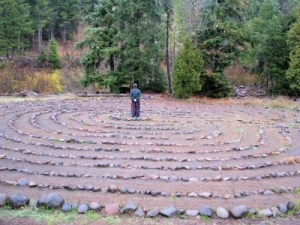
One of our recent speakers spoke of pilgrimages, and someone mentioned labyrinths as a form of pilgrimages in place. According to the World-Wide Labyrinth Locator there are at least 50 labyrinths in the Portland, Oregon, area. Many find solace and inspiration in waking mazes. There are also poems and stories published about mazes including the popular fantasy movie, The Labyrinth.

They provide an extensive list of labyrinths for your own personal pilgrimage within a 25 mile radius of Forest Grove.

Brent VanFossen stands in the middle of the Breightonbush Hot Springs Labyrinth - photography by Lorelle VanFossen.Closer to Forest Grove, you may explore the following labyrinths:

  • Pacific University just south of Old College Hall in the Southwestern Corner off College Way
  • Cornelius United Methodist Church on South Beech Street
  • Mission of the Atonement Church, SW Scholls Ferry Road, Beaverton
  • Sauvies Island near Collins Beach (parking pass required)

There is even a Labyrinth Network Northwest with events and activities focused on local labyrinths, including a recent holiday candlelight walk through a downtown Portland labyrinth.

Please note that some of these are private gardens or property available for access by appointment, and others are church, school, and open community areas. Please respect their property and hours of access.