Writing Tips for Editors July 2015

This roundup of writing tips comes from editors – specifically editors screaming to writers to LISTEN AND OBEY!

Editors are the sheriff to our published words, the one who rounds up the misbegotten criminals and victims of our words. We owe it to them to listen to their great words of advice so we become better writers before we hand over our words to them.

Ten useful writing tips from a frustrated editor – One Salty Blonde: This is not directly from an editor but from a writer with a fantastic editor who left notes on her book that not only made it better, but made her a better writer.

5. Avoid weak adjectives and most adverbs. They weaken writing. So instead of walked quickly, write dashed or bolted. Instead of tall man, write about him towering over something.

6. Do a search of “that” when you are done with a piece. Then take out the ones that are unnecessary. It will be lots of them. “He said that he didn’t do it.” Imagine you must pay $5 for every unneeded that.

Another great article on editing is designed for blogging, but applies to writing of all types. It comes from “7 Simple Edits That Make Your Writing 100% More Powerful” by Shane Arthur of Boost Blog Traffic:

There are some bloggers who seem to have a natural gift when it comes to writing. Some bloggers seem to be naturally gifted writers.

They manage to get their ideas across clearly and economically, which means that readers can easily follow what they write. Readers devour their clear, economical prose.

Not only is there a lot of respect for what they have to say, but also the way that they say it. People respect what they say – and love how they say it.

Some beautiful lessons on editing in that.

Here are a few more good tips, advice, and instructions from editors to editors and to writers.

Celebrate and Be Thankful

The following is by Liz Winston, a guest to Writers in the Grove Monday workshop. She wrote the following and shared it with us with permission to publish based upon the 4th of July prompt. Liz is a singer specializing in jazz and gospel in Seattle and also works retail during the day.

Another day
Full of fun,
Family, friends,
food, and faith.

A time to celebrate and
Be thankful for a chance to
Choose to make a positive
Difference in life.

Whether I face emotional,
Physical or mentally challenged,
Being thankful for past
And present progress
Things that have molded me into
The person you see today.

Being thankful
For another year to
Celebrate life whether
I feel ready or not.

Boom, bang, pop, sizzle,
Oooh, awwww, wow, oooh
As the lights are bright in
the sky tonight.

Together on the Fourth of July

This week, the prompt was 4th of July. A guest visiting the Writers in the Grove Monday workshop gave us permission to publish her prompt. Her name is Susan Siverson and she is proud mother of 4, lives in Seattle, and is a former bank manager now working at Seattle Pacific University in the Education Department.

That’s not fair – I have rights
But where do your rights end and mine begin?
Will you keep pushing the boundaries
Blind to your selfishness?
Could you be oblivious
Or do you just not care?

Then I think, and wonder –
Were you taught manners?
Or did you grow in
An environment of pain and uncertainty?

Yet today these differences fade
As we shift focus to a single theme
To dine, laugh, watch
Mesmerized by moments of light
Predesigned to enchant.
Speechless and awed together.

Mark Thalman Poetry Writing Workshop July 27, 2015

Mark Thalman, teacher, poet and author of Catching the Limit will teach a poetry writing workshop at the Forest Grove Senior/Community Center in Forest Grove, Oregon, on Monday, July 27.

Mark is a “poet of place” who writes to include his reader in his experience of Nature’s sights, sounds and colors. With more than thirty years of teaching experience, Mark will prompt the group to write and help them learn to polish their own work.

Workshop sessions will be 10 to noon, with a break for lunch. Afternoon session from 1 to 3.

There are two sessions and the fees will be free for members of Writers in the Grove for morning session, others $5. The afternoon session will be an additional $5. The entire day is $10 for non-members and $5 for members. All are welcome to attend.

Being in The Moment

Based upon the prompt from the Mark Thalman workshop in June 2015.

I’m listening to wise words I want to hold in my head.
Husband pings. His flight just landed in Indianapolis.
Love.
A dog growls on the sidewalk outside. The owner scolds.

The speaker makes a point that might change my life. Realign my thinking.
Phone flashes. Neighbor calling. Answer or not.
Not.
Police siren whines in the distance. Coming close? Moving away. Breathe.

Confirmation is spoken. I’m not alone in my way of thinking. Reassured.
Beep. Transcription of message arrives.
WTF.
“This is Max up with you on the screen and island of me…Boston yo case firm up…”

“Study your craft,” he continues. “Watch, listen, learn.”
Husband says luggage still in Atlanta.
Brilliant.
Motorcycle passes, snorting out its muffler.

“Sometimes the moment is given to you to take…”
Husband whines he can’t get the rental car he wants.
Crap.
“…other times you have to slug it out and fight for it.”

Homework Prompt: Because

The following is a homework prompt, presented by Mark Thalman in his workshop on June 22, 2015. Please complete the prompt and bring it to share on the Monday morning workshop, June 29.

Because.

Start with the word “because” and tell us how something happened, and another thing happened, and another thing, all because. Described as the Rube Goldberg machine or domino effect.

Prompt: At This Moment

The following prompt came from Mark Thalman in his June 22, 2015, workshop on the business and art of writing poetry. It came from the section where he discussed the impact of writing a “shared experience,” one that connects a moment with other events happening all at the same time.

At this moment…what is happening in the world or in your mind at the very same moment.

Mark Thalman on The Business and Art of Writing Poetry

Mark Thalman, poet and teacher and author of Catching the Limit, a collection of poetry focused on outdoors, nature, and the Pacific Northwest, spoke to Writers in the Grove this morning about the art of writing and publishing poetry. These are notes from the workshop.

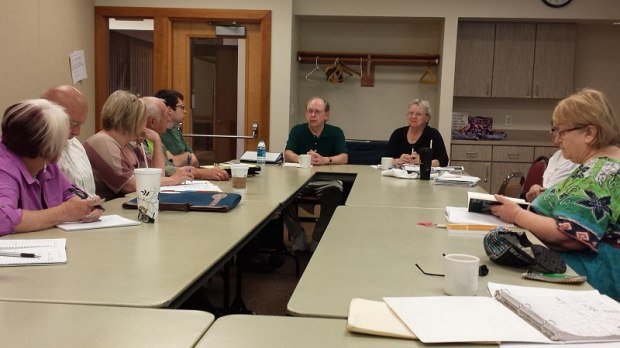
Mark Thalman poet speaks to Writers in the Grove group on June 22 2015 - Photography by Lorelle VanFossen - Forest Grove Senior and Community Center.

Organization for Writers

An essential part of the job of a professional writer and poet is to stay organized. To Mark Thalman, this means organized in your work habits as well as paperwork.

He shared with us details on how he tracks his writing on the computer in digital files, backed up to flash drives and other computers, and saved off-site as well. He recommends naming the files with dates to track revisions and versions. Most operating systems now embrace long file names, and he recommends you be as specific as possible to help you locate the file later.

He saves files to his document folder for his writing but doesn’t create a folder for them until there are three or four files, typically versions of the poem. Then he puts them in a folder with the title of the poem, or words describing the poem until he has a title set. All versions are kept in that folder, dated by their version date. This gives him the opportunity to revisit any of his older versions as he develops the final piece.

While he tends to keep all of his written work in digital form but also goes old school and prints out final published pieces, which he stores in a notebook. The notebook tracks the record of his poetry, each one numbered.

He sends out his work regularly to publishers, generally magazines, anthologies, prize, and contests. He tracks them in a printed chart. The chart lists the poem number, tracked back to the binder with the printed copy, the title or working title, and across the top, the publications to which he submits. Each time he sends a piece out, he writes down the date. When he gets a response, he notes it in the form. He said that he typically has 15 pieces out to editors at any one time.

When working on a book, he prints out copies of the poems and starts to organize them in another binder, considering placement, flow, and categorization, grouping similar pieces together. Thalman explained that this helps him put his work in book form as soon as possible, looking for gaps, and connecting the pieces together by theme. (more…)

Inspiration: Life Observed Through the Radio

From the prompt on where do you go for inspiration.

The volume of the street notched up the decibels, radios drowning out traffic noises, voices lowered for a moment, ears tuned in, heads tilted toward the nearest plastic speaker box.

Top of the hour. I glanced at my watch to confirm, quickening my pace. I was still two blocks from my destination and now late.

The ability to tell time by the top of the hour started long before I came to the unholy land called Israel. For me, it was natural, keeping me in touch with the world around me as I traveled through its vastness. But never had I been around an entire culture obsessed with the news on the hour.

They had to be. Each 5 minute news summary dictated where you did your shopping, how you commuted back home, and where to avoid as you traveled through town and country as terrorism dictated our paths. (more…)