Author: Lorelle VanFossen

Lorelle VanFossen is a pioneering XR Innovator and WordPress leader, tech educator, keynote speaker, and producer bridging virtual reality and digital innovation. Co-founder of Educators in VR, founding WordPress community member, and passionate advocate for emerging technologies and human rights. Expert in immersive education, VR/XR event production, UX, and digital transformation.

The Dancer Still

The following is by Writers in the Grove member, Lorelle VanFossen, and is based upon the Prompt-a-Month: Dance.

Texturized art effect of ballet dancer on pointe in arabesque.Toe pointed. Leg elongated. Feel the burn through the calf muscles as they push the reach even further. Thigh muscles combine to lift and stretch the leg beyond the normal range, a straight arrow pointed toward the floor away from the body, toe not touching, every line straight and arched in all the right places as if coaxing the toe longer a little more. Just a little more. Reach, strain, stretch, push, tighten, balance, yet relax. Don’t let them see the pain. Head tilted down at an angle, shoulders pulled back, arms thrust forward reaching but hesitating, palms up, thumbs wide, fingers closed, curled, begging. The other leg bent, knee aligned in the direction of the other, heel down, glued to the floor, a stable foundation. An illusion of stability. A brush of wind would knock her over. A forward step paused in mid motion. Make it look effortless. Make it look like it is a gentle yearning, a pleading with the body to take just one tiny step in that direction, ahead but holding back, cautious. It is a dangerous step. One that leads to another, and another, and another step forward into the unknown.

Elaina kept this position for as long as she could, keeping the tension in her body in a tug of war between relaxed and tight, straining with the effort. She didn’t hear the clock ticking in the hall, the purring of the cat wandering nearby, nor the roar of cars outside the door on the street. She heard pain, a sweet familiar pain, ringing through her body, buzzing in her ears, knocking against her heart begging her for release. She felt the warmth of a spotlight against her closed eyes, the moment frozen, ready to burst out onto the stage with the unheard embrace of the music’s thrust.

She ignored the fact that it was only the morning sun through the front window peaking through the pale blue curtains. Through the rushing noise of the passing cars, she heard the gasp of an audience at her entrance, one step, then frozen in this pose, waiting for the music to queue that next step, but held, anticipating the moment she would take that next move, ablaze in feathers, sequins, and chiffon, disguised as a worn-out house dress.

When her body could no longer hold the moment, the audience straining with her now, feeling the tension, breathing with her, on the edge of their seats, she took that step forward, placing her right foot on the carpeted floor, pushing herself forward over the toe, leaning down and up into the move, her body straightened, head up, arms lifted higher, her other leg straight out behind her at a point. She held this for thirty seconds, allowing the clanging to quiet in her head, the body now in a more stable, relaxed state.

Her cat wandered by and wound around her standing ankle. Elaina opened her eyes and looked down into those wide golden eyes framed with soft gray hair. The cat meowed, the open mouth turning into a yawn with a whining sound as she completed another rotation then headed off toward the kitchen where she knew food would soon appear. (more…)

Writer’s Toolbox: Describe and Critique Art

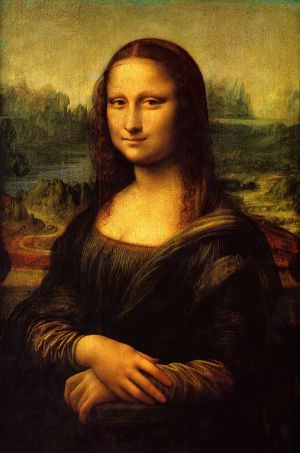
Mona Lisa - Leonard Da Vinci - Wikipedia.Your characters head for the local museum or art gallery. Their eyes are filled with wondrous sights. Colors, patterns, shapes, textures, renewing their spirit, giving them the beauty they crave in their life. Or boring them to tears as they’ve just been dragged to another thing-they-don’t-wish-they-had-to-do-in-order-to-save-a-realtionship-or-get-sex.
Either way, it helps to have words to describe and critique that art.

Describing artwork is one of the fascinating uses of language, in any language. How does the writer capture a painted expression, a twisted sculpture, an abstract painting? Could you describe the Mona Lisa with the right words to make the magic of Leonardo Da Vinci’s portrait explain why it continues to attract millions of visitors eager for a glimpse of the woman’s face with a lack of expression?

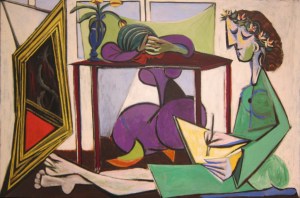
Interior with Girl Drawing - Pablo Picasso.Artwork is encountered in most books in some way, a photograph of a suspect, a painting on a wall, a quilt, lacework, or arts and crafts item that tells us more about the character, place, or solves a mystery. How do you describe it to not only let the reader see see it, but also choose words that match the tone, scene, time, and owner?

In general, use the following tips for presenting a work of art, though how you choose to describe it and use it in your writing is your personal, creative decision.

  1. Identify the artwork type and medium (canvas, photograph, painting, sculpture, drawing, etc.).
  2. Identify the artist (if possible or relevant).
  3. If a well-known piece, name it.
  4. Describe the objects in or subject matter of the artwork (field, flowers, sunset, ocean, person, portrait, sky, furniture).
  5. Describe the colors, lines, patterns, shapes, and textures.
  6. Describe the first impression of the artwork, what your character or your reader would see at first glance.
  7. Where is the light source? Is the source from the sky, electric, natural light, artificial light, and light direction (top, under, side, backlit (behind)).
  8. What are the sensory qualities, the mood and visual effect, of the work?
  9. Why is it placed in this this particular spot?
  10. Why did the owner buy it?
  11. If the artwork has sentimental value, what is it? How does that help with the character development and backstory?
  12. If the artwork has financial value, what is it and why is that important to your story and character? Did they buy it only for investment? Or to support an artist they found interesting? Or maybe a relative trying to be an artist? Or is it part of their nest egg, saving for the future, betting on the artist? Would they sell it? When? Why?
  13. How does it fit into the rest of the room, building, or scene? Would the character seeing this, if they didn’t own it, think it fits perfectly there or not?
  14. What does this artwork tell the reader about the character or place?
  15. Many people interpret and respond to artwork differently, some with contrasting viewpoints. How would your characters respond? The same, differently? Would they each have a different reaction to the artwork? Does that add to the conflict?
  16. If important to the story, interpret the artwork from the perspective of the artist. Why did they create this? What was their inspiration, motivation, and goals to do so? This might reflect back on the personalities and backstory of your characters.

To help you learn more about learning how to describe arts and arts and crafts, we’ve put together some resources.

Here is a YouTube video for writers on how to describe art.

The following will help you describe artwork and critiquing it to help you flesh out the experience of your characters.

Prompt: Love is a Temporary Madness

The prompt this week came from Louis de Bernières’ Corelli’s Mandolin:

Love is a temporary madness.
It erupts like an earthquake and then subsides.
And when it subsides you have to make a decision.
You have to work out whether your roots have become so entwined together that it is inconceivable that you should ever part.
Because this is what love is.
Love is not breathlessness, it is not excitement, it is not the promulgation of promises of eternal passion.
That is just being “in love” which any of us can convince ourselves we are. Love itself is what is left over when being in love has burned away, and this is both an art and a fortunate accident.
Your mother and I had it, we had roots that grew towards each other underground, and when all the pretty blossom had fallen from our branches we found that we were one tree and not two.

Novel Writing: Storyboarding and the W Plot Chart

Mary Carroll Moore is a popular published author offering educational information on writing and publishing your novel. The following video covers creating a storyboard for your novel using a 3-act structure, specifically the W Plot Chart, helping you find the 5 most important points in your novel.

The following are articles and resources covering more about the W Plot Chart and 3-act structure.

Where to Publish Your Short Story

During our Writers in the Grove workshops, we often suggest to our members that a particular work needs to be sent out to a magazine or online publishing site for publishing.

While there are many writing contests a writer could enter with a poem or short story, the following are articles featuring a variety of places that want your story short work. And some pay fairly well.

There are many articles on the web to help you get your short story through the submission process well, but take note of the specifics in “How to Get Your Short Stories Published in Lit Mags” by Writer Unboxed. There are some great guidelines to help.

Writing Tips: Shoelaces, Knots, and Ties

Another tool to add to your writer’s toolbox is Ian’s Shoelace Site. The tagline is “bringing you the fun, fashion, and science of shoelaces.”

How does your character tie his or her shoes? The choices they make may tell the reader much about their personality, their past, culture, and experiences with shoes.

Do they tie them tight or loose? Use a specific technique for tying? Why? How? How do you describe how they tie their shoes?

Are they athletic? Maybe they were in the past and tie their shoes based upon the technique they used for their football, baseball, ice skates, hockey skates, or running shoes, even though they haven’t touched the sport in decades.

Maybe they are old and need the helix twisted shoe laces to hold their shoes on because their arthritis can’t tie a bow any more. Or maybe they had to go through physical therapy to relearn how to tie their shoes after an accident or stroke. How would they do that and what are the different shoelaces and shoes available to help them?

What types of laces do they have in their shoes? Leather shoes often have thin strings for laces. Many people today slip colorful shoelaces into their tennis shoes for fashion or attention.

Can you name the parts of a shoelace? Are they shoe ties or shoelaces? What’s the tip called that helps slip through the loops or rings to threat a pair of shoes? What is it made of? Are there different kinds?

Did you know that there are almost 2 trillion ways to thread a shoelace through eyelets to tie a pair of shoes?

Ian’s Shoelace Site offers answers to all these character development questions. Ian even has a book published in 2007 called “Laces” to help you learn even more about shoe laces with detailed pictures and graphics.

Check out the following web pages on Ian’s site to learn more about how your character might tie their shoes.

The Humanity of Flowers

The following is by Writers in the Grove member, William Stafford, and was inspired by the prompt, Coming Over the Rise I Saw.

That humans could be as compatible as flowers. Flowers do nt seem to care what kind is planted next to them or about their color or fragrance, if any. Some need space of their own but still do not attack their neighbors.

Oh that we could share our space in the world as gracefully.