Writing Tips

NaNoWriMo: Let Your Character Take You on a Month Long Journey

A few people have been asking me about NaNoWriMo, the National Novel Writing Month challenge to write 50,000 words in 30 days, and they want to know how it works, and how they can get involved even though they might not have a specific story to write about. We put together everything you need to know to participate in NaNoWriMo in “It’s NaNoWriMo Time: How To, Tips, Techniques, and Survival Advice,” and you will find other NaNoWriMo topics we’ve covered scattered throughout the site.

To address the question of how to participate in NaNoWriMo when you don’t have a specific story to write is a different and more complex question. Ask yourself:

  • Is there a story idea that haunts you, nags you, disturbs your sleep?
  • Is there something you’ve always thought or said, “That would make an interesting book.”
  • Is there a person or place that fascinates you?
  • Is there a hobby or special interest that you return to over and over again through your life?
  • Is there a skill, talent, ability, or knowledge you have that not many others do?
  • Is there a question that you wish someone would answer?

Here are some things you need to know about NaNoWriMo as you answer those questions:

  • You do not have to write a book.
  • You do not have to write fiction.

The reality is that you just have to write. There are prompts to stir the imagination and inspire you to write on that subject or something else in our Prompt-a-Day starting November 1.

To help some of our writers, I’d like to take a different approach to storytelling and novel writing, and that is to have you answer a question a day about a character that may be tickling your imagination.

Answer a Question a Day in Words

A writer of many novels told me years ago that sometimes her novels write themselves and sometimes she writes them, but always, her characters tell her where to take the story.

I’ve thought about that often, writing with such commitment that you, the author, steps out of the way and you let the characters tell the story.

If that sounds like fun, we’ve put together a series of questions to help you answer a question once a day with words, letting your character or characters take you on a journey.

In the wise words of our Writers in the Grove leader, M.J. Nordgren, always look for conflict – in every sentence, every paragraph, and every page. That is what makes for an exciting read – and write. These prompts are designed to help you explore the conflicts within the character, between the character and other players in the story, conflicts between the character and their environment and situation, and conflicts between the character you started with and who the character becomes as they are tested throughout your story.

There doesn’t have to be any chronology to these. That’s what editing is for. But exploring these concepts, answering these questions, may just inspire a bestseller.

As with all such prompts, let them take you where they take you. There are no rules, except those set by NaNoWriMo to write every day a minimum of 1,677 words.

  1. Where is your character right now? Why are they there?
  2. If your character were afraid of anything, what would it be and look like?
  3. What are your characters habits? What body language, behaviors, tasks do they repeat regularly? Which are annoying to others? Which are annoying to self? Which are beneficial? How do they help the character?
  4. When your character’s routine is disrupted, what happens?
  5. What wounds does your character carry forth into their adulthood? Why?
  6. What does your character hope for in life? Do they have goals, dreams, aspirations? What is stopping them?
  7. What would be the worse thing that could happen to your character? How would it happen, when, and why?
  8. Where does your character spend the most of their time daily? Describe and define it.
  9. If your character could go anywhere in the world, money no options, where would they go and why?
  10. Describe your character’s family. Be specific in describing the family members as well as your character’s thoughts about them.
  11. Describe your character’s friends. Who are they, what do they look like, how did they meet, and how do they support or not support your character with their relationship?
  12. What are your character’s expectations, the things they expect from the world, their family, and friends? How do these expectations differ from reality?
  13. How is your character treated by other people? Is the treatment appropriate?
  14. When put in an emergency situation, how would your character respond?
  15. If your character was to go on a journey, how would they travel? Foot, air, wagon, car, train…? Why would they choose this method?
  16. Describe someone your character would hate. Why?
  17. Has your character ever been in love? What was it like? Describe the person. What happened?
  18. Your character has a secret. What is it and why it is a secret? Who would be hurt if the knowledge was revealed?
  19. If your character had a dinner party, who would they invite and why? What would the dinner conversation? Describe it.
  20. Describe your character’s heroes.
  21. Your character won the lottery or a grand prize. What would it be and how would your character handle the winnings?
  22. Open the door to the home of your character and walk us through it. Pay attention to what is in the closets and behind closed doors.
  23. Does your character eat when they get up in the morning or wait? When and what do they eat through a typical day, and what do they do when eating? Do they eat in, out, or in a special place? What are they eating? Why?
  24. In your imagination, you are standing and overlooking a place in which your character lives. Describe it for every season.
  25. Where was your character born and how does that birthplace impact the personality, history, and relationships of the character?
  26. What makes your character laugh out loud? Why?
  27. Describe a moment when your character’s heart was broken, never to be fully mended.
  28. Look at your character’s hands and feet. Describe them. What are on them? Shoes, gloves? Jewelry? Tattoos?
  29. Does your character have a job or hobby or both? Describe it in detail, and how they got into that job or hobby. What is good or bad about it?
  30. A disaster has befallen your character and their place of residence is destroyed. What items do they mourn the loss of most?

Print this out and assign a question a day and see where your writing takes you.

For examples of more character questions to ask your character and see where they take you, see the following.

Where will your character take you?

NaNoWriMo: How to Write a Novel in 67 Steps

Part serious, part humor, “In Reality How People Write A Novel: 67 steps” by the The Authors’ Nook breaks down the novel process into quick and easy steps such as:

  1. Declare to your friends and family that you’re writing a book.
  2. Immediately regret telling them because now you feel pressure.
  3. Stare at a blank page.
  4. To freshen up, Google: “How to write a book.”
  5. Remember that it’s a massive undertaking.
  6. Friends ask you, “So, how’s your book coming? Remember me when you’re famous!” And you want to die.
  7. Start to plot the novel just to get your mind off the pressure.
  8. Writer’s block.
  9. Netflix binge.
  10. Write 15 pages.
  11. Rewrite the 15 pages.
  12. Delete 14 pages.
  13. Drink a little too much.
  14. Netflix binge.
  15. Structure your story.

Sound familiar?

NaNoWriMo: Beat Sheets and Story Engineering Worksheets

There are some terms you need to know if you will be participating in NaNoWriMo this year.

  • Plotter: A writer who plots out their story with an outline, which they tend to follow for the most part during NaNoWriMo.
  • Pantser: A writer tackling NaNoWriMo with little planning and forethought, just writing by the seat of their pants.

A few years ago, a new term arose, brought to light by Angela Quarles, self-labeled a Geek Girl Romance Writer. She also offers writing advice, tutorials, and tools to help writers.

In her post about her experience and the lessons learned, she describes the two key types of writers who participate in the National Novel Writing Month challenge, and invented her own type called plotser:

What’s a plotser? A cross between a pantser and a plotter, with maybe a wee bit more emphasis on the pre-plotting.

With Hurricane Sandy and other circumstances, my new agent (signed only on Oct 4) and I weren’t able to coordinate on what direction to take for a sequel to MUST LOVE BREECHES. So for most of October, I wasn’t even sure if I was participating in NaNoWriMo. Then at the end of the month, I decided to take up a premise that had nothing to do with BREECHES so I wouldn’t waste my time writing a sequel she didn’t want.

However, that meant I’d not spent time plotting at all.

I had what I thought was a fun premise and a sense of who the H/h were and so started one day late on November 2. I caught up with everyone over the weekend and was doing swimmingly until about Day 5, then my word count dribbled downward and things ground to a halt. I had no idea where I was going with this and I didn’t like feeling that way. This wasn’t the normal ‘what I’m writing is drivel’ feeling, I really felt like all my characters were just spinning their wheels waiting for something to happen. Like the plot. Ugh.

A local writer friend sagely advised me to take a break for a week, two weeks, to figure out the plot and then do a FastDraft blitz at the end. So I did! I ended up creating a spreadsheet to help myself stay focused on what I needed to discover…

As a result of her experience, she created the Story Engineering Worksheet (Excel Spreadsheet), a spreadsheet created in Excel that breaks down all the elements of a novel into their finest detail. To download, click, on the link or right click and save to your hard drive.

Described as a “mix of the four act/part structure, and beat sheets,” the worksheet is based on the spreadsheet by Jamie Gold called a beat sheet, a worksheet that structures your plot all on one page.

Described by Storyfix in their Lessons for Writers:

The “beat sheet” is a way to sequence your story, using bullets instead of whole sentences or paragraphs.

Yes, this is an outline, but it is more than that. It is a scene structure for your novel built around basic plot points or story arcs. (more…)

Writing Advice: A Place to Write

In a recent issue of The Costco Connection, Andrea Downing Peck intervie3ws author Kristin Hannah, author of Nightingale, Winter Garden, and 19 other books.

Nightingale tells the story of a woman who joins the French Resistance and saves downed Allied airmen and others, including her family, via an escape route she creates to Spain during World War II.

In the interview, she describes finding not only a writing space, but the space in which the writing takes place, in that time and place that inspires. For her, it is the Pacific Northwest. She makes her home on Bainbridge Island near Seattle.

If you are a certain kind of person and can live anywhere in the world, this place speaks to you. There is a certain individual that is drawn to the landscape, lifestyle, mountains, ocean, and sound. I also think the rain makes us more productive. There are a lot of days where there is really nothing else to do. You might as well write.

Several of the writers in Writers in the Grove have shared pictures and stories of their favorite writing places. Where is yours? What is it about the space that makes it your special place to write?

It’s NaNoWriMo Time: How To, Tips, Techniques, and Survival Advice

NaNoWriMo Flyer.November 1, 2015, at midnight is the start of NaNoWriMo, the National Novel Writing Month.

The goal of NaNoWriMo is to write 50,000 words (and complete a novel) in 30 days.

Sound impossible? The numbers divide down to 1,666 words a day, typically 60-90 minutes of writing.

To participate, you may do so actively or passively. This can be a solo experience or a highly social one. You can connect online and/or connect in person through the many local activities, events, and write-ins where people gather in a social space to write and get to know each other.

Here is how it works.

  1. Before November 1, sign up on the NaNoWriMo site. There is no fee. It’s free. By registering, you will get email notifications and notes to cheer you on throughout the month, and be able to track your word count daily.
  2. At midnight, October 31, you start writing.
  3. Each day, you report the number of words you’ve written. If you are using Scrivener, it’s easy to update this information daily. I’ve included tips on how to track your writing below.
  4. If you wish, participate in the regional forums such as the one for Washington County, Oregon, and consider attending some of the many local events throughout the month. NOTE: There are also prep events online and locally worth attending.

That’s it.

NaNoWriMo typically features over 310,000 participants on six continents. Many educators work with their students to participate during November as well as throughout the year. (more…)

Prompt: Positive or Negative Effects on Love and Kindness

The prompt came from the book “Art as Experience” by John Dewey. In one section he describes that for art to be whole, it has to have its own unity. Each word in a poem has to come from what came before it, and contribute to the words that come after.

The example is an excerpt from Wordsworth’s “The Prelude.”

…the wind and sleety rain,
And all the business of the elements,
The single sheep, and the one blasted tree,
And the bleak music from that old stone wall,
The noise of wood and water, and the mist
That on the line of each of these two roads
Advanced in such indisputable shapes.

The wind as the noun is not described in adjectives but in the descriptions of what followed in the poem, the single sheep, blasted tree, bleak music from the stone wall, noise of wood and water…all paint the sense and emotional quality of the state of the wind.

Part one of the prompt was to write at least 7 words that leave you with a negative feeling, each one building upon the other. Then write at least 7 words that leave you with a positive feeling, building upon the previous one.

Part two of the prompt was to write something about the negative or positive effects on the topic of love and kindness, growing the feeling as the word choices push the reader forward with the growing emotions.

Writing Tips: Writing Chapter Hooks

This is part two of “Writing Hooks,” based on the workshop notes by Bunny Hansen, a Writers in the Grove member. If you haven’t read part one, please do so as it contains many notes and resources for understanding more about the writing of opening hooks.

Hooks can be found anywhere in the telling or a story. These hooks keep the reader reading and carry them through from sentence to sentence, paragraph to paragraph, page turning page, and pulling the reader through the book, chapter after chapter.

An example of a foreshadowing (okay, blatant foreshadowing) is found in the new book, “The Martian,” by Andy Weir, a statement that not only keeps the reader reading, but they now know what is coming, and based upon what has come so far in the book, they know it is going to be a fun ride.

Everything went great right up to the explosion.

The satirical nature of Weir’s writing and the strength of his first person character is found throughout the book, excellent examples of character-driven hooks, and readers keep reading for those precious ironic gems such as this much quoted passage at the midpoint of the book.

I need to ask myself, ‘What would an Apollo astronaut do?’ He’d drink three whiskey sours, drive his Corvette to the launchpad, then fly to the moon in a command module smaller than my Rover. Man those guys were cool.

And this prime example of voice, style, and character after using his own body waste to start a garden of potatoes:

They say once you grow crops somewhere, you have officially ‘colonised’ it. So technically, I colonised Mars.

In your face, Neil Armstrong!

In the trailer for the movie from the book, examine the use of hooks that not only ask questions but keep the viewer watching.

An example of foreshadowing is found in this excerpt from “To Kill a Mocking Bird” by Harper Lee in the early section of the story:

I wanted you to see what real courage is, instead of getting the idea that courage is a man with a gun in his hand. It’s when you know you’re licked before you begin, but you begin anyway and see it through no matter what.

The lawyer, Atticus Finch, tells his children that it is better to be noble than take arms, proving it when he takes a case sure to fail by defending Boo Radley because it is the right thing to do. The reader easily sees into the heart of the character and feels compassion for him. You feel his courage and determination, a warrior with the law as his only weapon, and you keep reading on. (more…)

Writing Techniques: Writing Hooks

The following are the notes from the presentation on writing hooks by Writers in the Grove member, Bunny Hansen. The two hour workshop presented in August 2015 was based upon extensive research by Bunny on the variety of hooks used in writing, with tips on how to write such hooks. Writers in the Grove thanks Bunny for sharing her notes with us.

In part two, Bunny covers the hooks found throughout a story or novel, focusing also on the hooks at the ends of chapters.

There is art in the writing of hooks and story openings. They are found in poems, short stories, fiction, and non-fiction. Even editorial articles begin with strong hooks that compel the reader to keep reading. Some are written by the author in the beginning, a thought that leads to the opening of a story, and others are crafted, each word considered carefully, tested among readers, torn apart and glued together to make the reader dive into the words.

A good hook sets the tone, the way the author expresses his attitude toward the subject, characters, action, and setting. Tone can be ironic, sarcastic, personal, impersonal, melancholy, joyous, angry, contemptuous, frightening, etc. Here are some of the characteristics of a well-written hook:

  • Ideally the opening sentence.
  • An attention-getter.
  • Creates a bond of interest, giving the reader a reason to care and invest in reading the story.
  • Says, “Drop everything you’re doing and read me right now.”
  • Draws a reader into the action and the message, making him a part of the story or piece.

A good hook always asks a question whether implicitly or explicitly. The question is what makes an opening a hook. The body of your work (fiction, nonfiction, novel, essay, article, poem, book or music) answers the questions raised by the hooks. A good hook, thus a good question, engages the reader, and they spend the rest of the book seeking answers to those initial questions.

Consider the questions raised in the opening lines of the acclaimed and award-winning book, “Ender’s Game,” by Orson Scott Card.

I’ve watched through his eyes, I’ve listened through his ears, and I tell you he’s the one. Or at least as close as we’re going to get.

Who is this person speaking? How are they watching and listening through this character? What could have that much power? Who is the one? Why is he the one? One for what? And why are we settling for this one? Have we run out of time? The questions just keep coming in the reader’s mind. (more…)

Scrivener: Names and Autocomplete

In this ongoing series on Scrivener, you should have the basics under your belt. Let’s dive a little deeper into those basics with your new imported project or with the blank project we created early on in these tutorials. In this tutorial I’ll cover the Name Generator and Autocomplete Suggestion features in Scrivener.

One of the great tools Scrivener includes is a Name Generator. It helps you to generate possible character names.

To access it, go to Tools > Writing Tools > Name Generator.

Scrivener - Tools - Options - Writing Tools - Name Generator - Lorelle

The Name Generator generates random character names and can be customized to generate names specific to region and cultural areas for male, female, or both. You can set the the generator by first and last name letters or include specific letters. You can even search for names with specific meanings. (more…)

Scrivener: Import Documents and Files

Throughout this ongoing series on Scrivener so far, you’ve been experimenting with a blank project. I highly recommend my students learn first with a blank project so they can screw it up and experiment thoroughly before they start importing their own writing. Few listen. Either way, it’s time to talk about how to import your writing into Scrivener, and practice first on your experimental project.

There are two ways to get your content into Scrivener.

You can copy and paste from your word processor. Take care doing this as it will often bring in code and formatting that you might wish to remove later. You can also import the content directly into Scrivener.

We will cover both methods, but to do this right (or at least wiser), start with formatting a blank Scrivener project.

Remember, importing your writing into Scrivener makes a copy of the original files. It does not modify them. They remain untouched. Save them off your computer in a protected and secure place as backups.

Formatting a New Project

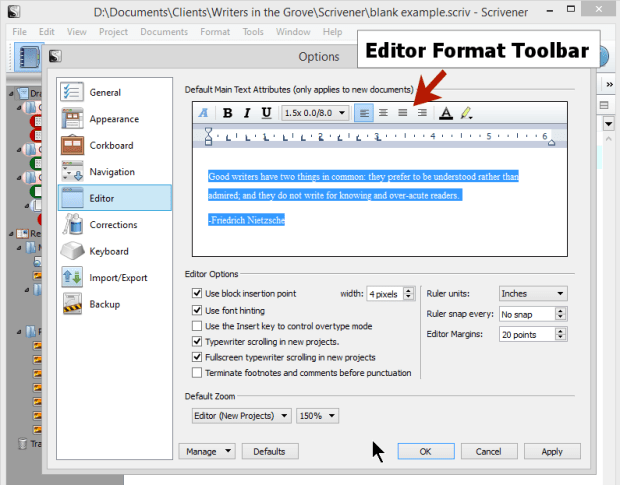
Go to Tools > Options > Editor.

Scrivener - Options - Editor - Interface - Lorelle

This is where you format Scrivener for what you will use on the screen. This is NOT how the document will look when published. Get that thought out of your head immediately.

The Editor creates your writing environment. How do you wish to write? Single spaced lines? Double spaced? Wide margins? Narrow? Indented paragraphs? Not? Large fonts? Serif or sans-serif fonts?

With the Editor, you can set up a writing environment the way you wish to write. When the writing is compiled (exported), you may control the end result there.

Changing the formatting of the Editor is best done before you add your writing. It applies only to new documents, not previous ones. I’ll cover how to fix the older styles and formatting in another tutorial. (more…)