The Forest Grove Elementary School District in Forest Grove, Oregon, is looking for volunteers to be local pen pals with their students. They are eager to help children learn how to write and read cursive as well as communicate via handwritten letters with others. For more information, contact your local school or use our contact form.
Writer’s Toolbox: Geometric Shapes
It went “Zip” when it moved
And “Bop” when it stopped
And “Whirrr” when it stood still
I never knew just what it was and I guess I never will.
 The Tom Paxton song made famous by Peter, Paul, and Mary, as well as John Denver, describes a thing that defines description, a child’s toy that was amusing all the same.
When it comes to describing the physical shape of an object, we can’t get away with just the sound effects. We need the words.
The basic geometric shapes are:
- lines
- curves
- angles
- triangles
- square
- rectangle
- pentagon
- pentagram
- hexagon
- octagon
- polygon
- circle
- arc
- ellipse
Then we add variations on the above. These are geometric shapes based upon lines and planes, but what about solid figures or 3-dimensional shapes?
- cube
- cylinder
- rectangular prism
- pyramid
- tetrahedron
- octahedron
- polygon
- sphere
- cone
What shape is a carrot? Do you know? Is it a triangle? No, it’s an inverted cone. Is the sun a ball? Yes, it is a ball, more specifically, the sun is a sphere.
The words you use to describe a shape may be technical or playful, finding similes to represent their shapes, such as “he was as thin and lanky as a much-used toothbrush.”
Did you know that there are some personality tests that use geometric shapes to represent a person or personality?
From “Geometric Shapes: Simple and Unusual Personality Test,” if the triangle is your preferred shape:
This form symbolizes leadership. Main ability of triangles is to focus on goals and deeply and quickly analyze situations. A Triangle is a very confident person who wants to be right in everything. Triangles find it difficult to admit their mistakes, are easy to train, and absorb information like a sponge. Their career gives their life meaning.
Here are some charts and web pages to add to your writer’s toolbox to help you define the geometric shape of the objects, and possibly the characters, in your writing. We’ve also included some lists of words to describe the shape of objects.
- Geometric Shapes Chart – Geometry Playground (pdf)
- Shapes – Basic geometry – Khan Academy
- Geometry – Math’s Fun
- List of Geometric Shapes – Math Salamanders
- Favorite Shape Reveals Personality – Weekly World News
- Words used to describe the shape of objects – synonyms and related words – Macmillan Dictionary
- Descriptive Words List of Adjectives for Shapes & Patterns – Descriptive Words
- Word List: Shapes and Forms of Objects – Phrontistery
- Shapes Vocabulary Word List – EnchantedLearning.com
Scrivener Tips: The Scratch Pad
This is another Scrivener Tip from Writer’s in the Grove. We will be presenting a series of Scrivener workshops soon in Forest Grove, Oregon. Until then, or after, if you have a question about how to use Scrivener, let us know and we’ll do our best to help you out.
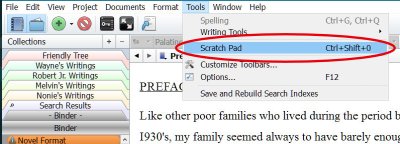 Ever get a new idea, a bit of inspiration, as you are writing? I used to turn to a piece of paper or sticky note to jot down my idea, but found that by the time I made the note and switched back to my writing program, I’ve lost track of what I’m writing. Moving my eyes from the computer screen and fingers from the keyboard invites distraction. Luckily, Scrivener offers a way to make notes and keep on writing.
The Scrivener Scratch Pad is built into Scrivener and can be accessed by:
- Windows: Tools > Scratch Pad or CTRL+ALT+SHIFT+P
- Mac: SHIFT+CMD+ENTER
You can add a note to it quickly with a mouse from within the Scratch Pad window. Click the T for Text in the bottom left corner to create a new note and start typing.
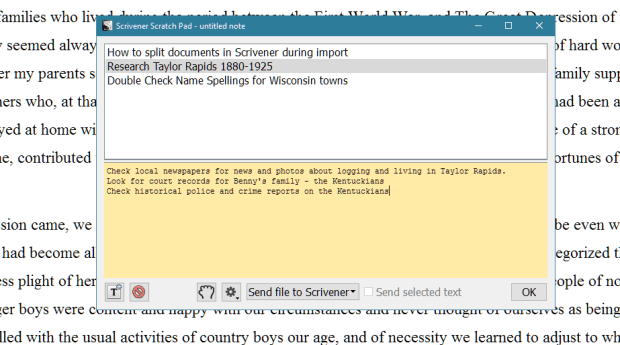
You can add as many notes as you wish in the Scratch Pad.
You can send the note to Scrivener later as the start of a new plot shift or poem.
- Select the note.
- Click Send file to Scrivener.
Two options will appear to either copy it to a specific file or new one, or append text to another text, adding it to the bottom. You can also select a portion of the note and send just the selected text.
One of the cool things about the Scratch Pad in Scrivener is that the notes persist between projects. You can make notes on other projects that pop into your head or you discover while researching another project. Think of all the ways you can use the Scratch Pad in Scrivener to deal with these thoughts while staying focused on the task at hand.
For more tips, see “Using the Scratch Pad in Scrivener” by The Digital Researcher, and the following:
- The Scratch Pad – Simply Scrivener
- Scrivener’s Scratchpad: ONE Advantage for Note-Taking – Writer’s Territory (video)
- Scrivener’s Scratch Pad (video)
- Scrivener Saturday: The Scratch Pad – Rebeca Schiller
- Yard. Doç. Dr. Celal Öney (Mus Alparslan University, Mus/Turkey): How to Use Scratch Pad Panel in Scrivener Windows
The Dancer Still
The following is by Writers in the Grove member, Lorelle VanFossen, and is based upon the Prompt-a-Month: Dance.
 Toe pointed. Leg elongated. Feel the burn through the calf muscles as they push the reach even further. Thigh muscles combine to lift and stretch the leg beyond the normal range, a straight arrow pointed toward the floor away from the body, toe not touching, every line straight and arched in all the right places as if coaxing the toe longer a little more. Just a little more. Reach, strain, stretch, push, tighten, balance, yet relax. Don’t let them see the pain. Head tilted down at an angle, shoulders pulled back, arms thrust forward reaching but hesitating, palms up, thumbs wide, fingers closed, curled, begging. The other leg bent, knee aligned in the direction of the other, heel down, glued to the floor, a stable foundation. An illusion of stability. A brush of wind would knock her over. A forward step paused in mid motion. Make it look effortless. Make it look like it is a gentle yearning, a pleading with the body to take just one tiny step in that direction, ahead but holding back, cautious. It is a dangerous step. One that leads to another, and another, and another step forward into the unknown.
Elaina kept this position for as long as she could, keeping the tension in her body in a tug of war between relaxed and tight, straining with the effort. She didn’t hear the clock ticking in the hall, the purring of the cat wandering nearby, nor the roar of cars outside the door on the street. She heard pain, a sweet familiar pain, ringing through her body, buzzing in her ears, knocking against her heart begging her for release. She felt the warmth of a spotlight against her closed eyes, the moment frozen, ready to burst out onto the stage with the unheard embrace of the music’s thrust.
She ignored the fact that it was only the morning sun through the front window peaking through the pale blue curtains. Through the rushing noise of the passing cars, she heard the gasp of an audience at her entrance, one step, then frozen in this pose, waiting for the music to queue that next step, but held, anticipating the moment she would take that next move, ablaze in feathers, sequins, and chiffon, disguised as a worn-out house dress.
When her body could no longer hold the moment, the audience straining with her now, feeling the tension, breathing with her, on the edge of their seats, she took that step forward, placing her right foot on the carpeted floor, pushing herself forward over the toe, leaning down and up into the move, her body straightened, head up, arms lifted higher, her other leg straight out behind her at a point. She held this for thirty seconds, allowing the clanging to quiet in her head, the body now in a more stable, relaxed state.
Her cat wandered by and wound around her standing ankle. Elaina opened her eyes and looked down into those wide golden eyes framed with soft gray hair. The cat meowed, the open mouth turning into a yawn with a whining sound as she completed another rotation then headed off toward the kitchen where she knew food would soon appear. (more…)
I Wish
The following was written and shared by Writers in the Grove member, Patti Bond.
I wish upon the stars,
Stars so shiny and bright.
I wish the world would
Be at peace.
I wish that everyone
Would get along.
I wish for the homeless to be
Able to find a place to live.
I wish for happiness
And joy for all.
I wish for wishes to come
True so the world would
Be a different place.
I wish upon the rainbow that
People would just be happy.
Labor Day 2016 Meeting: Diana Lubarsky
We will be meeting at the home of Diana Lubarsky in Hillsboro, Oregon, Monday morning. Please use our contact form for the address. See you there!
Prompt-a-Month: Vacation
 The September prompt-a-month for our Writers in the Grove members is:
Vacation
The deadline for submissions is September 30, 2016.
Check out the guidelines and instructions for submissions in the announcement, and we look forward to you taking us on a trip.
Writer’s Toolbox: Describe and Critique Art
 Your characters head for the local museum or art gallery. Their eyes are filled with wondrous sights. Colors, patterns, shapes, textures, renewing their spirit, giving them the beauty they crave in their life. Or boring them to tears as they’ve just been dragged to another thing-they-don’t-wish-they-had-to-do-in-order-to-save-a-realtionship-or-get-sex.
Either way, it helps to have words to describe and critique that art.
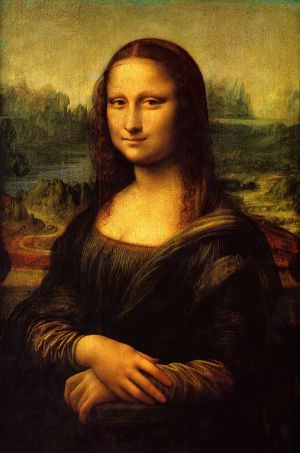
Describing artwork is one of the fascinating uses of language, in any language. How does the writer capture a painted expression, a twisted sculpture, an abstract painting? Could you describe the Mona Lisa with the right words to make the magic of Leonardo Da Vinci’s portrait explain why it continues to attract millions of visitors eager for a glimpse of the woman’s face with a lack of expression?
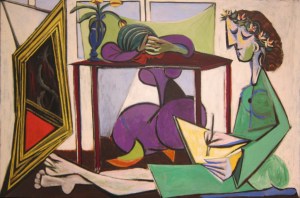 Artwork is encountered in most books in some way, a photograph of a suspect, a painting on a wall, a quilt, lacework, or arts and crafts item that tells us more about the character, place, or solves a mystery. How do you describe it to not only let the reader see see it, but also choose words that match the tone, scene, time, and owner?
In general, use the following tips for presenting a work of art, though how you choose to describe it and use it in your writing is your personal, creative decision.
- Identify the artwork type and medium (canvas, photograph, painting, sculpture, drawing, etc.).
- Identify the artist (if possible or relevant).
- If a well-known piece, name it.
- Describe the objects in or subject matter of the artwork (field, flowers, sunset, ocean, person, portrait, sky, furniture).
- Describe the colors, lines, patterns, shapes, and textures.
- Describe the first impression of the artwork, what your character or your reader would see at first glance.
- Where is the light source? Is the source from the sky, electric, natural light, artificial light, and light direction (top, under, side, backlit (behind)).
- What are the sensory qualities, the mood and visual effect, of the work?
- Why is it placed in this this particular spot?
- Why did the owner buy it?
- If the artwork has sentimental value, what is it? How does that help with the character development and backstory?
- If the artwork has financial value, what is it and why is that important to your story and character? Did they buy it only for investment? Or to support an artist they found interesting? Or maybe a relative trying to be an artist? Or is it part of their nest egg, saving for the future, betting on the artist? Would they sell it? When? Why?
- How does it fit into the rest of the room, building, or scene? Would the character seeing this, if they didn’t own it, think it fits perfectly there or not?
- What does this artwork tell the reader about the character or place?
- Many people interpret and respond to artwork differently, some with contrasting viewpoints. How would your characters respond? The same, differently? Would they each have a different reaction to the artwork? Does that add to the conflict?
- If important to the story, interpret the artwork from the perspective of the artist. Why did they create this? What was their inspiration, motivation, and goals to do so? This might reflect back on the personalities and backstory of your characters.
To help you learn more about learning how to describe arts and arts and crafts, we’ve put together some resources.
Here is a YouTube video for writers on how to describe art.
The following will help you describe artwork and critiquing it to help you flesh out the experience of your characters.
- List of Descriptive Words to Critique Art – Your Dictionary
- Words used to describe works of art or crafts – synonyms and related words – Macmillan Dictionary
- Art – Words To Use
- Art Words List and Critique Terms Bank – About Painting
- Descriptive Design and Art Words – Sinclair Design Studio
- Five Tips for Describing Your Artwork to the Average Person – Online Marketing for Artists
- Museum of Modern Art – San Francisco – Glossary of Art Terms
- How to Critique Artwork: 11 Steps (with Pictures) – wikiHow
- Glossary of Visual Art Terms – Nancy Doyle Fine Art
- Artistic Criticism – How to Critique Art – Diversified ART
Prompt: Love is a Temporary Madness
The prompt this week came from Louis de Bernières’ Corelli’s Mandolin:
Love is a temporary madness.
It erupts like an earthquake and then subsides.
And when it subsides you have to make a decision.
You have to work out whether your roots have become so entwined together that it is inconceivable that you should ever part.
Because this is what love is.
Love is not breathlessness, it is not excitement, it is not the promulgation of promises of eternal passion.
That is just being “in love” which any of us can convince ourselves we are. Love itself is what is left over when being in love has burned away, and this is both an art and a fortunate accident.
Your mother and I had it, we had roots that grew towards each other underground, and when all the pretty blossom had fallen from our branches we found that we were one tree and not two.
Novel Writing: Storyboarding and the W Plot Chart
Mary Carroll Moore is a popular published author offering educational information on writing and publishing your novel. The following video covers creating a storyboard for your novel using a 3-act structure, specifically the W Plot Chart, helping you find the 5 most important points in your novel.
The following are articles and resources covering more about the W Plot Chart and 3-act structure.
- The W-Plot Novel Structure vs. Dramatica
- Skotos – Plot Strategies
- Patricia Sargeant – W Plot Resources
- Fiction University: How to Plot With the Three-Act Structure
- The 4 Story Structures that Dominate Novels | WritersDigest.com
- Everything 4 Writers – E4W Masterlist – How to be a Better Writer [Plot,…
- Plot Outline Creation – 7 Methods | Now Novel
- Plot – Examples and Definition of Plot
- 25 Ways To Plot, Plan and Prep Your Story « terribleminds: chuck wendig
- How to Structure A Story: The Eight-Point Arcn – Daily Writing Tips
 Writers in the Grove