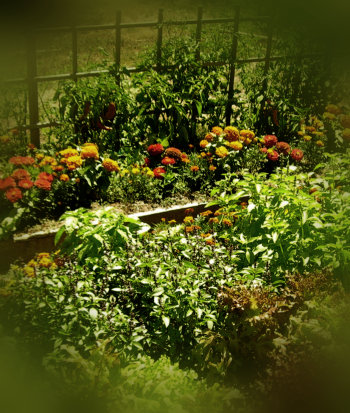
What Would We Be Without Gardens

The following was written by Writers in the Grove member, Patti Bond, as part of our month long prompt, garden.

Yellow Rose Bud from Portland International Rose Garden - closeup photo by Lorelle VanFossen.Trees, shrubs, flowers, and vegetables, all these make up gardens. While I was growing up, we had a huge vegetable garden. My family planted cucumbers, zucchini, tomatoes, and pumpkins.

I remember one Fall, we grew a huge pumpkin. It was mine and it was stolen. I was very upset.

I took to foot looking for it. I found it in someone’s garage.

I high-tailed it home and retrieved my little red wagon. I snuck back there and brought my pumpkin home. While I don’t recall any other major mishaps with the garden, which was probably a good thing, I remember my family focused on keeping not only the vegetable garden but other gardens we tended, too.

To name a few, we had many flower gardens, roses, petunias, and colorful daffodils. Gardens are a lot of work to maintain with all the watering, weeding, fertilizing, and pruning. Certain flowers only bloom during specific times of the year. For example, roses only bloom in summer through early fall in the Pacific Northwest. Daffodils come up in early March, or sometimes, if the weather is unseasonably warm, daffodils come up in late February, a bright surprise at the end of winter.

Gardens that are kept up nice usually means that people care about the way their house and yard looks. Today, there are also garden flags people display in their yard which look nice.

I loved picking flowers from the garden to make beautiful floral arrangements to give to family and friends, or even to enjoy on my bedside table. They bring me such happiness, what would we do without gardens?

Prompt-a-Month: Water

Writers in the Grove Prompt-a-Month badge.The August prompt-a-month for our Writers in the Grove members is:

Water

The deadline is August 31, 2016.

Check out the guidelines and instructions for submissions in the announcement, and we look forward to your great submission. Submissions will be published throughout September.

Where to Publish Your Short Story

During our Writers in the Grove workshops, we often suggest to our members that a particular work needs to be sent out to a magazine or online publishing site for publishing.

While there are many writing contests a writer could enter with a poem or short story, the following are articles featuring a variety of places that want your story short work. And some pay fairly well.

There are many articles on the web to help you get your short story through the submission process well, but take note of the specifics in “How to Get Your Short Stories Published in Lit Mags” by Writer Unboxed. There are some great guidelines to help.

Who You Are

The following is by Writers in the Grove member Bev Walker.

You are the end of a million generations
foraging for food and shelter.
Thousands of times, over and over,
famine has wiped out whole nations.
Each time, one of your family survived.
Or you wouldn’t be here.

You are the end of a million generations
devastated by disease and storm.
For a million years, in a million places,
through showers of meteors,
Thousand of times, over and over
while all around them died.
One of your family was left standing,
and had to bury the rest.

You are the end of a million generations
torn apart by earthquake, flood, tornado,
arctic blizzard, every terror you can imagine,
whole nations buried beneath every desert,
Whole civilizations lost beneath sea and jungle,
now known only to birds and fishes.
Whole races gone, all gone…except
one of your family.
The result is you.

You are the end of a million generations
destroyed by war after war,
Marauding armies determined to wipe out all in their path.
Somehow, one after another,
century after century,
One of your family made it through all that;
you are the proof.

Neither they, nor you, made it because
you’re the smartest, healthiest, or bravest.
“Survival of the fittest” went out the window
the first time someone reached out
To the wounded, an orphan, a cripple, the sick;
that’s the difference between you
And the ant and the crocodile.

Through a thousand ice ages,
through whole continents ablaze,
There stood one who is still a part of you,
yes, you, and your neighbor, whatever your ilk.
You are the end result of a million miracles,
a treasure, a pearl of great price.

Writing Tips: Shoelaces, Knots, and Ties

Another tool to add to your writer’s toolbox is Ian’s Shoelace Site. The tagline is “bringing you the fun, fashion, and science of shoelaces.”

How does your character tie his or her shoes? The choices they make may tell the reader much about their personality, their past, culture, and experiences with shoes.

Do they tie them tight or loose? Use a specific technique for tying? Why? How? How do you describe how they tie their shoes?

Are they athletic? Maybe they were in the past and tie their shoes based upon the technique they used for their football, baseball, ice skates, hockey skates, or running shoes, even though they haven’t touched the sport in decades.

Maybe they are old and need the helix twisted shoe laces to hold their shoes on because their arthritis can’t tie a bow any more. Or maybe they had to go through physical therapy to relearn how to tie their shoes after an accident or stroke. How would they do that and what are the different shoelaces and shoes available to help them?

What types of laces do they have in their shoes? Leather shoes often have thin strings for laces. Many people today slip colorful shoelaces into their tennis shoes for fashion or attention.

Can you name the parts of a shoelace? Are they shoe ties or shoelaces? What’s the tip called that helps slip through the loops or rings to threat a pair of shoes? What is it made of? Are there different kinds?

Did you know that there are almost 2 trillion ways to thread a shoelace through eyelets to tie a pair of shoes?

Ian’s Shoelace Site offers answers to all these character development questions. Ian even has a book published in 2007 called “Laces” to help you learn even more about shoe laces with detailed pictures and graphics.

Check out the following web pages on Ian’s site to learn more about how your character might tie their shoes.

The Humanity of Flowers

The following is by Writers in the Grove member, William Stafford, and was inspired by the prompt, Coming Over the Rise I Saw.

That humans could be as compatible as flowers. Flowers do nt seem to care what kind is planted next to them or about their color or fragrance, if any. Some need space of their own but still do not attack their neighbors.

Oh that we could share our space in the world as gracefully.

Prompt: Coming Over the Rise I Saw

The prompt this week was inspired by a trip taken by MJ Nordgren. She described covering over a rise in her car and seeing before her a wide sweep of brightly colored flowers, a field of bright red poppies alongside a field of vivid blue Bachelor’s Buttons. It was so lovely, she had to stop and reflect upon it. Thus our prompt this week is:

As I was coming over the rise I saw…

Good Enough

The following is from our Writers in the Grove member, Lorelle VanFossen, for our prompt-a-month series for July, based upon the prompt “garden.”

Sunflower, close upThe petals radiated out in a burst of sunlight, yellow, softly moving in the breeze. A bee landed on the center, climbing around the pistil and stamens that would soon become the seeds I’d snack on over the winter. They were so good, my mouth watered.

The center pattern of the sunflower is considered by many to be a mathematical marvel. I find it hypnotizing. While many believe it is a helix pattern, I trace the Fibonacci sequence from the center, spiraling out, 1, 2, 3, 5, 8, 13, 21, 34, 55…each number a sum of the previous two numbers. From the center, the future seeds curve curves out in two series, each winding in the opposite direction, stretching out to the very petals, each seed aligned with its neighbor, a mosaic found throughout history in the ancient tiled floors of the Byzantines, Romans, Greeks, and Moors. Or so my text books say.

The bee leaps off the flower as the wind tilts the flowery landscape, then returns, a black and yellow fuzzy creature crawling around the spiraling maze.

A thump on the ground next to me draws my attention back to earth. It’s my sister. She tugs on the soft green leaves of the plant. The bee loses its purchase and flies away.

“Whatcha doing?”

“Counting.”

She’s heard this before, and she never asks the obvious next question. She doesn’t care much about the world beyond her nose.

“I’m bored.”

I have no answer for that. It’s a statement that stymies me every time. How could anyone be bored. There is so much to see, so much to do, so much to learn – even the flowers teach us math and pattern. To her, this is an old song. The responsibility of the world is to entertain her, and right now, we are failing her.

A hawk stabs the air with its cry. I lean back to see it circling overhead, lifting on the warm current. A small bird dives out of seemingly nowhere to jab at it, warning the giant predator that it has been seen and it is not wanted. I swap a mosquito buzzing around my ear and wish I could do the same to all the mosquitoes this time of year.

“Let’s do something,” she orders me. I think we are. Clearly, not enough for her. “There must be something for us to do around here.”

A chill runs up my spine. This was a warning sign. Trouble was ahead. A bored Cindy was a danger to all peaceful and good creatures.

Action was required. I stood up, dusting off the dry dirt and leaves from my backside. Without another person in sight, the job to entertain my sister and keep her and all around her from harm became my responsibility.

On my list of chores and things-to-do I found enjoyable were mucking out the barn, pulling weeds, refilling the horse trough, and checking on the chickens. None of these passed Cindy’s criteria for amusement. These were my times, time spent on repetitive tasks so ingrained, I moved through them without thinking, my find free to wander, explore, and revisit books and text books, absorbing and processing the lessons from school and all around me. She found these tasks, in her words, “utterly boring and mundane.” Big words for a little girl in a frilly white and yellow lace dress with sparkling silver shoes, a fashion statement at odds with the farm.

“Want me to push you on the swing?” The rubber spare tire swing hung sadly from the old pully pole on the barn.

“Nah, did that yesterday.”

“You seemed to enjoy it.”

“Yeah, but that was yesterday. It’s boring now.”

“We could go down to the pond and skip rocks.”

“It’s too far.”

“It’s a three minute walk.”

“I said it was too far.” (more…)

Writing Your Book: Worksheets and Templates for Writers by Jamie Gold

The amazing prolific writer and educator, Jami Gold offers a wide variety of Worksheets for Writers in Excel spreadsheets, documents, and Scrivener templates. We’ve mentioned this collection in our NaNoWriMo articles and tips. These are precious gems you need in your writing toolbox.

These forms are essential for developing and writing your book, be it fiction or memoir. These worksheets and charts will help you structure your story, develop characters and scenes, and gives you a checklist for all of the things you need to have to make your book a success.

Download these and save to a master toolbox folder for your writing on your computer. To use them, make copies and rename them to the project you are writing as well as the date. You will use many of these over and over again for everything you write.

The Garden

The following is inspired by our Prompt-a-Month program. The prompt for this past month was “garden.” This deadline for this month’s prompt, “dance,” is July 31, 2016.

This is contributed by our Writers in the Grove member Gretchen Keefer.

Garden Vegetables out of focus.Allie groaned as she rolled over to shut off the alarm. Through her slitted eyes the gray light of early dawn filtered in. “Why did the alarm go off so early?” she wondered. This was too early for a summer morning. Yet there was something about today….

As she stretched and tried to open her eyes more fully, she heard movement in the kitchen; then the back door closed. “Grandmom.” Allie jumped out of bed. Today was the day she was supposed to help Grandmom take her produce to the farmers’ market. The vegetables had been packed last night, but Grandmom wanted to pick the flowers fresh this morning. Hastily pulling her shorts, shirt and sandals on, Allie hurried out to the garden.

Grandmom greeted her with a warm smile. “Good morning. I’m glad you could join me today. Isn’t it a lovely morning!”

Allie wondered how Grandmom could know this was a lovely morning when the day hadn’t even begun yet. Grandmom was always cheerful, which was one of the special things about Grandmom that Allie liked so much. Yawning, she took the scissors Grandmom offered and tried to pay attention to her instructions. Pick the blooms that are just opening, cut the stems at an angle and put them directly into the ready bucket of water. As they worked, Grandmom hummed familiar tunes or told Allie interesting facts about some of the flowers. Occasionally she would remind Allie to cut the stems a bit longer, so people could arrange the flowers as they wanted to, or to leave some of a particular plant for the bees, which were already starting to buzz around the fragrant blossom. (more…)