Author: Lorelle VanFossen

Lorelle VanFossen is a pioneering XR Innovator and WordPress leader, tech educator, keynote speaker, and producer bridging virtual reality and digital innovation. Co-founder of Educators in VR, founding WordPress community member, and passionate advocate for emerging technologies and human rights. Expert in immersive education, VR/XR event production, UX, and digital transformation.

Prompt: Three Random Words with Same First Letter and Share

The prompt this week was to think of three nouns, all starting with the same letter, having nothing to do with each other. Then pass it to your neighbor and that is your prompt.

If you are doing this alone, grab a newspaper or dictionary, pick a letter and select the first three nouns starting with that letter, and write.

Getting Your Article, Short Story, or Poem Published for the First Time

Writers in the Grove is a creative writing group, focused more on supporting each other’s writing passions through education and writing opportunities. Some of us are also published from time to time. While the group’s focus isn’t on how to get published, we do cover that topic occasionally.

This article serves as a general tutorial and guide to help you get your work published for the first time, taking you step-by-step through the generic process of submitting your work in article, story, or poem formats, not novels and non-fiction books, though the process is similar.

The process begins with craft, learning as much as you can about what you are writing and preparing to submit before you begin the process.

Know The Craft of Writing

Each writing genre has specific standards for writing format, form, and function, and it is part of the development of your craft to learn these.

Understand, editors don’t want to reject anyone’s writing. Their job is to accept and reject those that don’t pass through their filters. Many editors are inundated with dozens if not hundreds of submissions weekly, sometimes daily, so they’ve learned to reject for simple grammar mistakes or be the rare ones to see past the poor language skills to find the gem of the story. Present your best work so you never give them an excuse to reject your work.

Improve Your Skills with Writers in the Grove

Writers in the Grove offers a chance for you to bring your short story or poem to our group to read in the second half of our weekly workshops. This is a great opportunity for gentle feedback, but also practice your reading skills.

We also produce two author reading events annual, Lend an Ear and Wintersong, a chance to submit and read a 4-minute piece before an audience of 50-100 people, again, another excellent opportunity to read publicly and get public exposure for your work.

  • Learn How to Spell or Use Spell Check Wisely: Some editors are forgiving about the occasional spelling mistake, others are not. If you regularly misspell words, learn them or pay close attention to them when you use them.
  • Learn Punctuation Rules: Learn how to use punctuation, and understand why you use commas, colons, semi-colons, hyphens, and quote marks, and how to constrain yourself from using exclamation points.
  • Become a Grammar Guru: Learn sentence structure, prepositions, clauses, and how to use and not use them. Writing is a non-stop class in how to use the language. Learn to use it to craft the words into a symphony.
  • Edit Brilliantly: Edit your work. Never submit a first draft. Craft your draft. Only submit your best work, so edit with a strong and graceful hand.
  • Get Feedback: There are many groups dedicated to helping you publish, giving you the high-powered review and critique you may need to succeed in the marketplace. Writers in the Grove members will give you gentle feedback, designed to encourage rather than discourage, though we will give you a harder review if you ask, we are not publishing experts nor editors, just writers with experience. In addition to our group, look for groups focused on publishing in our area or online to improve your professional writing skills.
  • Network and Build Relationships: Some writers rarely submit their work for publication. Editors invite them to submit because they have established a connection, a relationship, and reputation for quality work. Look for opportunities in your community to attend other writing groups, conference, and workshops to get to know others in the business. Travel to writing conferences, and find a way to connect with those who are buying your work.
  • Take Classes, Read Articles, Study Books, Learn Writing: You are never too old or experienced to stop learning about your craft. Luckily, the Portland area is stuffed with exceptional colleges and educational facilities offering writing courses, workshops, and events. Don’t forget the Willamette Writers and their monthly activities and annual conference.
  • Learn What Publishers Want and Need: As with everything, writing is part of the supply and demand economy. You have to give them what they want to buy. Carefully study their publication. Read through their guidelines for writing and submission as well as their want lists to give them just what they need.

Your Writing is Now a Business

Did you know that many short stories were picked up by agents and publishers to be turned into novels and movies? Orson Scott Card’s famous, award-winning book, Ender’s Game, started out as a short story. It not only became an international bestseller, with numerous sequels, but also a movie. (more…)

Prompt: Spin

The prompt this week was an exercise in writing spin, the tangle we weave when at first we deceive.

Spin is a form of propaganda, a public relations, marketing, and political writing and speaking style to slant the bias interpretation of news, events, campaigns, corporation stances, and products. Manipulative and deceptive, spin uses cleverly phrased words and phrases to twist the truth. Children caught “red-handed” will often spin a yarn (where the term originates) to exaggerate or obfuscate the truth.

The prompt exercise was to pick a newsworthy topic and report on it three ways to explore the concept of spin. We did this in teams of three but it may be done by an individual.

  1. Write a non-biased report of the topic or news item. Keep to the facts.
  2. Write a negative slant on the topic.
  3. Write a positive slant on the topic.

Examine the words in each.

  • Which words are neutral?
  • Which are influential?
  • Which are inflammatory?
  • Which was easier for you to write and why?

Spin doctoring, mastering the art of writing and speaking spin, is a craft based upon Socratic Questioning and rhetoric. Socratic Questions is part of critical thinking, asking enough questions to get the listener to think more about the situation, thus your arguments may become theirs as they question their rationale.

Spin writing was also called rhetoric, explained by Plato as an essential part of the “smooth-tongued oration that would inflame passions and distort the truth.”

In “The History of Political Spin (And Why It’s Not So Bad for Us As You’d Think)” on the Washingtonian, the author describes how Teddy Roosevelt used his famous PR strategy to redirect the citizens to a more hopeful attitude in a country starving and suffering.

Roosevelt reinvented presidential addresses, in those days reserved for lengthy speechmaking in honor of national anniversaries, and turned them into almost daily news events. The presidential secretary, whose role had been expanded under McKinley to include the care and feeding of the press, now offered reporters informal sit-downs with TR, even while he was in his barber’s chair—and distributing wax-cylinder recordings of his speeches. The presidential tour around the country to bolster a political point was another Roosevelt innovation.

Neil Rackman’s book, “Spin Selling,” describes the SPIN cycle as an acronym for situation questions, problem questions, implication questions and need-payoff questions.

Writing spin involves answering these questions:

  • What is the situation and how does it need to change and in whose favor?
  • What is the problem? Clearly identify it. Then ask yourself, is this really the problem or is it something else? A problem with air quality could actually be a bigger problem if the industry closed down and took its jobs somewhere else.
  • What is the implication of the situation and problem? Who and what is harmed? At risk? Potentially damaged? Why? Look at all of the consequences.
  • Identify the need or payoff. Who wins? Who loses? Why? How? Who needs to win the most and why? How do the words chosen sway an opinion or decision toward the desired outcome?

When it comes to writing fiction, we are spinning a tale, taking the reader on a biased journey through their imagination, often leading them down paths they never considered placing a foot, closing the book with their mind stretched into new directions, life journeys altered.

This example of spin explained comes from Shannon L. Alder, author and creator of Shannonisms:

Never give up on someone with a mental illness. When “I” is replaced by “We”, illness becomes wellness.

Famous author, E.B. White said:

I have yet to see a piece of writing, political or non-political, that does not have a slant. All writing slants the way a writer leans, and no man is born perpendicular.

The art of spin is popular in movies, “Wag the Dog” is a prime blatant example, but there are more subtle examples, too. In the movie, “Promised Land (2012),” the main character, Steve, arrives in a small town as a top sales agency for a natural gas fracking company. Similar to his own impoverished hometown, he is eager to help the people in this small farming community take this “free money” opportunity to get rich quick. At first, people are eager for his arrival and offers. When a local science teacher objects, they pause and reconsider, allowing an environmental advocate to step in and question their loyalty to generations of farming with damning evidence of the impact of fracking. The town sides with him, yet you feel for Steve as he battles against this interloper. As an audience member, you feel yourself shifting sides throughout the story to the stunning but inevitable conclusion.

We are surrounded by media that specializes in convincing us to buy, vote, and choose one side or the other, rarely giving us a chance to make our own decisions based upon unbiased information.

Even reporting on the same subject, news media is found to slant toward their bias. ScienceNews magazine reported recently on how a computer can now determine bias.

Consider this excerpt from The National Review, an outlet that self-identifies as conservative:

“I’m hitting the road to earn your vote because it’s your time, and I hope you’ll join me on this journey.”

Or this slice, featured by The Nation, which self-identifies as liberal:

“Everyday Americans need a champion, and I want to be that champion.”

From the quotes alone, you might not be able to tell whether the news outlet is liberal or conservative. But a computer probably can. Scientists developed an algorithm that, after churning through more than 200,000 quotes from 275 news outlets, discovered bias in their quote choice. Creating a graph that grouped media outlets by their selected quotes reveals pockets that pretty accurately reflect the political leanings of the outlets. The research suggests that information about an outlet’s political stripes is embedded in quote choice, surrounding context aside.

“Readers might experience very different personalities of the same politician, depending on what the news outlets they follow choose to quote from that politician’s public speeches,” says Cornell computer scientist Cristian Danescu-Niculescu-Mizil, a coauthor of the study…Even though readers are exposed to the politician’s own words, “the part of the speech the reader has access to changes,” he says.

Look at the word choices and how they influence your thinking. Learn how to spot them in your own writing as well as use them to sway other characters or the reader.

For more information on writing spin and the art of spin doctors:

Today we live in a society in which spurious realities are manufactured by the media, by governments, by big corporations, by religious groups, political groups… So I ask, in my writing, What is real? Because unceasingly we are bombarded with pseudo-realities manufactured by very sophisticated people using very sophisticated electronic mechanisms. I do not distrust their motives; I distrust their power. They have a lot of it. And it is an astonishing power: that of creating whole universes, universes of the mind. I ought to know. I do the same thing.
Philip K. Dick
National Poetry Writing Month 2016

Like NaNoWriMo, there is a NaPoWriMo, the National Poetry Writing Month for the entire month of April.

The goal of the project is to write a poem of day every day for 30 days in April.

There are many tips and techniques on their site and other poets and writers are offering tips and prompts throughout the month.

Prompt: Truth

The following questions were asked this week for the Writers in the Grove Monday morning workshop prompt in Forest Grove, Oregon:

Questions:
Truth.
What is truth?
How do you know?
Does it make a difference who says it?
Under what circumstances?
If it is printed, heard or seen on TV or radio, spoken by someone, does it matter who that someone is?
Did your parents teach you to believe in the tooth fairy? Why?
How did you feel about them later?
Can truth be stretched?
Are there absolutes or only relatives?
Can something hurtful but true do more or less harm than a comforting lie?
Who gets to decide?
What criteria should be used?
Should all people use the the same criteria?
If not, whose should be used and why?
Should you teach your children to believe in Santa?
When you write, what do you owe and to whom?
Why is this a dangerous discussion?

Art of the Story Festival in Washington County

The 12th Annual Storytelling Festival, The Art of the Story, is in Washington County, Oregon, this year from April 2-9, 2016. Hosted by the Washington County Library System, the Art of the Story features five professional storytellers at various functions during the week, and also hosts a Story Slam Contest and other events.

All events are free. The schedule details are available on their site, and here is a summary.

  • Saturday, April 2 – Beaverton Library 7-8:30PM – Story Slam Contest (Adults)
  • Monday, April 4 – West Slope Library 6:30PM – Tom Swearingen – “It Happened Out West”
  • Tuesday, April 5 – Hillsboro Library 7PM – Tom Swearingen – “Horsin’ Around” (Adults)
  • Wednesday, April 6 – Multiple events
    • Forest Grove Library 7PM – Patrick Ball – “The Fine Beauty of the Island” (Adults)
    • Sherwood Library 7PM – Kevin Kling – “Chicken Soup for the Chicken” (Adults)
  • Thursday, April 7 – Multiple events
    • Banks Library/City Hall 7PM – Kevin Kling – “Holiday Inn”
    • Tualatin Library 7PM – Val Mallinson – “My 15 Minutes of Fame” and Amy Theberge “Amy Flew Over the Cuckoo’s Next” (Adult programs)
  • Friday, April 8 – Multiple events
    • Cedar Mill Library 7PM – Patrick Ball – “The Wit and Wonder of Irish Storytelling”
    • North Plains Library 7PM – Kevin Kling – “Walkin’ Shoes” (Adults)
  • Saturday, April 9 – Multiple events
    • Aloha Library 11AM – Amy Theberge – “Amy Flew Over the Cuckoo’s Nest” and VAl Mallinson – “Daring Dachshund Adventure Tales!” (Adult programs)
    • Garden Home Library (THPRD Garden Home Recreation Center” 7-9pm – Finale Concert featuring the Story Slam Contest Winner and featured storytellers from the week’s events.

For the writer, the art of storytelling is part of our craft. We highly recommend this annual event. People come from around the state and country to participate and attend this spectacular storytelling event featuring world-class award-winning storytellers.

If there is one event you cannot miss, it is the finale on Saturday evening, April 9. It is the best of the best and we will work with Writer’s in the Grove members to carpool to the event.

Meeting Our Selves

The following was written and submitted by our Writer’s in the Grove member, Ralph Cuellar.

Our “selves” are like spirits
Until we meet in the flesh
and misunderstand each other
When we’re offered information
we’d rather not accept
When we’re confronted with alternate
versions of our dreamed reality.
Our external world is like a series of
collisions in a bumper car amusement ride.

Lost Child

The following is by Veronica Weeks-Basham, a member of Writers in the Grove. It was inspired by Prompt: Being Brave.

I have decided that I don’t exist.
That person died when my parents refused to accept or even see
The person that I was discovering myself to be.
That person, like the mythical Atlantis,
Sank beneath a sea of criticism, disregard and approval
When my being reflected back their own comfortable version of themselves.

Scrivener: Printing Your Manuscript

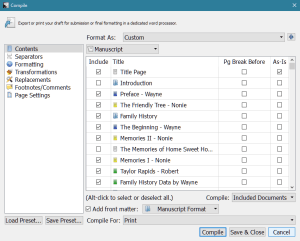
Scrivener_-_Compile_Contents_ScreenThe process of printing a manuscript in Scrivener is called compiling. It represents the power in Scrivener to literally compile your writing how you wish it to appear in print or in a digital file for the next steps in preparing your book for publishing.

In one of my Scrivener projects, I have 6 versions of a book I’m working on.

  • The original draft
  • Second and third drafts
  • A copy edited version returned from a copy editor
  • The cleaned up version of that copy editor
  • Another version with alpha reader edits added

I could have even more versions, and at any time along the process of writing I could print out any of these versions for posterity, or go back to an earlier version to find out why I wrote it that way or what an editor had to say, or restore an edited version to one of the original versions, all within the same project file.

When it comes time to print these versions, or the final glorified version of my manuscript, it begins with a compilation process as I choose which documents to include or exclude from the version I’m creating – or, in Scrivener language, compiling.

Remember, as discussed in the tutorial on how to format your manuscript for writing, what appears on the screen may be different what the final version prints. (more…)