Writing Tips

Understanding Publishing Rights

The “right” clause depends on many factors – there is no “one size fits all” – so be vigilant and pay attention, and make the right business decision for you and your book.

Today’s big take-away lesson is this: pay attention to the grant of rights, and know what rights you’re agreeing to give your publisher. A proper grant of rights lays the foundation for a positive, long-term business relationship between the author and the publisher – and that, of course, is good for everyone.

Do You Know Your (Publishing) Rights? – Susan Spann of Rocky Mountain Fiction Writers

Many of our Writers in the Grove members publish and share their work on our website here, often a first step toward publishing elsewhere such as on other websites, magazines, newspapers, and books.

According to many authors and publishing experts, one of the first things a professional writer needs to learn is what their publishing rights are, though it is often the last thing learned, usually after much confusion and frustration.

Writing is an art form, and professional writing is a business. There are business standards and practices. There are contracts, agreements, guidelines, and policies. You need to be professional in your writing and writing submissions.

Among all the things you need to learn before sending your work out into the world, you need to begin with understanding your publishing rights, the rights that determine who owns your work, how, where, and when it may be published, and how these rights influence your income from your written words.

Copyright and Trademark

To begin, let’s address the first two rights for writers, two that come with some confusion: the difference between copyright and trademark. When someone abuses your copyright or trademark, it is legally called a violation of your intellectual property. Both are intellectual property rights you will deal with constantly in your professional writing career.

Trademark protects brands and brand names. As a writer, you could choose to register your brand and author name, or the title of a book series, not the book title itself, as a trademark, protecting it from abuse and misuse, but that is a discussion for your legal professionals as you step through your career.

J.K. Rowling has long history of legal battles to protect Harry Potter and its entertainment empire. Some of those legal actions were over the trademark name of “Harry Potter,” “muggles,” and “Hogwarts,” including use of the name in fansite website addresses. Apple, Coca Cola, and many businesses protect their trademark name and brand by preventing trademark violations such as these. You are not allowed to use those names in your domain name or within your creative work unless it complies with their trademark rules and guidelines, or you receive legal permission, commonly called a license. (more…)

Writer’s Toolbox: Geometric Shapes

It went “Zip” when it moved
And “Bop” when it stopped
And “Whirrr” when it stood still
I never knew just what it was and I guess I never will.

Chart of Geometric Shapes from Playbuzz.The Tom Paxton song made famous by Peter, Paul, and Mary, as well as John Denver, describes a thing that defines description, a child’s toy that was amusing all the same.
When it comes to describing the physical shape of an object, we can’t get away with just the sound effects. We need the words.

The basic geometric shapes are:

  • lines
  • curves
  • angles
  • triangles
  • square
  • rectangle
  • pentagon
  • pentagram
  • hexagon
  • octagon
  • polygon
  • circle
  • arc
  • ellipse

Then we add variations on the above. These are geometric shapes based upon lines and planes, but what about solid figures or 3-dimensional shapes?

  • cube
  • cylinder
  • rectangular prism
  • pyramid
  • tetrahedron
  • octahedron
  • polygon
  • sphere
  • cone

What shape is a carrot? Do you know? Is it a triangle? No, it’s an inverted cone. Is the sun a ball? Yes, it is a ball, more specifically, the sun is a sphere.

The words you use to describe a shape may be technical or playful, finding similes to represent their shapes, such as “he was as thin and lanky as a much-used toothbrush.”

Did you know that there are some personality tests that use geometric shapes to represent a person or personality?

From “Geometric Shapes: Simple and Unusual Personality Test,” if the triangle is your preferred shape:

This form symbolizes leadership. Main ability of triangles is to focus on goals and deeply and quickly analyze situations. A Triangle is a very confident person who wants to be right in everything. Triangles find it difficult to admit their mistakes, are easy to train, and absorb information like a sponge. Their career gives their life meaning.

Here are some charts and web pages to add to your writer’s toolbox to help you define the geometric shape of the objects, and possibly the characters, in your writing. We’ve also included some lists of words to describe the shape of objects.

Scrivener Tips: The Scratch Pad

This is another Scrivener Tip from Writer’s in the Grove. We will be presenting a series of Scrivener workshops soon in Forest Grove, Oregon. Until then, or after, if you have a question about how to use Scrivener, let us know and we’ll do our best to help you out.

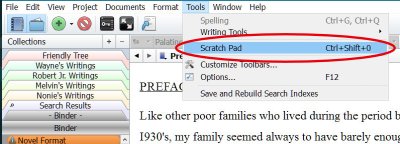
Scrivener - Scratch Pad on Tools Menu - Writers in the Grove.Ever get a new idea, a bit of inspiration, as you are writing? I used to turn to a piece of paper or sticky note to jot down my idea, but found that by the time I made the note and switched back to my writing program, I’ve lost track of what I’m writing. Moving my eyes from the computer screen and fingers from the keyboard invites distraction. Luckily, Scrivener offers a way to make notes and keep on writing.
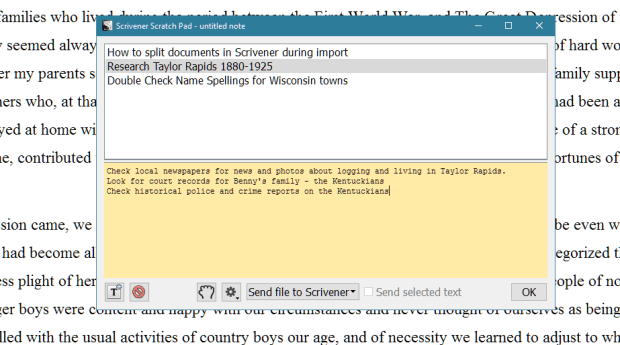
The Scrivener Scratch Pad is built into Scrivener and can be accessed by:

  • Windows: Tools > Scratch Pad or CTRL+ALT+SHIFT+P
  • Mac: SHIFT+CMD+ENTER

You can add a note to it quickly with a mouse from within the Scratch Pad window. Click the T for Text in the bottom left corner to create a new note and start typing.

Scrivener Scratch Pad - examples - Writers in the Grove.

You can add as many notes as you wish in the Scratch Pad.

You can send the note to Scrivener later as the start of a new plot shift or poem.

  1. Select the note.
  2. Click Send file to Scrivener.

Two options will appear to either copy it to a specific file or new one, or append text to another text, adding it to the bottom. You can also select a portion of the note and send just the selected text.

One of the cool things about the Scratch Pad in Scrivener is that the notes persist between projects. You can make notes on other projects that pop into your head or you discover while researching another project. Think of all the ways you can use the Scratch Pad in Scrivener to deal with these thoughts while staying focused on the task at hand.

For more tips, see “Using the Scratch Pad in Scrivener” by The Digital Researcher, and the following:

Writer’s Toolbox: Describe and Critique Art

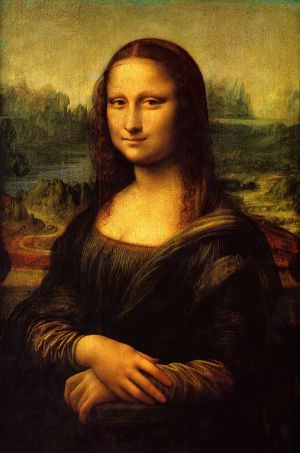
Mona Lisa - Leonard Da Vinci - Wikipedia.Your characters head for the local museum or art gallery. Their eyes are filled with wondrous sights. Colors, patterns, shapes, textures, renewing their spirit, giving them the beauty they crave in their life. Or boring them to tears as they’ve just been dragged to another thing-they-don’t-wish-they-had-to-do-in-order-to-save-a-realtionship-or-get-sex.
Either way, it helps to have words to describe and critique that art.

Describing artwork is one of the fascinating uses of language, in any language. How does the writer capture a painted expression, a twisted sculpture, an abstract painting? Could you describe the Mona Lisa with the right words to make the magic of Leonardo Da Vinci’s portrait explain why it continues to attract millions of visitors eager for a glimpse of the woman’s face with a lack of expression?

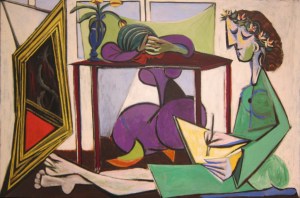
Interior with Girl Drawing - Pablo Picasso.Artwork is encountered in most books in some way, a photograph of a suspect, a painting on a wall, a quilt, lacework, or arts and crafts item that tells us more about the character, place, or solves a mystery. How do you describe it to not only let the reader see see it, but also choose words that match the tone, scene, time, and owner?
In general, use the following tips for presenting a work of art, though how you choose to describe it and use it in your writing is your personal, creative decision.

  1. Identify the artwork type and medium (canvas, photograph, painting, sculpture, drawing, etc.).
  2. Identify the artist (if possible or relevant).
  3. If a well-known piece, name it.
  4. Describe the objects in or subject matter of the artwork (field, flowers, sunset, ocean, person, portrait, sky, furniture).
  5. Describe the colors, lines, patterns, shapes, and textures.
  6. Describe the first impression of the artwork, what your character or your reader would see at first glance.
  7. Where is the light source? Is the source from the sky, electric, natural light, artificial light, and light direction (top, under, side, backlit (behind)).
  8. What are the sensory qualities, the mood and visual effect, of the work?
  9. Why is it placed in this this particular spot?
  10. Why did the owner buy it?
  11. If the artwork has sentimental value, what is it? How does that help with the character development and backstory?
  12. If the artwork has financial value, what is it and why is that important to your story and character? Did they buy it only for investment? Or to support an artist they found interesting? Or maybe a relative trying to be an artist? Or is it part of their nest egg, saving for the future, betting on the artist? Would they sell it? When? Why?
  13. How does it fit into the rest of the room, building, or scene? Would the character seeing this, if they didn’t own it, think it fits perfectly there or not?
  14. What does this artwork tell the reader about the character or place?
  15. Many people interpret and respond to artwork differently, some with contrasting viewpoints. How would your characters respond? The same, differently? Would they each have a different reaction to the artwork? Does that add to the conflict?
  16. If important to the story, interpret the artwork from the perspective of the artist. Why did they create this? What was their inspiration, motivation, and goals to do so? This might reflect back on the personalities and backstory of your characters.

To help you learn more about learning how to describe arts and arts and crafts, we’ve put together some resources.

Here is a YouTube video for writers on how to describe art.

The following will help you describe artwork and critiquing it to help you flesh out the experience of your characters.

Novel Writing: Storyboarding and the W Plot Chart

Mary Carroll Moore is a popular published author offering educational information on writing and publishing your novel. The following video covers creating a storyboard for your novel using a 3-act structure, specifically the W Plot Chart, helping you find the 5 most important points in your novel.

The following are articles and resources covering more about the W Plot Chart and 3-act structure.

Where to Publish Your Short Story

During our Writers in the Grove workshops, we often suggest to our members that a particular work needs to be sent out to a magazine or online publishing site for publishing.

While there are many writing contests a writer could enter with a poem or short story, the following are articles featuring a variety of places that want your story short work. And some pay fairly well.

There are many articles on the web to help you get your short story through the submission process well, but take note of the specifics in “How to Get Your Short Stories Published in Lit Mags” by Writer Unboxed. There are some great guidelines to help.

Writing Tips: Shoelaces, Knots, and Ties

Another tool to add to your writer’s toolbox is Ian’s Shoelace Site. The tagline is “bringing you the fun, fashion, and science of shoelaces.”

How does your character tie his or her shoes? The choices they make may tell the reader much about their personality, their past, culture, and experiences with shoes.

Do they tie them tight or loose? Use a specific technique for tying? Why? How? How do you describe how they tie their shoes?

Are they athletic? Maybe they were in the past and tie their shoes based upon the technique they used for their football, baseball, ice skates, hockey skates, or running shoes, even though they haven’t touched the sport in decades.

Maybe they are old and need the helix twisted shoe laces to hold their shoes on because their arthritis can’t tie a bow any more. Or maybe they had to go through physical therapy to relearn how to tie their shoes after an accident or stroke. How would they do that and what are the different shoelaces and shoes available to help them?

What types of laces do they have in their shoes? Leather shoes often have thin strings for laces. Many people today slip colorful shoelaces into their tennis shoes for fashion or attention.

Can you name the parts of a shoelace? Are they shoe ties or shoelaces? What’s the tip called that helps slip through the loops or rings to threat a pair of shoes? What is it made of? Are there different kinds?

Did you know that there are almost 2 trillion ways to thread a shoelace through eyelets to tie a pair of shoes?

Ian’s Shoelace Site offers answers to all these character development questions. Ian even has a book published in 2007 called “Laces” to help you learn even more about shoe laces with detailed pictures and graphics.

Check out the following web pages on Ian’s site to learn more about how your character might tie their shoes.

Are We There Yet? How Long Does It Take?

Ever wonder how long it takes to travel?

This is more than an answer to “Are we there yet?” It is a challenge that faces ever writer when their character leaves the comfort of home or work and must travel to another location.

If traveling by foot, how long does it take? By car? By bus? By train? What about by horse? The time spend traveling across the same difference changes with the mode of transportation.

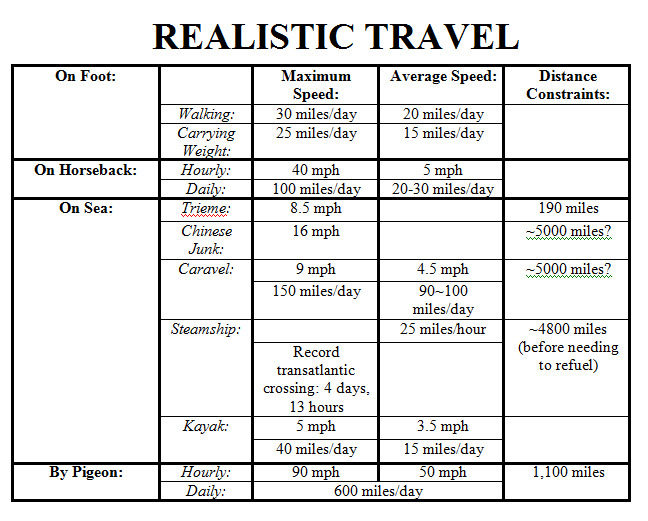
The folks behind The Writer’s Handbook found a chart that answers some of these questions if you are considering traveling by horse, sea, foot, or pigeon. This is a great tool to add to your writer’s toolbox.

Another travel time chart to keep in your writer’s toolbox comes from Lapham’s Quarterly.

What about calculating for traffic congestion? It might take you 30 minutes to get to Portland, Oregon, in the middle of the day, and 3 hours to travel the same distance during rush hour. There is much to think about when you take your character traveling.

Here are a few more examples:

  • A healthy person can walk 3-4 miles an hour on flat and even ground (36-48 miles a day possible)
  • A healthy person can walk 1-2 miles an hour on rugged terrain, less if off-trail
  • By horse on roads or trails with level or rolling terrain – 40 miles per day
  • By horse through mountainous terrain on roads or trails – 20 miles per day
  • By horse through hilly grasslands with no roads or trails – 25 miles per day
  • By horse through rugged mountainous terrain with no roads or trails – 10 miles per day
  • By horse during Roman Era on roads or trails with level or rolling terrain – 20 miles per day
  • By horse during Roman Era on level or rolling terrain with no roads or trails – 15 miles per day
  • A wagon can travel 15-25 miles a day depending upon size, horses, path, and load
  • A league is 3 miles, the distance someone could travel in one hour.

Other tools to help you estimate travel times include:

This is just the tip of the travel time iceberg. What about travel by train? By skateboard? By bike? By helicopter? By skiing? By air balloon?

It’s your imagination traveling with your character. Add their travel type and estimates to your writer’s toolbox as a guide to help you estimate travel times.

Writing Tips: Don’t Write Chronologically

In an article on Writer’s Digest called “10 Tips for Writing” by Chuck Sambuchino, he offers two good tips we writers need to remember:

Don’t write linearly: Don’t set out to write something from beginning to end. A story is meant to be read from front to back, but not necessarily created that way. If you have an idea for writing the sixth chapter first, then start there. The epilogue can even be the first thing you put down on paper, then work your way back. Scattered chapters will eventually be filled in, and it will force you to look at the story from different angles, which may present different ideas or new approaches. You’d be surprised how well this works when a whole book starts coming together…

Ask for (and take lots of) punishment: It is well worth finding yourself a professional writer or editor and asking/paying them to look at your work. Tell them to give you highly critical feedback with no sugarcoating. Let them go so far as to be cruel too, just so you really get the point. There is a lot of rejection and criticism involved in the publishing industry. Getting accustomed to it sooner than later is advantageous. If you want to be serious about your writing, then you’ll need to know everything wrong with your writing. Accepting and understanding the harsh realities of your shortcomings is a most important step to getting better.

The first point is very important. Write what you know about what you want to say, then go back and fill in the rest of the story. Editing is part of the craft of writing, so let the story unfold as it comes into your mind, not on some chronological journey.

While Writers in the Grove doesn’t offer the harsh feedback noted in this article, such feedback maybe given one-on-one or in other groups designed for such feedback, focused on publishing. We also recommend the Willamette Writers Conference and their various groups and meetups. They offer a wide range of critique and feedback opportunities.