Writing Tips

Writing Tips: Kill Your Darlings and Make Writing a Habit

Marelisa of Daring to Live Fully brought us “57 Tips For Writers, From Writers,” a fantastic series of tips from some of the most famous writers.

From Stephen King’s book, On Writing, she references this bit of wisdom for writers.

Mostly when I think of pacing, I go back to Elmore Leonard, who explained it so perfectly by saying he just left out the boring parts. This suggests cutting to speed the pace, and that’s what most of us end up having to do (kill your darlings, kill your darlings, even when it breaks your egocentric little scribbler’s heart, kill your darlings)…I got a scribbled comment that changed the way I rewrote my fiction once and forever. Jotted below the machine-generated signature of the editor was this mot: “Not bad, but PUFFY. You need to revise for length. Formula: 2nd Draft = 1st Draft – 10%. Good luck.

From John Grisham, she shares this:

He goes on to say that at first you have to treat writing as a hobby; you write a page a day in your spare time. Grisham explains that he created spare time to write, although he had a full time job. He adds that he always tells young aspiring writers that if they’re not writing a page a day, then nothing is going to happen. But if they make sure to write a page a day it becomes a habit, and before long they have a lot of pages piled up.

For those of us considering writing full time, these are wise words.

Writing Tips: Harsh, Eye-Opening Tips for Writers

In “21 Harsh But Eye-Opening Writing Tips From Great Authors” by Cody Delistraty of Thought Catalog, he explains:

Even the great writers of our time have tried and failed and failed some more. Vladimir Nabokov received a harsh rejection letter from Knopf upon submitting Lolita, which would later go on to sell fifty million copies. Sylvia Plath’s first rejection letter for The Bell Jar read, “There certainly isn’t enough genuine talent for us to take notice.” Gertrude Stein received a cruel rejection letter that mocked her style. Marcel Proust’s Swann’s Way earned him a sprawling rejection letter regarding the reasons he should simply give up writing all together. Tim Burton’s first illustrated book, The Giant Zlig, got the thumbs down from Walt Disney Productions, and even Jack Kerouac’s perennial On the Road received a particularly blunt rejection letter that simply read, “I don’t dig this one at all.”

Cody continues with some excellent tips writers need to know when it comes to publishing your book.

One tip and quote of particular meaning to our group was:

You can’t wait for inspiration. You have to go after it with a club.
Jack London

Looking for inspiration, use your club on our many Prompts.

Prompt: A Roll of the Dice

Attending a weekend writing retreat led by science fiction author Nina Kiriki Hoffman, Writers in the Grove member, Lorelle VanFossen received permission from Nina to introduce our group to The Story Catcher technique she developed. The following is a summation of the technique for inspiring writing prompts based upon random words and phrases. The document used for the prompt exercise is available for download and printing in a link at the bottom of this post.

Collection of multi-sided, colorful dice.A prompt is anything that inspires you, the writer, to write. It could be a word, a phrase, an idea, and the source of the inspiration could come from anywhere or anything at any moment. The prompt this week was also a workshop on generating random prompts.

How would your writing change if you could generate the serendipity of your prompts on a regular basis, possibly turning it into a habit, a writing exercise used daily?

Nina Kiriki Hoffman developed The Story Catcher, a tool to generate random prompts based upon chance, specifically a roll of the dice.

Nina’s Story Catcher is a booklet where you collect words and phrases as you go through your day-to-day living, twelve words on a page, each page numbered in sequence.

To use the Story Catcher:

  1. Roll one or two standard dice.
  2. Select one or both dice to generate the page number. For page 11, one or both of the dice could total 11. For page 64, one die would be 6 and the other 4.
  3. Turn to that page number and roll again.
  4. Write down the resulting prompt from among the 12 on that page.
  5. Repeat this process three to five more times, noting each word or phrase generated.
  6. Using the resulting randomly generated words or phrase, write your prompt within a 15 minute time limit.

This process generates a completely random set of prompts. Examples might be: (more…)

Getting Your Article, Short Story, or Poem Published for the First Time

Writers in the Grove is a creative writing group, focused more on supporting each other’s writing passions through education and writing opportunities. Some of us are also published from time to time. While the group’s focus isn’t on how to get published, we do cover that topic occasionally.

This article serves as a general tutorial and guide to help you get your work published for the first time, taking you step-by-step through the generic process of submitting your work in article, story, or poem formats, not novels and non-fiction books, though the process is similar.

The process begins with craft, learning as much as you can about what you are writing and preparing to submit before you begin the process.

Know The Craft of Writing

Each writing genre has specific standards for writing format, form, and function, and it is part of the development of your craft to learn these.

Understand, editors don’t want to reject anyone’s writing. Their job is to accept and reject those that don’t pass through their filters. Many editors are inundated with dozens if not hundreds of submissions weekly, sometimes daily, so they’ve learned to reject for simple grammar mistakes or be the rare ones to see past the poor language skills to find the gem of the story. Present your best work so you never give them an excuse to reject your work.

Improve Your Skills with Writers in the Grove

Writers in the Grove offers a chance for you to bring your short story or poem to our group to read in the second half of our weekly workshops. This is a great opportunity for gentle feedback, but also practice your reading skills.

We also produce two author reading events annual, Lend an Ear and Wintersong, a chance to submit and read a 4-minute piece before an audience of 50-100 people, again, another excellent opportunity to read publicly and get public exposure for your work.

  • Learn How to Spell or Use Spell Check Wisely: Some editors are forgiving about the occasional spelling mistake, others are not. If you regularly misspell words, learn them or pay close attention to them when you use them.
  • Learn Punctuation Rules: Learn how to use punctuation, and understand why you use commas, colons, semi-colons, hyphens, and quote marks, and how to constrain yourself from using exclamation points.
  • Become a Grammar Guru: Learn sentence structure, prepositions, clauses, and how to use and not use them. Writing is a non-stop class in how to use the language. Learn to use it to craft the words into a symphony.
  • Edit Brilliantly: Edit your work. Never submit a first draft. Craft your draft. Only submit your best work, so edit with a strong and graceful hand.
  • Get Feedback: There are many groups dedicated to helping you publish, giving you the high-powered review and critique you may need to succeed in the marketplace. Writers in the Grove members will give you gentle feedback, designed to encourage rather than discourage, though we will give you a harder review if you ask, we are not publishing experts nor editors, just writers with experience. In addition to our group, look for groups focused on publishing in our area or online to improve your professional writing skills.
  • Network and Build Relationships: Some writers rarely submit their work for publication. Editors invite them to submit because they have established a connection, a relationship, and reputation for quality work. Look for opportunities in your community to attend other writing groups, conference, and workshops to get to know others in the business. Travel to writing conferences, and find a way to connect with those who are buying your work.
  • Take Classes, Read Articles, Study Books, Learn Writing: You are never too old or experienced to stop learning about your craft. Luckily, the Portland area is stuffed with exceptional colleges and educational facilities offering writing courses, workshops, and events. Don’t forget the Willamette Writers and their monthly activities and annual conference.
  • Learn What Publishers Want and Need: As with everything, writing is part of the supply and demand economy. You have to give them what they want to buy. Carefully study their publication. Read through their guidelines for writing and submission as well as their want lists to give them just what they need.

Your Writing is Now a Business

Did you know that many short stories were picked up by agents and publishers to be turned into novels and movies? Orson Scott Card’s famous, award-winning book, Ender’s Game, started out as a short story. It not only became an international bestseller, with numerous sequels, but also a movie. (more…)

Scrivener: Printing Your Manuscript

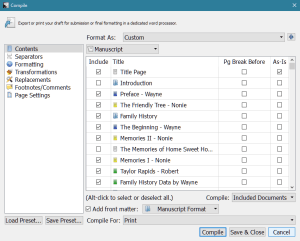
Scrivener_-_Compile_Contents_ScreenThe process of printing a manuscript in Scrivener is called compiling. It represents the power in Scrivener to literally compile your writing how you wish it to appear in print or in a digital file for the next steps in preparing your book for publishing.

In one of my Scrivener projects, I have 6 versions of a book I’m working on.

  • The original draft
  • Second and third drafts
  • A copy edited version returned from a copy editor
  • The cleaned up version of that copy editor
  • Another version with alpha reader edits added

I could have even more versions, and at any time along the process of writing I could print out any of these versions for posterity, or go back to an earlier version to find out why I wrote it that way or what an editor had to say, or restore an edited version to one of the original versions, all within the same project file.

When it comes time to print these versions, or the final glorified version of my manuscript, it begins with a compilation process as I choose which documents to include or exclude from the version I’m creating – or, in Scrivener language, compiling.

Remember, as discussed in the tutorial on how to format your manuscript for writing, what appears on the screen may be different what the final version prints. (more…)

Scrivener: Formatting Your Manuscript for Writing

I’ve been asked to continue this ongoing series on how to use Scrivener, a powerful writing tool that is a must for many professional writers. Scrivener works for those writing poetry, fiction, non-fiction, screenplays, and…the list is long. It is a pre-production tool, a tool for the writing and development of your material for publishing. While Scrivener includes the ability to export the information as an ebook and material ready for publishing, it isn’t designed as a tool for publishing a pretty book. It is the workhorse that gets you to that point.

Scrivener is software installed on your Windows or Mac machine and is produced by Literature and Latte. The price is very reasonable and the purchased version of Scrivener maybe installed on your desktop and laptop without problems so you may work in both environments.

So far in this series we’ve covered:

In this part of the series, I’ll cover how to set the standard format for new documents, the process of fixing content that comes in a jumble in formatting, and how to set the default or standard format for new documents in Scrivener projects.

Setting the Standard Format for New Documents

Let’s begin with how to set the standard formatting for new documents in Scrivener, projects you are just starting. I’ll cover the process for Windows machines. It might be slightly different for Mac. (more…)

NaNoWriMo: The Half-Way Point with the Tips, Tricks, Tools, and Resources to Finish

It’s the half way point in NaNoWriMo and our Prompt-a-Day project is also half way through, hopefully inspiring you to look at your writing and characters in a new way.

Writers in the Grove now has 10 members participating. One participated last year, so this is a huge leap and we are so proud of everyone.

Because our group is so diverse in writing subject matter, age, and skills, we’ve made a few adjustments to the NaNoNoWriMo guidelines. Those that are willing to stick with the word count as a score card are continuing to do so, report in to NaNoWriMo’s check in for the region. Those who are intimidated by such accounting have committed to write for a minimum of an hour a day.

The same challenges that face the word count writers face the timed writers. What to write, how to say it, self-doubt, self-worth, and the dark cloud of wonder about how this will ever amount to something. The challenge is to let all of that go and just write. Edit on December 1, but for November, just write and see what happens.

We’ve heard from several people that their goals of plotting first went by the wayside as their characters took over. Now they are pantsing it, just writing by the seat of their characters’ pants, as one described it. “I just hang onto my keyboard and hope they take this thing somewhere.”

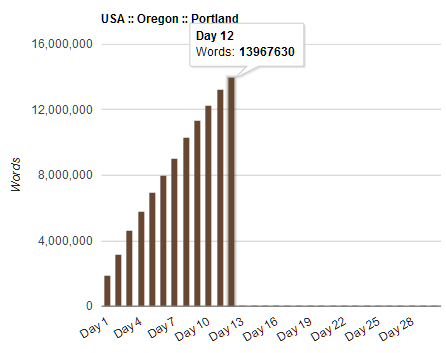
In the Portland region, we are getting closer and closer to 16 million words for those keeping score. That’s amazing.

NaNoWriMo Day 12 Portland Regional Word Count Chart 2015

To keep the momentum going, we’ve put together some guides and helpful resources and wanted to share them with you.

Novels aren’t written by muses who come down through the ceiling and shoot magic through your fingers and out onto your laptop’s keyboard. Before NaNoWriMo, some teensy part of me still believed that because writing is a creative act, it should feel easy. But fairies don’t write novels. They’re written with one simple equation:

Time + Work = Novel

Stephanie Perkins on NaNoWriMo Blog on the rewards of not giving up on your story

NaNoWriMo Survival Resources – To Get You To the Half-Way Point

The following articles and guides should help you get to the half-way point, or help you through the rest of your month long writing experiment. It is an experiment. Sometimes you know where you are going, and sometimes you have no idea, and sometimes, both are true. Edit on December 1 but keep writing through the month and see where it takes you.

Along the way, hopefully the following will help, inspire, and motivate you.

Prompts and NaNoWriMo Ass Kickers

(more…)

Get Paid to Write – How Much?

Writers in the Grove members often ask how much money they could make selling their writing. Here is a peek at some of the going rates. Don’t take “no payment but good exposure” as a reason to give your work away. Get paid for your work. You deserve it.

Let’s first start with defining the different writing markets.

  • You Wrote It, You Submit It: If you wrote something that others or you may think is worth publishing, send it out there. Check the submission guidelines of the magazines and publications appropriate for the material, and see if they are taking submissions. Send it in according to their submission guidelines. These are also called unsolicited submissions. If accepted, you will be paid their standard rate scale for their publication.
  • Pitch Your Story: Freelance writers review publication guidelines and wish/want lists and read every copy of the publication they can to come up with an idea for them. They pitch the story with a query in accordance with the submission guidelines, but it isn’t written yet. It is written upon acceptance, and paid per their standard rate scale.
  • Hired writing: There are many publications that hire or contract with freelance writers to write for them and pay them on a per word or story scale. These include magazines, newspapers, blogs, ghost writing, ghost blogging, and other forms. These positions are sometimes called copywriters and often includes writing for marketing and advertising as well as filler content.

Each of these pay about the same, though some more or less depending upon the publication pay rates and the specialization of the writing and writing topic.

Magazine/Editorial Writing

Magazines accept writing submissions and queries. Always check the guidelines for submission and if they are taking submissions before sending in your submission or query.

In 8 Short Story Publishers that Pay $1,000 or More by Freedom With Writing and “10 Magazines that Pay $500 or More” by The Write Life, they highlight eight top magazines and their pay rates. I did more research and found some other magazine rates and added them to the list. (Note: These rates are subject to change.)

AARP Magazine $1 per word = est. $250-1,000
Asimov’s Science Fiction $0.08 a word up to 20,000 words = $1,600
Cicada Magazine $0.25 a word up to 9,000 words = $2,250
Clarkesworld $0.10/.08 a word up to 16,000 words = $1,380
Cricket Magazine (children) $0.25 a word up to 6,000 words = $2,250
Earth Island Journal $0.25 a word up to 2,000 words = $500
Glimmer Train Stories (not for children) $0.05 a word up to 12,000 words = $700
MIT Technology Review $1.00 a word – est. for about 5,000 words = $5,000
Outside Magazine $1-1.50 a word = est. $250-1,500
Smithsonian $0.50 a word – est. 10,000 words = $5,000
Tai Chi Magazine $0.15 a word = est. $500
The American Gardener $0.20 a word est. 1,500 to 2,500 words = est. $300-600
The Nation $0.33 a word = est. $3250-500
The Progressive up to $1,300
The Sun up to $1,500
Tor (speculative fiction) $0.25 a word up to 10,000 words = $2,000
Travel and Leisure est. $0.20 a word for about 5,000 words = $1,000
VQR (Poetry/Literature) $0.25 a word = est. $200-500

These are general pay rates for magazines. Check their submission guidelines and rate sheets for more specific information on each publication.

Recently, some writers in our writing group mentioned they are worried about submitting their writing and having that company steal it or use it without their permission. If publications did that they would soon be out of business. However, once your writing is accepted, the copyright might transfer to their publication and agency, or at least the publication rights might be restricted. Read the fine print to ensure your rights are protected and the rights you give away are conscious decisions.

Freelance Writing

There are a variety of writing gigs for freelancers that goes beyond submissions to magazines and journals. This doesn’t mean they ignore that publishing market, they just add to it by submitting queries to publications and businesses, working-for-hire, and contract jobs. The writing market is more diversified, thus the income opportunities wider as well. For those determined to earn a living with their writing, keeping them writing while they are working on fiction or non-fiction work or other work, this is an ideal way to keep your hand in the words and be paid to do so.

The various writing job titles for freelancers include:

  • copywriting
  • ghost writing
  • guest blogging
  • blogging/blog writer
  • content marketer
  • content specialist
  • ghost blogging
  • web content writer
  • technical writer

Each of these titles are found on a variety of job boards, depending upon what the publication or business is looking for. The jobs may last for a few hours, days, weeks, months, or years. You choose which ones interest you and bid or submit for the work.

The Adventurous Writer reported on freelance writing pay rates and broke them down into rates for magazine and trade journals and newspapers, giving you a wide range of rates by word and hour, as well as writing jobs like proofreading, copyediting, ghostwriting, and other writing gigs. In general, the writing gigs ranged from 10 cents to $2 a word.

Who Pays Writers? is an anonymous, crowd-sourced list of publications for freelance writers and their pay rates. Anyone can submit information about a publication for freelance work and report their rate as well as their experience, giving you an unverified but general idea about these types of writing jobs.

Most blogs that pay for guest contributors or freelancers pay between $50-200 a post, typically 400-600 words. At the top dollar rate and max words, that’s $0.33 a word.

In general, you can make anywhere from $20-100/hour or charge by the project, with many projects ranging from $250-$1000s. For someone fully dedicated to freelance writing and well-disciplined, the monthly income varies from $1000 to $10,000 a month.

Carol from “Make a Living Writing” described the source of her income by client type, a clue as to where to look for profitable writing income that goes beyond just writing for print magazines. In 2011, 23% of her income came from writing for business magazine websites. By targeting companies that pay the higher rates, you can work less for more if your skills are up for the task.

If you are considering a freelance career, consider carefully the advice on hourly rates verses day rates by Carol Tice of Make a Living Writing. Also check out the Freelance Hourly Rate Calculator to help you estimate what you should be charging if you are considering freelance writing work.

For more information on submitting your work to publications, and becoming a freelance writer and selling your writing, see these resources.

How to Blog NaNoWriMo

What? Right even more during NaNoWriMo, the National Novel Writing Month challenge to write 50,000 words in 30 days? Are you crazy?

Actually, many people blog their NaNoWriMo experience on their blogs. Some even publish their daily writing on their site for their fans and community.

So many people are worried about sharing their novel idea or plot, it becomes almost a paranoia. Relax. There is much you can share without giving the whole thing away.

The fun of sharing your NaNoWriMo experience every day on your blog means you are part of a community. You are sharing your experience, the struggles, challenges, joys, discoveries, and lessons and techniques learned that might help others.

Here are some tips to help you cope if you choose to blog your NaNoWriMo experience.

Share The Journey

No matter what, share the journey.

We love learning how you got there, the good, the bad, the ugly. By sharing your journey with others, they will hopefully learn from your mistakes, but also feel inspired by how you overcame the challenges of writing 1,677 words a day for 30 days.

Just as you would jot down a description of your day in a journal, take 10 minutes at the end of the day or after you’ve completed your NaNoWriMo writing for the day, and consider the journey.

Was the writing easy today? Why? Was it a challenge, the intimidation of the blank screen getting to you? What happened? What made a difference?

Did someone say something or give you words of encouragement that impacted your attitude about your writing and your story?

Define the obstacles. What got in your way today? Was it family? Friends? Work? Illness? Or the story itself? The clearer you are in defining them, the faster you can prevent such interference going forward…sometimes. At the very least, by sharing, others may commiserate with you.

Find a new trick, tip, or technique? Share it and explain how it helps.

Let your readers and community know how you are doing so they are taking each step of the journey with you.

Crowd Source Your Stucks

“I hate my stucks,” a writer complained to me. “The stucks suck.”

We all get stuck when writing. Sometimes it is as simple as knowing the word but not finding it in your brain, or coming up with a great plot twist but it may require you learning about something you know little or nothing about.

Or there are those times when the characters aren’t talking to each other nor you, and you have stuck them into a situation you know not how to escape.

Share your stucks. Let your readers know if you get stuck and ask them how to get out of it. You don’t have to take their advice, but sometimes crowd sourcing the stucks breaks the damn, freeing your characters and your writing.

Seek a Kick in the Ass

A writer who does NaNoWriMo every year tells me that she the one year she didn’t blog her NaNoWriMo experience was the worst year for her writing. “I couldn’t get started, nor finish what I started. I needed a daily kick in the ass.”

When you blog your NaNoWriMo experience, other participants often find you and they will cheer you on when they detect you dragging, as you may for them. That’s why the meetups and social events in and around NaNoWriMo are so good for many people.

By being surrounded by determined folks who have been there, done that, wrote the writing, they know what it is like and they will lovingly kick you in the writing ass and keep you on track when you need it.

Or you can ask for it.

In “How to Shake Off Writer’s Fatigue” on the NaNoWriMo site, they recommend:

For the first few days, showing up to write every day is easy. The shiny factor hasn’t worn off yet, and the excitement over your story is almost palpable.

Then there are the other days, where the drive to write isn’t there. Adding words to your story feels like getting out of a warm, blanket-filled bed into a cold world: you don’t always want to do it, but it’s step one toward the journey ahead. Maybe you’ve written your characters into a corner with no ideas on getting them out. Or maybe you’re bored of your story but still have thousands of words to write before reaching the magical 50K…

We all go through it. There are the NaNoWriMo forums where you can find other participants to support and cheer you on, and you can blog about it and instantly feel better.

At least you wrote something in your blog. Does that count toward your daily word count? It might. 😀

Stop Writing Your Story and Build a World

Do some worldbuilding on your blog. Open the door to the world you’ve created in your novel and invite others in.

Let them ask you questions? Let them test out the furniture. See what happens when you throw open the gates to your imaginative world and watch people wander in.

They might help you build stronger walls, floors, ceilings, and gardens.

Best Practices

  • Schedule time to blog. You’ve scheduled time to write, now add just a few minutes, 10-15, to each day to document the day’s achievements and challenges and write it out on your blog.
  • Remember categories and tags. When we are in a hurry, putting thing where you can find them again gets set aside. Don’t mess up your site.
  • Keep it simple. Write short posts, focusing on the day’s writing activities. This isn’t the time to write a 3,000 word tutorial or technical article. Pick one topic from the day’s events to share with your experience.
  • Keep pictures to a minimum unless they matter. Save gratuitous images, pictures that serve as pretty and do little else, for the other months of the year.
  • Use lists to order your thoughts, points, and items. Unordered lists are bullet lists and numbered lists count down, making it not only easy to write but easy to read.
  • Be honest with yourself and others. And take a breath. NaNoWriMo can get crazy, stress you out, and make you want to throw your computer across the room. Be gentle on yourself and others and breatheeeeeeee. Remember that you love writing and every word you write is a labor of love.

Blog Your NaNoWriMo Woes, Joys, and Triumphs

We love to hear the good side of an experience, but most people like whining and complaining. Remember to include both in your NaNoWriMo posts not just to maintain balance with your readers but also within your self.

In “13 Ugly Truths About Nanowrimo,” Daniel Swensen explains why November is the worst month to do this in, but also offers up the reality of NaNoWriMo.

Nanowrimo can be a real blast, a useful experience, and a great utility for pumping out a first draft. But it’s very easy to take it too seriously and let the images of the purple bar, the winning trophy, and the approving faces of your friends coalesce into a harrowing vision of guilt and shame. When this happens, just sit back and remember, it’s just Nanowrimo. Winning is great, but it literally only means as much as you let it. Bailing out doesn’t make you a failure, or a bad writer, or a lazy no-good mutant. Sometimes, goals are just beyond our grasp for the moment.

But if you can, take the knowledge that you can walk away from Nano, consequence-free, and use it to rekindle your love of the game. You’re not here because you have to be. You’re here because you want to be. Because you love the exhilarating, exhausting, fun-as-hell rocket ride of Nanowrimo.

This isn’t a job. This is a choice. It is a learning experience. Learn it well, and the lessons will last a lifetime.

Just make the memories good ones.

Who is Blogging NaNoWriMo

There are many people blogging their NaNoWriMo experience. Here are some bloggers to monitor during November to help you see what they are doing and learn from their experiences.

Don’t have a blog? Go to WordPress.com to get a free blog and get sharing your NaNoWriMo experiences.

People Always Lie

The following is used by permission, written by Writers in the Grove member, Paula Adams, and published in the Fullerton Observer.

To Jonathan:

I love your column in the Fullerton Observer, but I got a surprise bump in the first line of your mid-September column: “I look at the picture of the boy LAYING lifeless … ” What?!

I realize the lay/lie thing is a common error (except for foreigners who usually know more of our grammar than we do), but we expect the media to do better, which it usually does.

Anyway, you need a word with your proofreader: “Lay” in the present tense requires an object – unless you’re a laying hen. Thus, I lay the book aside, and in the words of that grammatically confusing prayer, ” … I lay me down to sleep.” Without the object, we lie down to sleep, Goldilocks is lying on the bed, cats lie napping in the sun, and we lie low when there’s trouble.

Of course, our beloved English language changes the rules in the past tense (sigh), but just remember:

When stretching out for a nap in the present tense, people lie.

PEOPLE ALWAYS LIE, (sigh again).

Sincerely,
Paula Adams

– – – –

Dear Paula:

Great letter. I’m not lying to you! May we print it? I’ll lay you 8 to 5 that the editor will like it. Cheers!

Jonathan