nanowrimo

National Poetry Writing Month 2016

Like NaNoWriMo, there is a NaPoWriMo, the National Poetry Writing Month for the entire month of April.

The goal of the project is to write a poem of day every day for 30 days in April.

There are many tips and techniques on their site and other poets and writers are offering tips and prompts throughout the month.

NaNoWriMo: The Half-Way Point with the Tips, Tricks, Tools, and Resources to Finish

It’s the half way point in NaNoWriMo and our Prompt-a-Day project is also half way through, hopefully inspiring you to look at your writing and characters in a new way.

Writers in the Grove now has 10 members participating. One participated last year, so this is a huge leap and we are so proud of everyone.

Because our group is so diverse in writing subject matter, age, and skills, we’ve made a few adjustments to the NaNoNoWriMo guidelines. Those that are willing to stick with the word count as a score card are continuing to do so, report in to NaNoWriMo’s check in for the region. Those who are intimidated by such accounting have committed to write for a minimum of an hour a day.

The same challenges that face the word count writers face the timed writers. What to write, how to say it, self-doubt, self-worth, and the dark cloud of wonder about how this will ever amount to something. The challenge is to let all of that go and just write. Edit on December 1, but for November, just write and see what happens.

We’ve heard from several people that their goals of plotting first went by the wayside as their characters took over. Now they are pantsing it, just writing by the seat of their characters’ pants, as one described it. “I just hang onto my keyboard and hope they take this thing somewhere.”

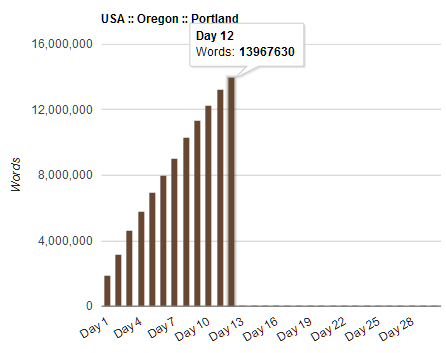
In the Portland region, we are getting closer and closer to 16 million words for those keeping score. That’s amazing.

NaNoWriMo Day 12 Portland Regional Word Count Chart 2015

To keep the momentum going, we’ve put together some guides and helpful resources and wanted to share them with you.

Novels aren’t written by muses who come down through the ceiling and shoot magic through your fingers and out onto your laptop’s keyboard. Before NaNoWriMo, some teensy part of me still believed that because writing is a creative act, it should feel easy. But fairies don’t write novels. They’re written with one simple equation:

Time + Work = Novel

Stephanie Perkins on NaNoWriMo Blog on the rewards of not giving up on your story

NaNoWriMo Survival Resources – To Get You To the Half-Way Point

The following articles and guides should help you get to the half-way point, or help you through the rest of your month long writing experiment. It is an experiment. Sometimes you know where you are going, and sometimes you have no idea, and sometimes, both are true. Edit on December 1 but keep writing through the month and see where it takes you.

Along the way, hopefully the following will help, inspire, and motivate you.

Prompts and NaNoWriMo Ass Kickers

(more…)

It’s A Scary Thing (A Tribute to NaNoWriMo)

Written from the Prompt at Writers in the Grove on Monday, October 26. Halloween type stories.


I’ve got a month-long challenge in front of me, to write almost 2,000 words a day and keep track of my progress.

I’m not sure which scares me more, the writing or the keeping track. I signed up a week ago and even the website gave me chills. This is just another thing I have to learn while doing the writing that I love.

My inner struggle keeps casting doubts on all my good intentions. The waffle-factor is showing itself to be a large, looming obstacle to overcome. I feel the need to keep plowing through until the writing can start to flow.

“Like a bull in a china shop,” I heard that phrase often throughout the years. They were always looking straight at me when they were verbalizing the clique’.

It’s not that I want to bulldoze my way through life. I would much rather be a dainty little flower with time to envelope the day in loving embrace and have the ability to fill nay-sayers with quiet consolation.

Instead, I bang, twist and impale while tearing apart ideas, methods and plans before finding a balance of thoughts for the writing to begin.

Doggedly, I will be sharpening my cleaver, dusting off the sledge hammer, and lifting mental weights daily until November 1st, before advancing laboriously into the challenge of NaNoWriMo.

How to Blog NaNoWriMo

What? Right even more during NaNoWriMo, the National Novel Writing Month challenge to write 50,000 words in 30 days? Are you crazy?

Actually, many people blog their NaNoWriMo experience on their blogs. Some even publish their daily writing on their site for their fans and community.

So many people are worried about sharing their novel idea or plot, it becomes almost a paranoia. Relax. There is much you can share without giving the whole thing away.

The fun of sharing your NaNoWriMo experience every day on your blog means you are part of a community. You are sharing your experience, the struggles, challenges, joys, discoveries, and lessons and techniques learned that might help others.

Here are some tips to help you cope if you choose to blog your NaNoWriMo experience.

Share The Journey

No matter what, share the journey.

We love learning how you got there, the good, the bad, the ugly. By sharing your journey with others, they will hopefully learn from your mistakes, but also feel inspired by how you overcame the challenges of writing 1,677 words a day for 30 days.

Just as you would jot down a description of your day in a journal, take 10 minutes at the end of the day or after you’ve completed your NaNoWriMo writing for the day, and consider the journey.

Was the writing easy today? Why? Was it a challenge, the intimidation of the blank screen getting to you? What happened? What made a difference?

Did someone say something or give you words of encouragement that impacted your attitude about your writing and your story?

Define the obstacles. What got in your way today? Was it family? Friends? Work? Illness? Or the story itself? The clearer you are in defining them, the faster you can prevent such interference going forward…sometimes. At the very least, by sharing, others may commiserate with you.

Find a new trick, tip, or technique? Share it and explain how it helps.

Let your readers and community know how you are doing so they are taking each step of the journey with you.

Crowd Source Your Stucks

“I hate my stucks,” a writer complained to me. “The stucks suck.”

We all get stuck when writing. Sometimes it is as simple as knowing the word but not finding it in your brain, or coming up with a great plot twist but it may require you learning about something you know little or nothing about.

Or there are those times when the characters aren’t talking to each other nor you, and you have stuck them into a situation you know not how to escape.

Share your stucks. Let your readers know if you get stuck and ask them how to get out of it. You don’t have to take their advice, but sometimes crowd sourcing the stucks breaks the damn, freeing your characters and your writing.

Seek a Kick in the Ass

A writer who does NaNoWriMo every year tells me that she the one year she didn’t blog her NaNoWriMo experience was the worst year for her writing. “I couldn’t get started, nor finish what I started. I needed a daily kick in the ass.”

When you blog your NaNoWriMo experience, other participants often find you and they will cheer you on when they detect you dragging, as you may for them. That’s why the meetups and social events in and around NaNoWriMo are so good for many people.

By being surrounded by determined folks who have been there, done that, wrote the writing, they know what it is like and they will lovingly kick you in the writing ass and keep you on track when you need it.

Or you can ask for it.

In “How to Shake Off Writer’s Fatigue” on the NaNoWriMo site, they recommend:

For the first few days, showing up to write every day is easy. The shiny factor hasn’t worn off yet, and the excitement over your story is almost palpable.

Then there are the other days, where the drive to write isn’t there. Adding words to your story feels like getting out of a warm, blanket-filled bed into a cold world: you don’t always want to do it, but it’s step one toward the journey ahead. Maybe you’ve written your characters into a corner with no ideas on getting them out. Or maybe you’re bored of your story but still have thousands of words to write before reaching the magical 50K…

We all go through it. There are the NaNoWriMo forums where you can find other participants to support and cheer you on, and you can blog about it and instantly feel better.

At least you wrote something in your blog. Does that count toward your daily word count? It might. 😀

Stop Writing Your Story and Build a World

Do some worldbuilding on your blog. Open the door to the world you’ve created in your novel and invite others in.

Let them ask you questions? Let them test out the furniture. See what happens when you throw open the gates to your imaginative world and watch people wander in.

They might help you build stronger walls, floors, ceilings, and gardens.

Best Practices

  • Schedule time to blog. You’ve scheduled time to write, now add just a few minutes, 10-15, to each day to document the day’s achievements and challenges and write it out on your blog.
  • Remember categories and tags. When we are in a hurry, putting thing where you can find them again gets set aside. Don’t mess up your site.
  • Keep it simple. Write short posts, focusing on the day’s writing activities. This isn’t the time to write a 3,000 word tutorial or technical article. Pick one topic from the day’s events to share with your experience.
  • Keep pictures to a minimum unless they matter. Save gratuitous images, pictures that serve as pretty and do little else, for the other months of the year.
  • Use lists to order your thoughts, points, and items. Unordered lists are bullet lists and numbered lists count down, making it not only easy to write but easy to read.
  • Be honest with yourself and others. And take a breath. NaNoWriMo can get crazy, stress you out, and make you want to throw your computer across the room. Be gentle on yourself and others and breatheeeeeeee. Remember that you love writing and every word you write is a labor of love.

Blog Your NaNoWriMo Woes, Joys, and Triumphs

We love to hear the good side of an experience, but most people like whining and complaining. Remember to include both in your NaNoWriMo posts not just to maintain balance with your readers but also within your self.

In “13 Ugly Truths About Nanowrimo,” Daniel Swensen explains why November is the worst month to do this in, but also offers up the reality of NaNoWriMo.

Nanowrimo can be a real blast, a useful experience, and a great utility for pumping out a first draft. But it’s very easy to take it too seriously and let the images of the purple bar, the winning trophy, and the approving faces of your friends coalesce into a harrowing vision of guilt and shame. When this happens, just sit back and remember, it’s just Nanowrimo. Winning is great, but it literally only means as much as you let it. Bailing out doesn’t make you a failure, or a bad writer, or a lazy no-good mutant. Sometimes, goals are just beyond our grasp for the moment.

But if you can, take the knowledge that you can walk away from Nano, consequence-free, and use it to rekindle your love of the game. You’re not here because you have to be. You’re here because you want to be. Because you love the exhilarating, exhausting, fun-as-hell rocket ride of Nanowrimo.

This isn’t a job. This is a choice. It is a learning experience. Learn it well, and the lessons will last a lifetime.

Just make the memories good ones.

Who is Blogging NaNoWriMo

There are many people blogging their NaNoWriMo experience. Here are some bloggers to monitor during November to help you see what they are doing and learn from their experiences.

Don’t have a blog? Go to WordPress.com to get a free blog and get sharing your NaNoWriMo experiences.
NaNoWriMo: Let Your Character Take You on a Month Long Journey

A few people have been asking me about NaNoWriMo, the National Novel Writing Month challenge to write 50,000 words in 30 days, and they want to know how it works, and how they can get involved even though they might not have a specific story to write about. We put together everything you need to know to participate in NaNoWriMo in “It’s NaNoWriMo Time: How To, Tips, Techniques, and Survival Advice,” and you will find other NaNoWriMo topics we’ve covered scattered throughout the site.

To address the question of how to participate in NaNoWriMo when you don’t have a specific story to write is a different and more complex question. Ask yourself:

  • Is there a story idea that haunts you, nags you, disturbs your sleep?
  • Is there something you’ve always thought or said, “That would make an interesting book.”
  • Is there a person or place that fascinates you?
  • Is there a hobby or special interest that you return to over and over again through your life?
  • Is there a skill, talent, ability, or knowledge you have that not many others do?
  • Is there a question that you wish someone would answer?

Here are some things you need to know about NaNoWriMo as you answer those questions:

  • You do not have to write a book.
  • You do not have to write fiction.

The reality is that you just have to write. There are prompts to stir the imagination and inspire you to write on that subject or something else in our Prompt-a-Day starting November 1.

To help some of our writers, I’d like to take a different approach to storytelling and novel writing, and that is to have you answer a question a day about a character that may be tickling your imagination.

Answer a Question a Day in Words

A writer of many novels told me years ago that sometimes her novels write themselves and sometimes she writes them, but always, her characters tell her where to take the story.

I’ve thought about that often, writing with such commitment that you, the author, steps out of the way and you let the characters tell the story.

If that sounds like fun, we’ve put together a series of questions to help you answer a question once a day with words, letting your character or characters take you on a journey.

In the wise words of our Writers in the Grove leader, M.J. Nordgren, always look for conflict – in every sentence, every paragraph, and every page. That is what makes for an exciting read – and write. These prompts are designed to help you explore the conflicts within the character, between the character and other players in the story, conflicts between the character and their environment and situation, and conflicts between the character you started with and who the character becomes as they are tested throughout your story.

There doesn’t have to be any chronology to these. That’s what editing is for. But exploring these concepts, answering these questions, may just inspire a bestseller.

As with all such prompts, let them take you where they take you. There are no rules, except those set by NaNoWriMo to write every day a minimum of 1,677 words.

  1. Where is your character right now? Why are they there?
  2. If your character were afraid of anything, what would it be and look like?
  3. What are your characters habits? What body language, behaviors, tasks do they repeat regularly? Which are annoying to others? Which are annoying to self? Which are beneficial? How do they help the character?
  4. When your character’s routine is disrupted, what happens?
  5. What wounds does your character carry forth into their adulthood? Why?
  6. What does your character hope for in life? Do they have goals, dreams, aspirations? What is stopping them?
  7. What would be the worse thing that could happen to your character? How would it happen, when, and why?
  8. Where does your character spend the most of their time daily? Describe and define it.
  9. If your character could go anywhere in the world, money no options, where would they go and why?
  10. Describe your character’s family. Be specific in describing the family members as well as your character’s thoughts about them.
  11. Describe your character’s friends. Who are they, what do they look like, how did they meet, and how do they support or not support your character with their relationship?
  12. What are your character’s expectations, the things they expect from the world, their family, and friends? How do these expectations differ from reality?
  13. How is your character treated by other people? Is the treatment appropriate?
  14. When put in an emergency situation, how would your character respond?
  15. If your character was to go on a journey, how would they travel? Foot, air, wagon, car, train…? Why would they choose this method?
  16. Describe someone your character would hate. Why?
  17. Has your character ever been in love? What was it like? Describe the person. What happened?
  18. Your character has a secret. What is it and why it is a secret? Who would be hurt if the knowledge was revealed?
  19. If your character had a dinner party, who would they invite and why? What would the dinner conversation? Describe it.
  20. Describe your character’s heroes.
  21. Your character won the lottery or a grand prize. What would it be and how would your character handle the winnings?
  22. Open the door to the home of your character and walk us through it. Pay attention to what is in the closets and behind closed doors.
  23. Does your character eat when they get up in the morning or wait? When and what do they eat through a typical day, and what do they do when eating? Do they eat in, out, or in a special place? What are they eating? Why?
  24. In your imagination, you are standing and overlooking a place in which your character lives. Describe it for every season.
  25. Where was your character born and how does that birthplace impact the personality, history, and relationships of the character?
  26. What makes your character laugh out loud? Why?
  27. Describe a moment when your character’s heart was broken, never to be fully mended.
  28. Look at your character’s hands and feet. Describe them. What are on them? Shoes, gloves? Jewelry? Tattoos?
  29. Does your character have a job or hobby or both? Describe it in detail, and how they got into that job or hobby. What is good or bad about it?
  30. A disaster has befallen your character and their place of residence is destroyed. What items do they mourn the loss of most?

Print this out and assign a question a day and see where your writing takes you.

For examples of more character questions to ask your character and see where they take you, see the following.

Where will your character take you?

NaNoWriMo: How to Write a Novel in 67 Steps

Part serious, part humor, “In Reality How People Write A Novel: 67 steps” by the The Authors’ Nook breaks down the novel process into quick and easy steps such as:

  1. Declare to your friends and family that you’re writing a book.
  2. Immediately regret telling them because now you feel pressure.
  3. Stare at a blank page.
  4. To freshen up, Google: “How to write a book.”
  5. Remember that it’s a massive undertaking.
  6. Friends ask you, “So, how’s your book coming? Remember me when you’re famous!” And you want to die.
  7. Start to plot the novel just to get your mind off the pressure.
  8. Writer’s block.
  9. Netflix binge.
  10. Write 15 pages.
  11. Rewrite the 15 pages.
  12. Delete 14 pages.
  13. Drink a little too much.
  14. Netflix binge.
  15. Structure your story.

Sound familiar?

NaNoWriMo: Beat Sheets and Story Engineering Worksheets

There are some terms you need to know if you will be participating in NaNoWriMo this year.

  • Plotter: A writer who plots out their story with an outline, which they tend to follow for the most part during NaNoWriMo.
  • Pantser: A writer tackling NaNoWriMo with little planning and forethought, just writing by the seat of their pants.

A few years ago, a new term arose, brought to light by Angela Quarles, self-labeled a Geek Girl Romance Writer. She also offers writing advice, tutorials, and tools to help writers.

In her post about her experience and the lessons learned, she describes the two key types of writers who participate in the National Novel Writing Month challenge, and invented her own type called plotser:

What’s a plotser? A cross between a pantser and a plotter, with maybe a wee bit more emphasis on the pre-plotting.

With Hurricane Sandy and other circumstances, my new agent (signed only on Oct 4) and I weren’t able to coordinate on what direction to take for a sequel to MUST LOVE BREECHES. So for most of October, I wasn’t even sure if I was participating in NaNoWriMo. Then at the end of the month, I decided to take up a premise that had nothing to do with BREECHES so I wouldn’t waste my time writing a sequel she didn’t want.

However, that meant I’d not spent time plotting at all.

I had what I thought was a fun premise and a sense of who the H/h were and so started one day late on November 2. I caught up with everyone over the weekend and was doing swimmingly until about Day 5, then my word count dribbled downward and things ground to a halt. I had no idea where I was going with this and I didn’t like feeling that way. This wasn’t the normal ‘what I’m writing is drivel’ feeling, I really felt like all my characters were just spinning their wheels waiting for something to happen. Like the plot. Ugh.

A local writer friend sagely advised me to take a break for a week, two weeks, to figure out the plot and then do a FastDraft blitz at the end. So I did! I ended up creating a spreadsheet to help myself stay focused on what I needed to discover…

As a result of her experience, she created the Story Engineering Worksheet (Excel Spreadsheet), a spreadsheet created in Excel that breaks down all the elements of a novel into their finest detail. To download, click, on the link or right click and save to your hard drive.

Described as a “mix of the four act/part structure, and beat sheets,” the worksheet is based on the spreadsheet by Jamie Gold called a beat sheet, a worksheet that structures your plot all on one page.

Described by Storyfix in their Lessons for Writers:

The “beat sheet” is a way to sequence your story, using bullets instead of whole sentences or paragraphs.

Yes, this is an outline, but it is more than that. It is a scene structure for your novel built around basic plot points or story arcs. (more…)

NaNoWriMo Novel Template for Scrivener

We’ve several members prepping for NaNoWriMo this year, the annual National Novel Writing Month where writers commit to write 50,000 words in 30 days through the month of November. We’ve put together “It’s NaNoWriMo Time: How To, Tips, Techniques, and Survival Advice” to help you as well.

For those using Scrivener to write and track their daily targets of 1,667 words, Scrivener is not only offered for 20% off during NaNoWriMo, but they also have a NaNoWriMo Novel Template to help you keep track of your progress.

Download and install the free (or paid) version of Scrivener. You will find all the information including tutorials and the template file on their Scrivener NaNoWriMo 2015 Offers web page.

NaNoWriMo Novel Template Setup.To install the NaNoWriMo Novel Template:

  1. Scroll to the bottom of the 2015 offers web page and look for the title The NaNoWriMo Novel Template
  2. Click or right click and save the ZIP file for the version of Scrivener you are using (Mac or Windows)
  3. Extract the scrivtemplate file to the directory where Scrivener is installed and the subdirectory called ProjectTemplates.
    • The location on your computer is typically C:\Users\UserName\AppData\Local\Scrivener\ProjectTemplates
  4. Open Scrivener and go to File > New Project
  5. Switch to the Fiction Templates
  6. Look for a template titled NaNoWriMo Novel Template and select it
  7. Type in a file name such as “My November 2015 Novel Draft” and choose the folder in which to store the files within your Documents folder
  8. Click Create
  9. The first document you will see contains all the instructions you need to understand how to use the template during NaNoWriMo.

NaNoWriMo Novel Template Instructions.

To get started on November 1, go to Project > Project Targets and drag that pop-up window to a location where it doesn’t interfere with your writing. Start writing, and glance over after 45 minutes or so to see how you are doing. (more…)

A Prompt a Day for NaNoWriMo

To honor NaNoWriMo and members and fans of Writers in the Grove, our members are submitting a prompt-a-day for the entire month of November.

The prompts cover everything and anything. They might include an image for a wordless prompt or a quote or suggestion.

You may do what you wish with these prompts. You may twist them around to meet the needs of your story, characters, or plot. You may use them as a tangent writing project to help you break out of a blocked thought or walled-off idea. The word count still goes into your official ledger.

If you would like to join us for NaNoWriMo, we’ve put together “It’s NaNoWriMo Time: How To, Tips, Techniques, and Survival Advice” to help you ensure a successful month of writing in November.

You will find all the prompts in our Prompts post category. Follow/Subscribe to the site to keep up with these throughout the month of November during NaNoWriMo. You may unsubscribe at your leisure afterward, or keep being inspired by the great weekly prompts and activities from Writers in the Grove.

If you live in the Forest Grove, Washington County, Oregon, area, we invite you to join us. We meet weekly on Monday from 9-11am at the Forest Grove Senior and Community Center, and monthly at the Forest Grove Library, typically the second Saturday of the month at 10AM.

NaNoWriMo Prompts for November

The following will be a list of the NaNoWriMo Prompts on this site for the month of November 2015, starting the morning of November 1.

Come join the fun and write, write, and write some more!

It’s NaNoWriMo Time: How To, Tips, Techniques, and Survival Advice

NaNoWriMo Flyer.November 1, 2015, at midnight is the start of NaNoWriMo, the National Novel Writing Month.

The goal of NaNoWriMo is to write 50,000 words (and complete a novel) in 30 days.

Sound impossible? The numbers divide down to 1,666 words a day, typically 60-90 minutes of writing.

To participate, you may do so actively or passively. This can be a solo experience or a highly social one. You can connect online and/or connect in person through the many local activities, events, and write-ins where people gather in a social space to write and get to know each other.

Here is how it works.

  1. Before November 1, sign up on the NaNoWriMo site. There is no fee. It’s free. By registering, you will get email notifications and notes to cheer you on throughout the month, and be able to track your word count daily.
  2. At midnight, October 31, you start writing.
  3. Each day, you report the number of words you’ve written. If you are using Scrivener, it’s easy to update this information daily. I’ve included tips on how to track your writing below.
  4. If you wish, participate in the regional forums such as the one for Washington County, Oregon, and consider attending some of the many local events throughout the month. NOTE: There are also prep events online and locally worth attending.

That’s it.

NaNoWriMo typically features over 310,000 participants on six continents. Many educators work with their students to participate during November as well as throughout the year. (more…)