The prompt today is:
Everybody has done something they wished they hadn’t. And everybody has done something they are immensely pleased with, but nobody knows about it.
Bev Walker, Writers in the Grove
Pick either and write.
The prompt today is:
Everybody has done something they wished they hadn’t. And everybody has done something they are immensely pleased with, but nobody knows about it.
Bev Walker, Writers in the Grove
Pick either and write.
The blog for Literature and Latte, the makers of the popular writing tool, Scrivener, offer tips for NaNoWriMo on inline annotations, notes, and keeping track of inspiration that hits during the month-month writing marathon.
Since the daily word count is the main goal of the project for most people, this is okay. However, if you are also working toward the goal of producing something worthy of publishing—or at the very least, something you can be proud of—you might wish to somehow mark passages of text that you do not feel happy with, without completely deleting them or excluding them from the total counted work. There are a few ways of doing this in Scrivener.
The tips highlight the many ways a writer can take notes during the writing process in a way that doesn’t interrupt the creative workflow too much. This applies to the writing workflow and process beyond the scope of NaNoWriMo as well.
 The November prompt-a-month for our Writers in the Grove members is:
The Body
The deadline for submissions is 12/1/2017. Submissions will be published during the next 30 days.
Writers in the Grove members may hand in their submissions during the workshops or use our members only submission form. Check out the guidelines and instructions for submissions in the announcement.
…she stumbled and he caught her as she fell, sweeping her up in his – in his – what is that word? Darn it. You know the word. It means big, tough guy arms but not strong arms. Stereotype alert. What is that word? I had it a minute ago.
Happen to you?
It happens to everyone, especially writers. Sometimes I think our heads are so filled up with words, it’s like plunging your hand into an aquarium of tetras and hoping to catch just that one, you know, that one! The words slip right out of your brain.
The OneLook Reverse Dictionary and Thesaurus is here to help. It provides a free thesaurus and reverse dictionary look-up feature to help you overcome your brain farts, as we tend to call them.
I typed in the words “strong arms” and hit enter.

My choices were divided into All, Verbs, Adverbs, Nouns, and Adjectives, each with multiple pages of suggestions. “Strong arms” matched with the definition of “enforce,” which made me realize that the web page service concluded I meant “strong-armed” rather than the description of a pair of strong arms. Still, there were words I could use. In Adjectives I found muscular, heavy-armed, solid, colossal, substantial, gigantic, healthy, great, heavy, heft, savage, and smothered. My favorite was bionic but it didn’t work in this instance. There were many other words that weren’t appropriate, but they did trigger more descriptive ideas such as blockading, huddled, swarming, and pressed.
Clicking the “More Definitions” button opened a new web page with variations on the word “enforce,” which wasn’t going in the right direction, but did show the capabilities of the service to help you track down the right word. It listed links to definitions on over 30 different alternative sources, giving me the opportunity to really dig into the meaning of a word.
OneLook isn’t the only reverse word lookup service on the web. Experiment with The Reverse Dictionary and Reverse Word Search-Lookup by Wordsmyth.
And good luck with those word slippages.
I was surprised during our weekly Writers in the Grove free Monday workshop meeting that some of my fellow members didn’t know about the concept of world building in writing.
When you write fiction, you create a world, literally. It may represent the real world or a fantasy world. It consists of scenes, places where events occur in your story.
Your fictional world is made up of places, people, cultures, traditions, habits and routines, weather, geology, current events, and politics.
I’m working on a story that takes place in 1979. I begin my world building by researching historical events in 1979, then branch into newsworthy stories and topics, and even some trivia. If my story is concentrated solely in the United States, and specifically a location, say Seattle, then most of my research would focus on what happened in Seattle in and around 1979. Here are some of the results of my web search.
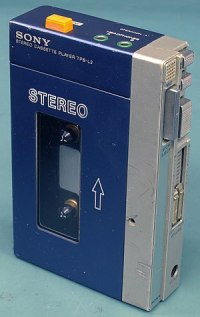 In my research, I discover that the average income that year in the United States was $17,500, and the average monthly rent was $280, a far cry from today’s prices. A gallon of gas cost 86 cents, oil was $24 a barrel, and the Toyota Corolla was one of the most popular cars on the road and the $200 Sony Walkman was in demand by most teenagers and college students. Michael Jackson’s “Off the Wall” album won awards and played out of boomboxes everywhere, blasting “Y.M.C.A.” by The Village People off the charts. The daily news included updates on Voyager 1 as it made its closest pass by Jupiter, the Three Mile Island nuclear accident, the Moral Majority religious movement by Jerry Falwell, 63 American hostages taken in Iran, and Saddam Hussein becoming president of Iraq. John McEnroe, Tracy Austin, Bjorn Borg, and Martinia Navratilova became household names as tennis champions. We watched MASH, The Jeffersons, The Dukes of Hazzard, One Day at a Time, and Three’s Company on television. The big screen played Alien, All That Jazz, Apocalypse Now, Start Trek: The Motion Picture, Norma Rae, The China Syndrome, Being There, Life of Brian, Mad Max, and the Muppet Movie.
If you are writing about 1979, this is the world your characters lived in. They listened to that music, watched that news, those movies, and said funny things like quotes from movies and television such as “Nothing comes between me and my Calvins” (Brooke Shields ad for Calvin Klein), “Reach out and touch someone” (AT&T ad), “I love the smell of napalm in the morning” (Apocalypse Now), and “You need this for your rent, boy” (Richard Pryor).
Cultural stories might filter into conversations or even the thoughts of your characters such as when then-President Jimmy Carter explained how he almost tipped when an enraged swamp rabbit swam toward his fishing boat, or comment on the first time a milk carton featured a picture of a missing child. Or the fears that swept the globe as NASA’s Skylab fell to Earth, landing in Australia, made fun of afterwards by many when the Shire of Esperance in Western Australia fined NASA $400 for littering. Or maybe how Charles Manson sent a Monopoly “Get Out of Jail Free” card in a humorous attempt to be released by the parole board. Or maybe the dinner table discussion that night might be about the work of Mother Teresa after she won the Nobel Peace Prize.
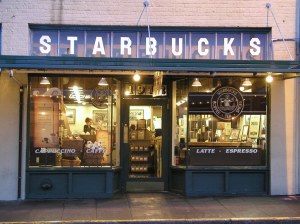 The world your characters live in influences their personalities, behaviors, even habits. A worker in 1979 living and/or working in downtown Seattle would have made sure they made a swing by Starbucks at 1912 Pike Place for a cup of their soon-to-be-famous coffee.
Now think about your characters and their relationship to this place and this time. Are all of your characters from here? Or maybe one or more of them are from different places, creating conflict when their worlds come together such as a white woman from Seattle falling in love with a black man from Mississippi in 1958, or the reverse. What about a new immigrant from Europe or Africa landing on the shores of the United States or Canada in the 1800s? Or maybe you have a person from Germany finding their way in Alabama in 1943 at the height of World War II? When we travel, we bring our worlds with us no matter where we go.
Your story may begin in any time and place. The world existed for your characters before the start of your story, and they might survive your story. Reveal the world they live in, as well as the world of history and experiences they carry with them through your story, to your readers as they shake hands and get to know your characters.
Here are a list of questions to help you define the world in which your characters live.
This is just a few of the questions to consider. Go through these, and the questions and suggestions offered in the resources below, then ask yourself: Could this scene happen anywhere else? How would it change? How would it change the characters? How would it change the story? See what happens.
One last bit of advice.
If you introduce something new to the world in which your characters live, ask yourself if this change their world. How does it? If it is magic or technology, does it impact only your characters or everyone in society? How? Why? Is it good, bad, or indifferent? How do they adapt to the change? is it good for everyone or just a few?
Remember, your characters live in the test tube of your imagination. Every twist or turn in the story may create a tsunami of change beyond the bubble that is your main characters. Let your readers see and feel the change.
Monday, November 6, 2018, author Tim Applegate will be speak at our Monday morning workshop from 9AM-11AM at the Forest Grove Senior and Community Center in Forest Grove, Oregon. This is a free, regular workshop event and all are welcome to join us. Bring pen and paper and an open mind as usual.
Tim Applegate will be speaking about publishing submission acceptance and rejections. He is the author of the novel Fever Tree and three books of poetry. A commercial contractor specializing in furniture and wood restoration for the hotel and cruise ship industry, he retired in 2015 to dedicate the next part of his life to writing full-time. He is the co-winner of the Tillie Olsen award for Creative Writing, and his work has been published in the Florida Review, The South Dakota Review, Lake Effect, The Briar Cliff Review, and others. He currently lives in the foothills of the Coast Range in Oregon.
 It’s NaNoWriMo time again, National Novel Writing Month. Get out your spreadsheet word trackers and timers and dust them off. The fun begins at midnight October 31 as you plow through toward your 50,000 words or 50 hour goal of writing every day for thirty days.
For Writers in the Grove, here are our rules for November’s NaNoWriMo writing event.
You may write however, whenever, whatever you wish. Here are some tips to help you get started.
Want to join us? Here is how to participate, and each step, other than the writing, is optional.
 Select a word tracker spreadsheet from our list of NaNoWriMo word trackers and spreadsheets. We have a new Writers in the Grove word and hour tracker spreadsheet, and a list of other word trackers.
Before you get too overwhelmed, we’ve created a NaNoWriMo Guide featuring all the tutorials, tips, techniques, and prompts we’ve published here on participating in NaNoWriMo. Enjoy.
Writers in the Grove members have been participating in the annual National Novel Writing Month, NaNoWriMo, for several years. Along the way we’ve shared many word trackers and NaNoWriMo Scrivener Templates, and this year, we are introducing our own.
In the free downloadable zip file, you will find:
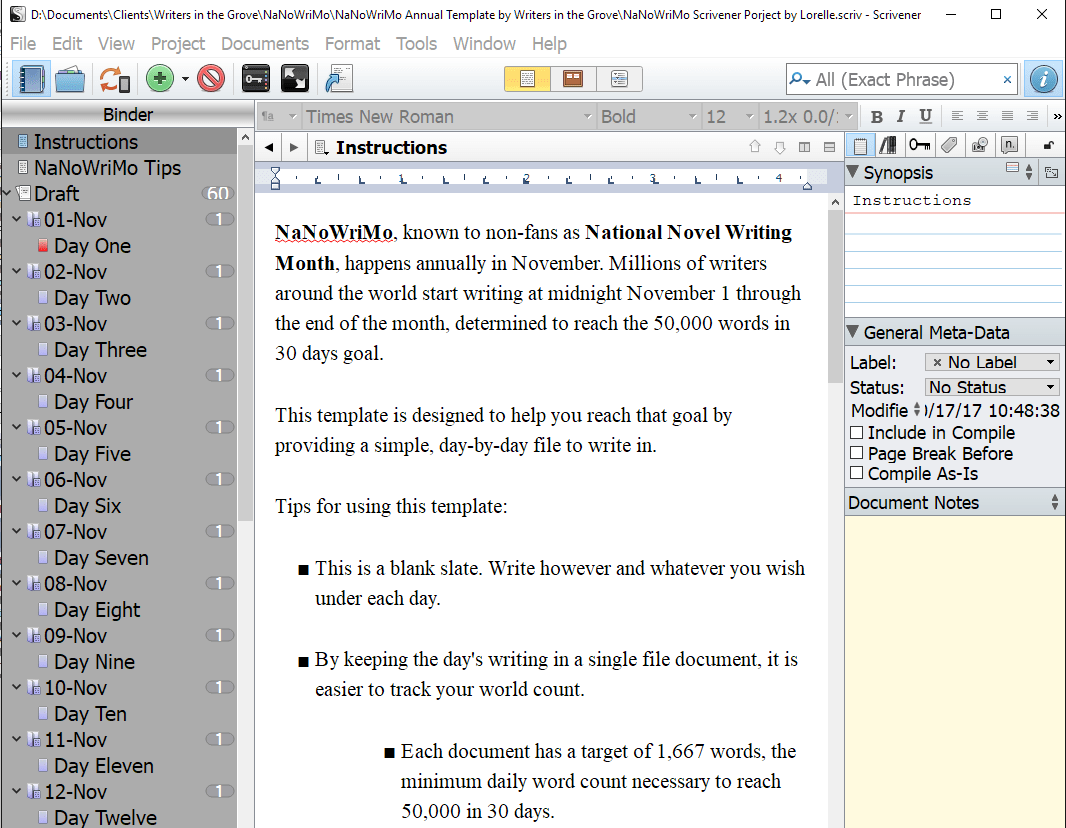
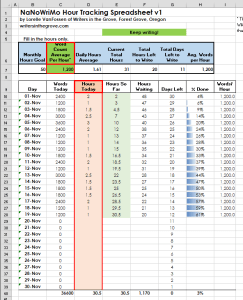
All files are designed to be reused over and over again. We may make changes, so stop by for updates once a year, or more would be appreciated.
As with all new ventures, we’d appreciate feedback and corrections and we will update the files here accordingly.
Again, you can download the free zip file with all the goodies, and have fun with NaNoWriMo.
The discussion and prompt today was on diversity in writing. The discussion was inspired by the New York Times article, “I’m Indian. Can I Write Black Characters?” by Thrity Umrigar:
I’ve always thought about it this way: If men can write about women and science fiction writers can write about space aliens, surely I can write about someone from a different race. And I have spent my entire adult life in the United States. Why shouldn’t I write about that most American of topics — race and race relations?
The debate about whether writers should create worlds and characters based in cultures other than their own is an important one. At its core, pushback in this area serves as a corrective to centuries of colonialism, stereotypical portrayals and racist caricatures. But I worry about how we balance pertinent questions about appropriation with the creative freedom to push boundaries and take risks that are essential to good writing.
To add another wrinkle to this debate, I have never been asked about the appropriateness of creating white American characters, as I did in an earlier novel, “The Weight of Heaven.” Of course, this probably has to do with our country’s ignoble history of racism and racist stereotypes, especially about African-Americans. There’s justifiably less concern about misrepresentation of white Americans.
We talked about how the industry whitewashes the characters we write about, and the confusion from the writers and publishers about the growing demand today for diverse characters. We discussed the struggles and challenges associated with writing a character unlike the author, and techniques to see the world through different eyes.
The prompt is to get inside the skin of someone not like you and write from that perspective.
As Umrigar wrote in the article:
I have made my peace with the fact that I have to defer to the publisher’s expertise about the realities of the marketplace. But to limit myself to write books only about India is to condemn me to tell the same stories. And that kind of pigeonholing is a creative death.
So, I will continue to tell the stories that I am called upon to tell. I know I’ll spend many more interviews explaining the characters I create, and that this tension contains its own revealing, dramatic and painful story about our culture and history.
During the 2017 NaNoWriMo event in November, Writers in the Grove members offer these prompts to provide inspiration and incentive to keep you going during the self-competition to write 50,000 words in 30 days. You may find NaNoWriMo prompts from previous years and prompts from our weekly workshops.
Today’s NaNoWriMo prompt is:
The FBI complicated my…
If you are participating in NaNoWriMo, or wish to, Writers in the Grove offers an extensive range of NaNoWriMo tips and techniques to help you through the month long writing project.
 Writers in the Grove