The Writing Exercise Instructor

So what do you do when the prompt of the day to write a 100 word sentence gives you lemons? What I do is not make lemonade, but rather to pick on the teacher. This is my complex sentence:

At the beginning of the class, she said to simply write a single sentence of 100 words, she then paused after her bold statement, with a wry smile and her signature dancing eyes behind those modern style corrective lenses, highlighted the teacher, the do-er, the know-er requesting a task from the writing group staggered around the make-shift tables, her contained zest for the mere notion of the writing prompt danced about visibly thus belying the fact her ideas could not stay internal as she said to the group to go start writing before she bowed her head to her computer terminal and began her own exploration of just what the writing prompt meant to her.

118 Words

Meeting Our Selves

The following was written and submitted by our Writer’s in the Grove member, Ralph Cuellar.

Our “selves” are like spirits
Until we meet in the flesh
and misunderstand each other
When we’re offered information
we’d rather not accept
When we’re confronted with alternate
versions of our dreamed reality.
Our external world is like a series of
collisions in a bumper car amusement ride.

Lost Child

The following is by Veronica Weeks-Basham, a member of Writers in the Grove. It was inspired by Prompt: Being Brave.

I have decided that I don’t exist.
That person died when my parents refused to accept or even see
The person that I was discovering myself to be.
That person, like the mythical Atlantis,
Sank beneath a sea of criticism, disregard and approval
When my being reflected back their own comfortable version of themselves.

Prompt: 100 Word Sentence

The prompt: A sentence with 100 words. Begin with a simple sentence, then add details, descriptions and modifiers to create a complex, detailed sentence.

The purpose of the prompt was an exercise in exploring sentence patterns and sentence lengths, based upon a presentation at Be Writing Conference in Eugene, Oregon, recently.

We often write consistent patterns. All short sentences. All long sentences. All noun, verb, object, noun, verb, object. Break the pattern by learning to write different types of sentences and sentence structures.

Exploring the Cumulative Sentence

A cumulative sentence begins with a base clause, a subject and verb and an object or just a subject and verb.

The woman sat down to write.
The woman fainted.
The man drove his car.
The child ran down the street.
The bird flew into the window.
She played the piano.
Uncle Edward leaned back in his recliner.
Her grandchild slipped on the ice.

A cumulative sentence adds the description of the action.

Here is an example by Muriel Spark in Memento Mori.

He went to speak to Mrs. Bean, tiny among the pillows, her small toothless mouth ppen like an “O,” her skin stretched thin and white over her bones, her huge eye-sockets and eyes in a fixed infant-like stare, and her sparse white hair short and straggling over her brow.

Add description of things that modify the subject. They clarify the character and move us into an emotional situation. We need the modifiers to describe the person, and their relationship. How does the character see the other person, the scene, the situation. What they see tells us more about the character as they interpret the scene.

Here is another example from William Faulkner’s “Barn Burning”

His father struck him with the flat of his hand on the side of the head, hard but without heat, exactly as he had struck the two mules at the store, exactly as he would strike either of them with any stick in order to kill a horse fly, his voice still without heat or anger.

We see the action of the hand striking the head, and we could assume many different emotions, justifications, and reactions, but the modification of the action implies the emotionless nature of the action, and reveals much about the character of the father, that he treats his animals and children equally.

In the following example in Dan Delillo’s “The Names” (Russian to English translation), he describes the wind as a character itself, and how essential the wind is to the story, mood of the story, and the life of the people in the story.

Some nights the wind never stops, beginning in a clean shrill pitch that broadens and deepens to a careless and suspenseful force, rattling shutters, knocking things off the balconies, creating a pause in one’s mind, a waiting-for-the-full-force-to-hit. Inside the apartment, closet doors swing open, creak shut.

Consider how the sentence travels? Does it incorporate backstory, create emotion, rhythm, pace. Sometimes the force of a sentence’s pattern and rhythm takes you to an intense place or state of emotion. This is very useful to moving the story forward and pulling the reader along, consuming each word, eager for the next, feeling what the character is feeling.

Use a cumulative sentence pattern as you wish, or not, in your writing, but learn how to recognize them and work with them. They can break up your short sentence pattern, add more to the story, and describe a moment to bring the reader there with you and the character.

This prompt is meant to explore the boundaries of how we normally write.

The Prompt

The prompt assignment:

Write a modifying cumulative sentence. Start with a noun, verb, and object, then modify it to a minimum 75 to 100 words [pick one].

An alternative for those handwriting and not willing to count, write at least 10 lines handwritten on typical school notebook paper.

This typically takes about 10-15 minutes – most of us write 400 to 600 words in our prompts, some more.
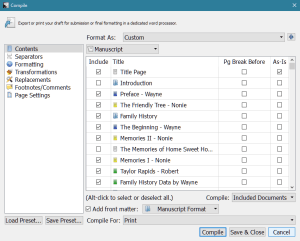
Scrivener: Printing Your Manuscript

Scrivener_-_Compile_Contents_ScreenThe process of printing a manuscript in Scrivener is called compiling. It represents the power in Scrivener to literally compile your writing how you wish it to appear in print or in a digital file for the next steps in preparing your book for publishing.

In one of my Scrivener projects, I have 6 versions of a book I’m working on.

  • The original draft
  • Second and third drafts
  • A copy edited version returned from a copy editor
  • The cleaned up version of that copy editor
  • Another version with alpha reader edits added

I could have even more versions, and at any time along the process of writing I could print out any of these versions for posterity, or go back to an earlier version to find out why I wrote it that way or what an editor had to say, or restore an edited version to one of the original versions, all within the same project file.

When it comes time to print these versions, or the final glorified version of my manuscript, it begins with a compilation process as I choose which documents to include or exclude from the version I’m creating – or, in Scrivener language, compiling.

Remember, as discussed in the tutorial on how to format your manuscript for writing, what appears on the screen may be different what the final version prints. (more…)

Prompt: Character Secrets and Relationships

The following prompt comes from the must-attend Be Writing Conference in Eugene, Oregon, presented by the WordCrafters writing group. It is a two part prompt and works best when done with a partner, though it may be done alone.

With your own character or select a personality or behavior characteristic from list one and a job description from list two and write about the resulting character using the prompt under these two lists:

  • List One: Personality and Behavior Characteristic:
    • Pyromaniac
    • Abused
    • Humiliated
    • Convicted
    • Egotistical
    • Kleptomaniac
    • Lying
    • Time Traveling
    • Barbaric
    • Bigoted
    • Suspicious
    • Curmudgeon
    • Pompous
  • Job Descriptions:
    • Kindergarten Teacher
    • Doctor
    • Baker
    • Dairy Farmer
    • Grocery Clerk
    • Nurse
    • Mother
    • Truck Driver
    • Housekeeper
    • Janitor
    • Accountant
    • Lawyer
    • Bank Clerk

Describe the following for your character, keeping it fairy concise:

  • Name.
  • Description as if pointing to the person across the room.
  • Where does this person spend the majority of their time and why?
  • What is their deepest secret, something they might never tell anyone including their best friend?

The next step is to either do another character or do this with someone else.

Share your characters with each other described in one to three sentences.

Answer the questions:

  • How would these two people know each other?
  • How did they meet?
  • What do they have in common?
  • What is there relationship? Is it friend, acquaintence, co-worker, family?
  • How does this relationship change your characters?

Celebrating National Poetry Month

The Vernonia Library has announced that Oregon Poet Laureate Emerita Paulann Petersen will have a reading at the Library on Sunday April 10, 6-7:30 pm.

This unusual opportunity has prompted the library to open on Sunday to accommodate this special reading event. The reading with the celebrated poet and teacher is open to the public.

Contact the library (503) 429-1818 or library@vernonia-or.gov with questions.


Prompt: I Was Told To Write a Book


It has been a question posed to many of us. Someone hears that you are attending a creative writing class and the conversation naturally swings.  Queries about being published and what kind of book you are writing can catch a person off guard if classes are a new direction.

Not all who attend are published. Everyone doesn’t feel the need to write a book. Some classes are designed simply to work out those mental cobwebs, to strengthen the creative drive, or to enjoy the company of other writers while trying group activities.

The Vernonia Library Writers Group met on 2/18 with the prompt; I was told to write a book…

For those who have no intention of publication, this was a stretch of the imagination, yet the 20 minute silent writing that followed created some interesting thoughts on the possibilities. The prompt also led to discussion regarding the practice of putting your writing out on a limb. Try a prompt that is not your style, something you are not comfortable with, dive in to an outlandish thought. Give those brain cells a good workout and see where it leads you!

The town of Vernonia has several activities planned for St. Patrick’s Day which would be the normal date that the Writer Group would meet, so we are going to be taking the month off to enjoy the festivities with the next class scheduled for April 21 at 6 pm.

In the meantime, attendees are working on a writing prompt: Logical Reasoning. We discussed stories that followed a logical path and those thoughts that do not follow linear reasoning. During the next class on April 21, the group will be dissecting and outlining paragraphs to trace the rational thoughts of a story. Hope to see you there.


Scrivener: Formatting Your Manuscript for Writing

I’ve been asked to continue this ongoing series on how to use Scrivener, a powerful writing tool that is a must for many professional writers. Scrivener works for those writing poetry, fiction, non-fiction, screenplays, and…the list is long. It is a pre-production tool, a tool for the writing and development of your material for publishing. While Scrivener includes the ability to export the information as an ebook and material ready for publishing, it isn’t designed as a tool for publishing a pretty book. It is the workhorse that gets you to that point.

Scrivener is software installed on your Windows or Mac machine and is produced by Literature and Latte. The price is very reasonable and the purchased version of Scrivener maybe installed on your desktop and laptop without problems so you may work in both environments.

So far in this series we’ve covered:

In this part of the series, I’ll cover how to set the standard format for new documents, the process of fixing content that comes in a jumble in formatting, and how to set the default or standard format for new documents in Scrivener projects.

Setting the Standard Format for New Documents

Let’s begin with how to set the standard formatting for new documents in Scrivener, projects you are just starting. I’ll cover the process for Windows machines. It might be slightly different for Mac. (more…)

Prompt: Being Brave


The prompt this week is from Pat Schneider’s book “Writing Alone and with Others,” a book we use as one of our key guides for our writing group. The exercise on being brave.

Write something that feels too huge, or too dangerous, to tell. Courage is not the special prerogative of those who have experienced some dramatic suffering. It is a part of the human condition, related to the danger and the suffering we all experience. Once a writer friend said, when she learned that I had been in an orphanage as a child, “Pat, you are so lucky! What hurt you is so clear and obvious!” She grew up in a proper home where church and community kept things in order. How do you find what went wrong, when the table is set with silver and the candles burn and everything is so proper? It takes courage – perhaps more than for those of us who have dramatic material in our background.

The following poem, of which this is an excerpt, served as the prompt example You may read the whole thing on Google Books for free.

The poem was written by a young woman in Japan during one of Pat’s workshops there. The woman is C. Misa Sugiura and speaks of the shame a child feels when ridiculed, focusing on the poet’s attendance at an elementary school in the United States.

When I was little,
people laughed at me
and called me
flatface.
They pulled their eyes into
slits
and said,
“Me Chinese!”
and laughed.

I didn’t know my
face was flat
so I went home
and looked in the mirror
to see…

So I went to school
and said, “I’m Japanese and
my face
is like yours,
isn’t it?

And they said,
No.
It isn’t!
It’s flat like a pancake.
Me Japanese pancake-face!
And they laughed.

And I went home again
and looked in the mirror
and I cried because
they were right.